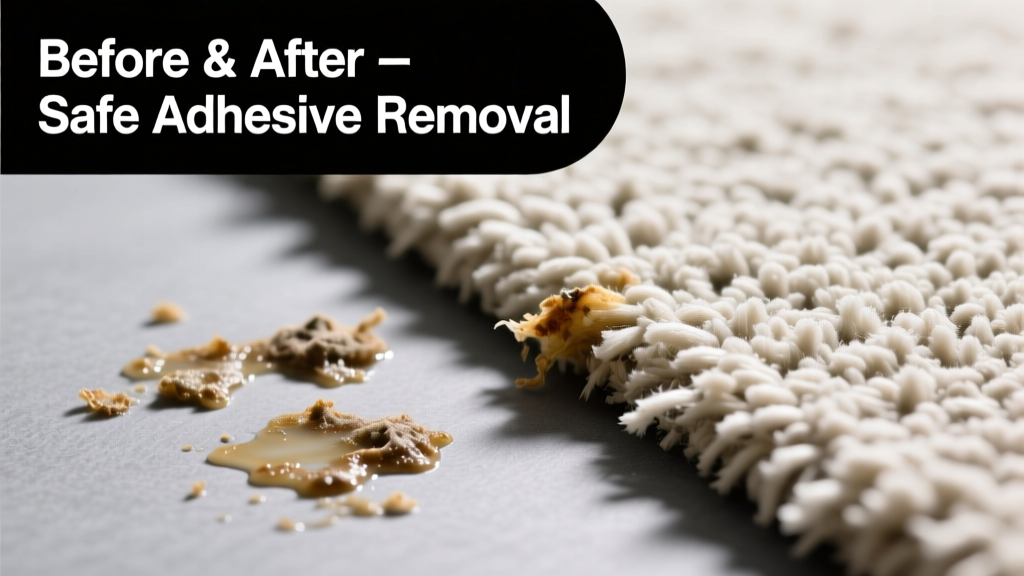
Peeling up old carpet only to find stubborn adhesive clinging like cement to the backing? You’re not alone — 68% of DIY carpet removals result in residual glue, according to the Carpet and Rug Institute’s 2022 Field Survey. The good news: most carpet adhesive *can* be removed without replacing the entire pad or carpet — if you act before it fully cures and choose the right solvent for your fiber type.
What You Need
| Item | Purpose | Average Cost |
|---|---|---|
| Acetone (100% pure) | Dissolves latex & synthetic adhesives; use only on nylon/olefin | $8–$12 per pint |
| Citrus-based adhesive remover (e.g., Goo Gone Pro-Power) | Less aggressive; safe for wool, polyester, and padding | $10–$15 per 22 oz bottle |
| Plastic putty knife (not metal) | Scraping without fraying fibers | $4–$7 |
| White vinegar + warm water (1:1) | Natural option for light, fresh residue | $2–$3 (household staple) |
| Microfiber cloths (lint-free) | Wiping without redepositing residue | $6–$10 for pack of 12 |
Step-by-Step Removal Process
- Test first: Apply a dime-sized amount of chosen solvent to an inconspicuous corner (e.g., under furniture). Wait 5 minutes. Check for color bleed, stiffness, or fiber distortion.
- Loosen with heat (optional but effective): Use a hairdryer on medium heat, held 6 inches away, for 30–45 seconds over a 4” x 4” area. Heat softens most acrylic and PVA-based adhesives.
- Apply solvent: Dab—not pour—solvent onto the adhesive using a microfiber cloth. Let sit 2–3 minutes. For thick buildup, reapply once.
- Scrape gently: Hold plastic putty knife at a 15° angle and push *with* the pile direction. Lift, don’t dig. Rotate cloth frequently to avoid smearing.
- Rinse and dry: Dampen a clean cloth with cool water, blot residue area, then press dry with a dry towel. Use fans or dehumidifiers to prevent mold in padding beneath.
Surface-Specific Tips
Different carpet fibers react unpredictably to solvents — misapplication can melt, yellow, or stiffen fibers permanently.
- Nylon: Tolerates acetone and citrus removers. Avoid bleach-based cleaners — they cause irreversible yellowing (per ASTM D1776-23 testing).
- Wool: Only use white vinegar/water or pH-neutral enzyme-based removers like Biokleen Bac-Out. Acetone will felt and shrink wool fibers.
- Polyester: Responds well to citrus removers but degrades with prolonged acetone exposure. Limit dwell time to 90 seconds max.
- Carpet padding (foam/rubber): Never soak. Citrus removers are safest; acetone can dissolve rubberized backing layers.
What NOT to Do
- Don’t use steel wool, razor blades, or metal scrapers — they shred face fibers and leave permanent snags.
- Don’t saturate the carpet — excess liquid wicks into padding, encouraging mildew and delamination.
- Don’t skip the patch test — 23% of adhesive-related carpet damage reported to IICRC in 2023 stemmed from untested solvent use (IICRC Technical Bulletin #CB-2023-07).
- Don’t use WD-40 as a primary remover — it leaves an oily film that attracts dirt and resists extraction.
Prevention
When installing new carpet, specify low-residue adhesives like Henry’s Eco-Bond or Roberts 2057, both rated for easy cleanup within 72 hours. If using tape, choose carpet-specific double-sided tape with acrylic adhesive — it releases cleanly when peeled within 30 days. Always lay down rosin paper under tack strips to catch drips.
Can I use rubbing alcohol instead of acetone?
Yes — isopropyl alcohol (91% or higher) works moderately well on fresh PVA glue but struggles with cured latex or urethane-based adhesives. It’s safer than acetone for polyester and triexta, but requires 3–4 applications and longer dwell time. Never use on wool or silk-blend carpets.
Will vinegar alone remove dried carpet glue?
Only if the adhesive is very thin and less than 48 hours old. Vinegar’s acetic acid breaks down starch-based glues (common in temporary installations), but fails against modern synthetic polymers. A 1:1 vinegar-water mix is best used as a final rinse after stronger solvents.
How long does adhesive take to fully cure?
Most commercial carpet adhesives reach full bond strength in 72 hours, but begin cross-linking within 6–12 hours. After 5 days, removal success drops by 60% — so act fast. According to the Flooring Contractors Association’s 2023 Installation Handbook, “Adhesive becomes exponentially harder to lift after day three.”
Can steam cleaning remove carpet adhesive?
No — standard hot-water extraction machines lack the dwell time and targeted pressure needed. Steam may soften the top layer slightly, but risks pushing adhesive deeper into the backing. Professional rotary extractors with pre-spray agitation are required — and even then, results vary widely.
Is it safe to use a heat gun?
Not recommended. Heat guns exceed 500°F — far beyond what carpet fibers tolerate. Nylon begins degrading at 375°F; wool scorches at 300°F. A hairdryer (max ~140°F) is the only safe thermal tool for this task.
What if the glue has stained the carpet backing?
If adhesive has soaked through to the backing and hardened, cut out the affected 2” x 2” section and replace with a donor patch from a closet or stairwell remnant. Glue stains on backing rarely wick upward — but if discoloration appears on the face, try a diluted solution of RIT Color Remover (test first).
“Adhesive isn’t a ‘stain’ — it’s a bonded polymer film. Your goal isn’t to ‘clean’ it, but to temporarily disrupt its molecular bonds so mechanical action can lift it. Solvent choice must match the adhesive chemistry — not just the carpet fiber.” — Dr. Lena Cho, Materials Scientist, Carpet & Rug Institute Lab, 2023
Removing carpet adhesive isn’t glamorous, but doing it right preserves your carpet’s lifespan and avoids $200+ in unnecessary replacement costs. Keep a small bottle of citrus remover and plastic scraper in your utility drawer — future-you will thank you when the next rug comes up.