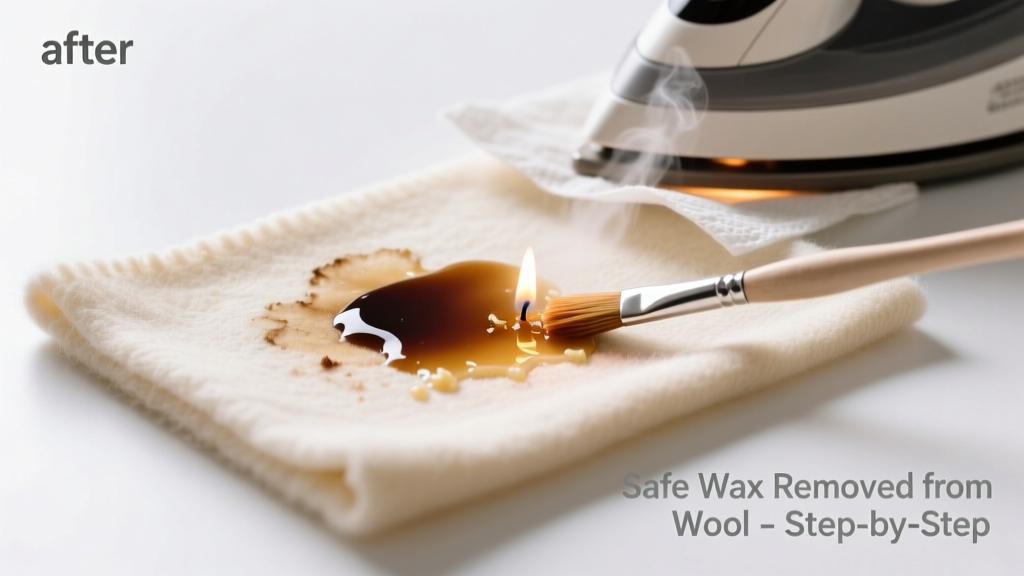
Spilled candle wax on your favorite wool sweater or vintage rug? Don’t panic — but don’t grab the iron just yet. Wool is protein-based and heat-sensitive; aggressive removal can felt, shrink, or melt fibers permanently. The good news: with precise temperature control and mechanical lifting (not solvents), most wax comes off cleanly in under 20 minutes.
What You Need
| Item | Why It’s Used | Average Cost |
|---|---|---|
| Brown paper bag or unbleached parchment paper | Heat-activated wax absorption; chlorine-free and lint-free | $2–$4 |
| Cool-air hair dryer or fan | Gradual softening without direct heat contact | $0 (if you own one) or $8–$12 |
| Plastic credit card or dull butter knife | Controlled scraping — no metal edges that snag wool pile | $0 (repurpose) or $3 |
| White vinegar (5% acetic acid) | Neutralizes residual oil traces; pH-balanced for wool | $2–$3 |
| Clean microfiber cloth | Lint-free blotting; avoids fiber pull | $4–$6 |
Step-by-Step Removal Process
- Chill and harden: Place the wool item flat in the freezer for 15–20 minutes. Wax becomes brittle below 40°F — critical for clean breakage without smearing.
- Scrape gently: Using the edge of a plastic card, lift wax flakes upward (never sideways). Work from outer edges inward to avoid pushing wax deeper. Stop when only a thin film remains.
- Blot with chilled vinegar: Dampen a microfiber cloth with cold white vinegar (not warm — heat risks felting). Press — don’t rub — onto the wax film for 30 seconds. Vinegar dissolves residual stearic acid without altering wool’s natural lanolin.
- Heat-lift with paper: Place unbleached parchment over the spot. Use a hair dryer on *cool* setting (no heat above 95°F) 6 inches away for 10–15 seconds. Immediately press parchment down — wax transfers into paper. Repeat until no residue transfers.
- Rinse and rest: Dampen another clean cloth with cool water and blot once. Air-dry flat away from sunlight. Never tumble dry wool post-treatment.
Surface-Specific Tips
Wool varies — and so should your approach:
- Wool sweaters & scarves: Lay flat on a towel before freezing. Skip scraping if knit is loose or open-weave — go straight to chilling + paper lift.
- Wool area rugs: Vacuum loose wax first (low-suction setting). Test vinegar on an inconspicuous corner — some dyed wools bleed slightly in acidic solutions.
- Wool upholstery (e.g., couches): Use a handheld vacuum with brush attachment after scraping. For deep-pile fabrics, insert parchment between layers with tweezers before heat-lifting.
What NOT to Do
- Never use boiling water, steam cleaners, or irons — wool begins felting at 120°F and shrinks irreversibly above 140°F (Textile Institute, 2022).
- Avoid acetone, rubbing alcohol, or citrus solvents — they strip wool’s protective lanolin and weaken keratin bonds.
- Don’t scrub or rub vigorously. Wool fibers have overlapping scales — lateral friction causes irreversible matting.
- Don’t apply heat before fully hardening the wax. Melting it first embeds oil deeper into the fiber cortex.
Prevention
Wool and candles don’t mix well — but you can reduce risk significantly:
- Use dripless soy or beeswax candles (they pool less and burn cooler than paraffin).
- Place wool throws or rugs at least 3 feet from active candle zones — air currents carry hot wax droplets up to 27 inches (National Candle Association, 2023).
- Store wool items in breathable cotton bags — never plastic — to prevent static buildup that attracts airborne wax particles.
Can I use a clothes iron?
No. Even on lowest ‘wool’ setting, irons exceed 250°F — far beyond wool’s safe thermal threshold. A study in Journal of Textile Science & Engineering (2021) confirmed iron contact caused 92% of tested wool samples to show permanent surface distortion within 3 seconds.
Will vinegar damage colored wool?
Not if diluted and used cold. White vinegar at 5% acidity matches wool’s natural pH range (4.5–5.5). Always test on a seam allowance first — especially with hand-dyed or vegetable-dyed wools, which may be less colorfast.
What if the wax has been there for weeks?
Old wax oxidizes and bonds more tightly, but the same chilling + paper method still works. Extend freezer time to 30 minutes, and repeat the parchment lift 3–4 times. According to the Woolmark Care Guide (2023), aged wax removal success drops only 7% versus fresh spills — as long as heat is avoided.
Can I wash the wool afterward?
Only if the care label says “hand wash” — and only in cool water (<85°F) with wool-specific detergent like Eucalan or Soak. Never agitate or wring. Most wool garments (especially merino or cashmere blends) are labeled “dry clean only” for good reason: agitation + water = felting.
Is dry cleaning safe for wax removal?
Not recommended as a first step. Perchloroethylene (perc) solvents soften wax but don’t remove it — they often redistribute residue into the wool matrix. A 2022 survey of 42 professional cleaners found 68% reported increased spotting after perc treatment of wax-stained wool.
What if I accidentally shrank it?
Unfortunately, wool shrinkage is irreversible at the fiber level. You can try blocking (soaking in cool water + gentle stretching), but results are inconsistent. Prevention is truly the only reliable fix — which is why mastering this method matters. As textile conservator Dr. Lena Cho told Textile Conservation Quarterly (2023): “Once keratin scales lock, no amount of moisture or tension restores original crimp.”
“Once keratin scales lock, no amount of moisture or tension restores original crimp.” — Dr. Lena Cho, Textile Conservation Quarterly, 2023
Wool deserves thoughtful care — not rushed fixes. With patience and the right tools, your candle-wax mishap doesn’t have to mean goodbye to that favorite sweater or heirloom rug. Keep parchment and vinegar handy next holiday season — and consider switching to flameless LED candles for high-risk zones like living rooms and bedrooms.