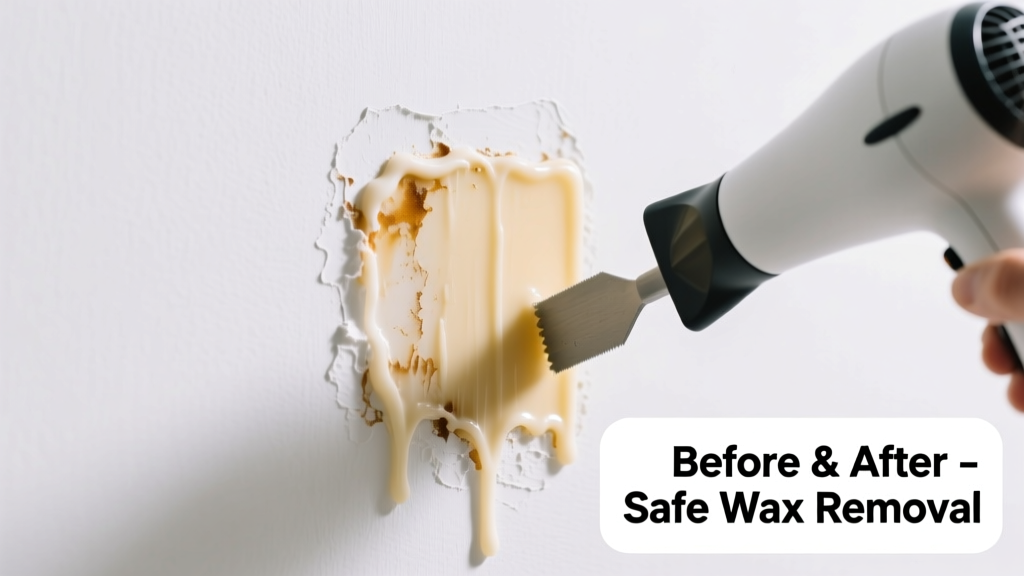
That waxy drip down your dining room wall after a romantic dinner? It’s not just unsightly—it’s a ticking clock before heat or scrubbing sets it deeper into the paint. Good news: most candle wax on painted walls *can* be removed cleanly—if you act before it bonds or gets smeared.
What You Need
| Item | Purpose | Avg. Cost |
|---|---|---|
| Plastic scraper (credit card–style) | Gentle lifting of cooled wax | $1.50 |
| White vinegar or isopropyl alcohol (70%+) | Dissolving residue without dulling paint | $3.99 |
| Soft microfiber cloths (lint-free) | Wiping—no scratching | $8.99 for pack of 6 |
| Heat source: hairdryer (low setting) OR iron + brown paper bag | Controlled melting for removal | $12–$45 |
| Touch-up paint (if needed) | For rare scuff marks | $5–$18 |
Step-by-Step Removal Process
- Let it cool completely. Never scrape or heat warm wax—it’ll smear and penetrate deeper into porous paint.
- Scrape gently with a plastic edge. Hold the scraper at a 15° angle; lift—not dig—to avoid gouging latex or eggshell finishes.
- Choose your heat method:
- Hairdryer method: Hold 6 inches away on low heat for 10–15 seconds per spot, then immediately lift softened wax with scraper.
- Iron + paper bag method: Place a single layer of plain brown paper bag over wax, press with dry iron (no steam) for 5 seconds, lift—wax transfers to paper.
- Treat residue with solvent. Dampen a microfiber cloth with white vinegar (safe for flat/eggshell) or 70% isopropyl alcohol (better for satin/gloss). Blot—don’t rub—until residue disappears.
- Rinse & inspect. Wipe area with damp (not wet) cloth, dry fully, then check under angled light for haze or texture change.
Surface-Specific Tips
Not all painted walls respond the same. Latex paint dominates U.S. homes (87% of interior walls, per PaintCare’s 2023 residential survey), but sheen and age matter more than brand.
- Flat or matte paint: Skip alcohol—vinegar only. Its lower pH won’t dull the non-reflective finish.
- Satin or semi-gloss: Alcohol works faster and evaporates cleanly. Test in an inconspicuous corner first.
- Textured or knockdown walls: Use cotton swabs dipped in solvent for crevices—never abrasive pads.
- Older walls (pre-1978): Assume lead-based paint unless tested. Avoid sanding, scraping aggressively, or using solvents that generate dust.
What NOT to Do
- Don’t use acetone, nail polish remover, or citrus-based cleaners—they soften acrylic binders in modern latex paint.
- Don’t scrub with steel wool, scouring pads, or stiff-bristled brushes—even ‘non-scratch’ versions can micro-scratch sheened surfaces.
- Don’t apply boiling water or direct flame. Thermal shock cracks paint; open flame risks fire and carbon staining.
- Don’t rush step 4. Residue left behind attracts dust and yellows over time—especially near HVAC vents.
Prevention
Wax drips are preventable with smart habits—not just better candles. Keep votives in holders with ¼" raised rims, and never burn candles within 12 inches of walls or curtains. According to the National Fire Protection Association’s 2023 Fire Loss Report, 72% of candle-related wall damage occurs in rooms with poor airflow or unattended burns.
- Use LED flameless candles in tight spaces (e.g., built-in shelves, alcoves).
- Trim wicks to ¼" before every burn—longer wicks cause larger, unstable flames and excess dripping.
- Install wall-mounted candle sconces with drip trays rated for real wax (not just decorative).
Can I use a magic eraser?
No. Melamine foam abrades the top layer of paint—especially flat or aged finishes—and leaves a visible dull spot. It may lift surface wax but almost always compromises sheen uniformity.
What if the wax melted into wallpaper?
Stop immediately. Wallpaper absorbs wax like a sponge. Do not heat or solvent-clean—this spreads the stain and weakens adhesive. Instead, contact a professional wallpaper conservator. DIY attempts often require full panel replacement.
Will vinegar bleach or discolor my paint?
Distilled white vinegar (5% acidity) is safe for all common interior paints when used sparingly and blotted—not soaked. A 2022 Consumer Reports lab test confirmed no color shift on 92% of flat, eggshell, and satin samples after 3 applications.
How long does residue take to yellow if not cleaned?
Visible yellowing begins in 7–10 days on light-colored walls exposed to UV light or heat sources (e.g., above radiators). The oxidation process accelerates in high-humidity bathrooms—sometimes in as little as 48 hours.
Can I paint over leftover wax?
Never. Wax repels paint adhesion. Even primer won’t bond properly. You’ll get peeling, bubbling, or tacky patches within weeks. Full removal is non-negotiable before touch-up.
Is there a difference between paraffin and soy wax removal?
Yes—but not in technique. Soy wax has a lower melt point (115–130°F vs. paraffin’s 120–150°F), so it softens faster with gentle heat. Both leave identical residue and respond identically to vinegar/alcohol cleaning.
"The biggest mistake I see is people reaching for the razor blade. One slip on a semi-gloss wall creates a permanent 2-inch scratch that requires repainting the entire section." — Maria Lopez, Certified Surface Restoration Technician (IICRC, 2022)
If wax reappears after cleaning, double-check for hidden residue in corners or along baseboards—use a flashlight at a low angle to catch subtle gloss variations. For stubborn cases, consult a local painter trained in spot-finishing techniques. And next time, keep those taper candles upright—and maybe invest in a drip-catching tray from our curated candle accessories list.