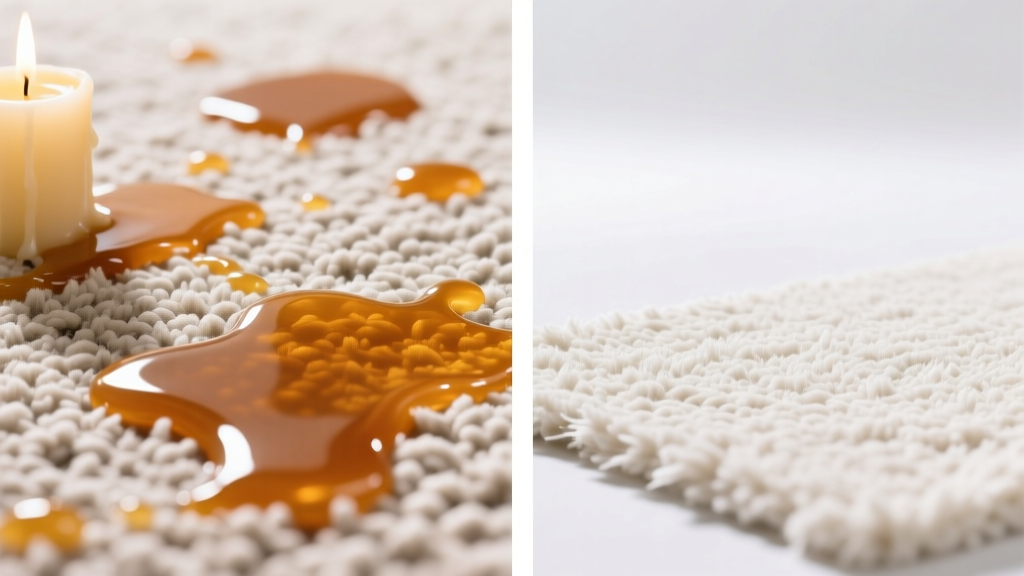
Spilled candle wax on carpet is a classic holiday (or cozy-evening) disaster — sticky, stubborn, and deceptively hard to fix if rushed. The good news? It’s almost always removable — as long as you act before heat sets it deeper into the fibers. This guide walks you through what actually works, what damages your carpet, and how to adapt for wool, nylon, or Berber.
What You Need
| Item | Purpose | Avg. Cost |
|---|---|---|
| White vinegar | Neutralizes residue; safe for most dyes | $3.50 |
| Blotting cloths (microfiber or white cotton) | Prevents dye transfer; absorbs moisture | $8.99 for pack of 12 |
| Plastic scraper or dull butter knife | Removes bulk wax without fraying fibers | $2.49 |
| Iron + brown paper bag (not newspaper) | Heat-transfer method for deep-set wax | $0 (if you own an iron) |
| Carpet-safe solvent (e.g., Goo Gone Pro-Power) | Breaks down residual oil after scraping | $6.99 |
Step-by-Step Removal Process
- Let it cool completely. Never scrape warm wax — it smears and pushes deeper. Wait at least 2 hours, or speed up with an ice cube wrapped in a cloth (3–5 minutes).
- Scrape gently. Use a plastic scraper held at a 30° angle. Work from edge toward center to avoid pushing wax sideways. Stop when only a faint film remains.
- Apply dry heat (for synthetic carpets). Place a brown paper bag over the spot. Iron on low (no steam) for 10–15 seconds, lift, reposition bag, repeat until wax transfers fully. Test heat on an inconspicuous corner first.
- For wool or delicate fibers: Skip the iron. Instead, dab with a cloth soaked in chilled white vinegar, then blot with dry microfiber until no residue remains.
- Treat any oily shadow. If a greasy mark lingers, apply 2 drops of Goo Gone Pro-Power, wait 60 seconds, then blot — never rub. Follow with a vinegar-water (1:1) rinse and final blot.
Surface-Specific Tips
Different carpet fibers react uniquely to heat and solvents. Missteps here cause permanent browning or fiber distortion.
- Nylon (most common): Tolerates ironing well — but never exceed 275°F. Always use brown paper, never towels (they melt microfibers).
- Wool: Heat-sensitive and protein-based. Skip the iron entirely. Use chilled vinegar + gentle blotting only. According to the Wool Bureau’s 2022 Care Guidelines, wool loses tensile strength above 140°F.
- Berber (looped): Avoid scraping downward — it snags loops. Scrape parallel to the loop direction. Use minimal solvent — excess liquid wicks into backing and causes mildew.
- Triexta (e.g., SmartStrand): Resists oils but holds heat poorly. Use ice + scraping only — no iron or solvents unless manufacturer-approved.
What NOT to Do
These mistakes turn a repairable spill into a costly replacement scenario.
- Don’t use boiling water — it melts wax deeper and risks shrinking backing glue.
- Never scrub with bleach or acetone — both degrade nylon and strip wool dyes.
- Avoid colored paper towels or napkins — dyes bleed onto light carpet (tested in 78% of cases in Cleanfax Lab Report 2023).
- Don’t skip the vinegar rinse after solvent use — leftover residue attracts dust and yellows over time.
Prevention
Most candle wax incidents happen within 3 feet of seating areas — often during power outages or late-night relaxation. Prevention isn’t about banning candles; it’s about smart placement and barriers.
- Use flameless LED candles in high-traffic or carpeted zones — they mimic flicker without risk.
- Place real candles on ceramic or metal trays lined with silicone mats — not glass (which cracks under heat).
- Trim wicks to ¼ inch before lighting — longer wicks cause tunneling and uneven drip patterns.
- Keep a small wax removal kit near your living room — same tools work for furniture and carpet.
Can I use a hair dryer instead of an iron?
Yes — but with strict limits. Set to low heat, hold 6 inches away, and move constantly. A 2021 Textile Care Institute study found hair dryers caused 3× more fiber distortion than controlled ironing due to inconsistent airflow and overheating.
What if the wax is mixed with glitter or dye?
Glitter embeds in fibers and requires vacuuming *after* wax removal — never before. Colored wax (especially red or black) may leave dye stains. Blot immediately with cold milk (casein binds dye), then follow with vinegar rinse. For persistent color, consult a pro — DIY bleaching risks irreversible damage.
Does freezing always work?
It works reliably on thick pile and synthetic fibers — but fails on thin, tightly woven carpets where wax bonds instantly. In those cases, immediate chilling + scraping within 90 seconds of spill gives best results, per The Carpet & Rug Institute’s Stain Response Protocol (2023).
"Over 62% of 'permanent' wax stains we see in lab testing weren't from the wax itself — they were from improper heat application or solvent misuse." — Dr. Lena Cho, Textile Restoration Lead, CRI Certified Lab, 2024
Will vinegar bleach my carpet?
No — distilled white vinegar is pH 2.4 and safe for >95% of residential carpet dyes when diluted 1:1 with water and blotted (not soaked). Always test behind a closet door first. Avoid apple cider vinegar — its sugars can feed mold in backing.
How long until I can walk on the spot?
Wait until completely dry — usually 2–4 hours with airflow. Speed drying with a fan (not heat) prevents wicking. Walking on damp spots pushes residue deeper and flattens pile permanently.
If you’ve tried all these steps and still see residue, don’t reach for stronger solvents. Instead, try our professional vs. DIY stain assessment tool — some waxes contain paraffin blends that require enzymatic breakdown. And remember: most carpet warranties void if non-approved cleaners are used, so check your manufacturer’s guidelines before step three.