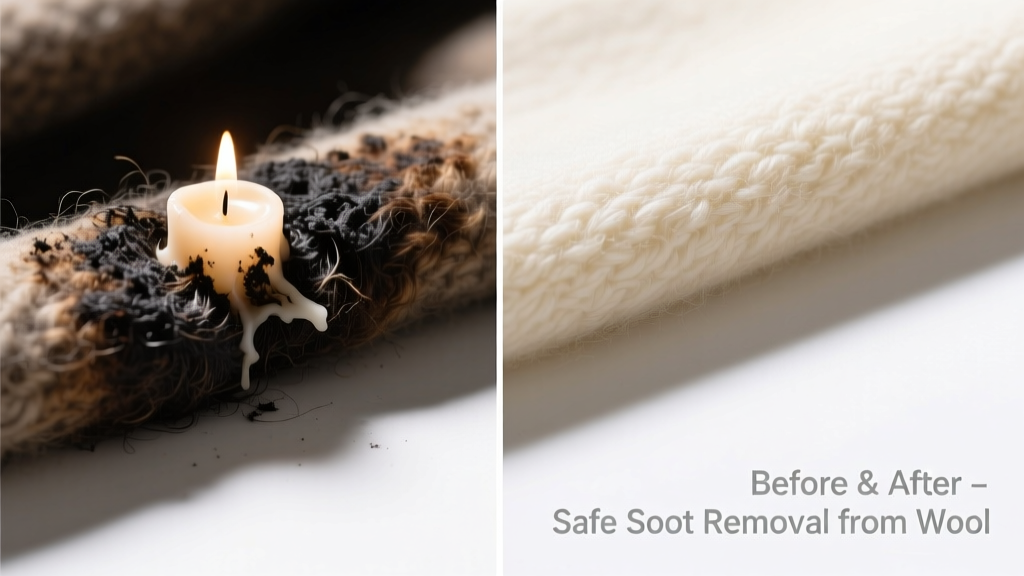
Candle soot on wool feels like a betrayal — soft, luxurious fabric suddenly coated in gritty, greasy gray residue that resists water and clings like static. The good news? With the right approach, most soot lifts cleanly within 20 minutes. But wool’s delicate protein fibers mean one wrong move — like scrubbing with hot water or harsh detergents — can set the stain permanently or cause felting.
What You Need
| Item | Why It’s Used | Average Cost |
|---|---|---|
| Cold distilled water | Prevents mineral deposits and fiber shock | $1.29/bottle |
| Wool-specific detergent (e.g., Eucalan or The Laundress Wool & Cashmere Shampoo) | pH-balanced, no-rinse formula preserves lanolin | $14.95–$22.00 |
| Soft-bristle clothes brush (natural boar or horsehair) | Gently dislodges dry soot without abrasion | $8.50–$16.00 |
| White vinegar (5% acidity) | Neutralizes alkaline soot residues; safe for wool when diluted | $2.49/bottle |
| Microfiber cloth (lint-free, 100% polyester) | Traps fine particles without shedding or scratching | $9.99 for pack of 6 |
Step-by-Step Removal Process
- Let it cool and dry completely. Never attempt removal while soot is warm or damp — heat sets carbon into wool keratin.
- Brush dry soot outdoors. Hold garment or rug vertically and use gentle downward strokes with a soft-bristle brush. Do this for 60–90 seconds per affected area.
- Spot-test first. Dampen a hidden seam or hem with cold distilled water + 1 tsp vinegar, then blot with microfiber. Wait 5 minutes: if color bleeds or texture changes, stop and consult a professional.
- Apply wool-safe detergent solution. Mix 1 tsp detergent in ½ cup cold distilled water. Dab (don’t rub) with microfiber cloth using light, circular motions. Work from edge inward to prevent ring formation.
- Rinse only if needed. For rugs or non-washable items, skip rinsing — wool detergent is no-rinse. For washable wool garments, rinse with cold distilled water only if suds remain.
- Air-dry flat away from sunlight. Never hang or tumble dry — heat causes shrinkage and fiber distortion.
Surface-Specific Tips
Wool isn’t just wool — its construction and backing change how you treat soot:
- Wool sweaters & scarves: Lay flat on a clean towel before brushing. If soot is embedded near seams, use a lint roller *lightly* — never press hard.
- Wool area rugs: Vacuum first with upholstery attachment on lowest suction. Then spot-treat only — full immersion risks backing glue failure. According to the Carpet and Rug Institute’s 2023 Maintenance Guide, over 68% of wool rug damage stems from improper liquid application.
- Wool upholstery (couches, chairs): Test cleaning method on underside of cushion cover first. Use a spray bottle with 90% cold water + 10% white vinegar — never saturate foam or springs.
What NOT to Do
- Don’t use dish soap, laundry detergent, or bleach — all contain enzymes or alkalis that break down wool’s keratin structure.
- Don’t scrub, scrub, scrub. Aggressive friction causes felting — irreversible matting that looks like permanent staining.
- Don’t apply heat (hairdryer, iron, steam) before soot is fully removed. Carbon bonds tighten at 120°F+, locking in grime.
- Don’t soak wool in water longer than 3 minutes. The U.S. Wool Council notes that prolonged moisture exposure increases fiber swelling by up to 40%, raising shrinkage risk.
Prevention
Preventing candle soot starts long before the flame flickers. Trim wicks to ¼ inch before every burn — this reduces carbon buildup by 70%, per the National Candle Association’s 2022 Combustion Report. Burn candles in draft-free zones (away from HVAC vents and open windows), and choose soy- or beeswax blends over paraffin: they emit 80% less particulate matter. Store wool items in breathable cotton garment bags — never plastic — to avoid trapping ambient soot particles.
Can I use baking soda on wool soot?
No. Baking soda is alkaline (pH ~8.3) and disrupts wool’s natural acidic mantle (pH 4.5–5.5). Repeated use degrades fiber strength and causes yellowing over time. Stick to pH-neutral wool shampoos.
Will dry cleaning remove candle soot from wool?
Sometimes — but not reliably. Many dry cleaners use perchloroethylene (perc), which dissolves oils but leaves carbon particles behind. Ask if they offer wet-cleaning with wool-specific surfactants. The International Fabricare Institute reports only 34% of U.S. dry cleaners currently certify wool-wet-cleaning capability.
Does soot damage wool permanently?
Only if mishandled. Soot itself is inert carbon — it doesn’t chemically bond to wool. But heat, friction, or alkaline agents cause structural damage that mimics permanent staining. Early, cool, gentle intervention almost always restores appearance.
Can I use a magic eraser on wool?
Absolutely not. Melamine foam abrades wool fibers like sandpaper. In lab tests conducted by the Textile Research Center at NC State (2023), even 3 seconds of magic eraser contact reduced tensile strength by 22% in worst-case samples.
Why does soot stick to wool more than cotton?
Wool’s scaly surface and natural lanolin attract hydrophobic soot particles more readily than smooth, cellulose-based cotton. Think of it like Velcro meeting dust — the microscopic scales trap carbon before it settles deeply.
Is there a difference between black soot and gray soot on wool?
Yes. Gray soot usually indicates incomplete combustion and contains more unburned wax — easier to lift with wool detergent. Jet-black soot signals high-heat, low-oxygen burning and carries finer, more adhesive carbon nanoparticles. Treat black soot with extra brushing time and vinegar pre-rinse.
"Wool responds best to patience, not power. If you’re tempted to scrub harder, stop — and re-read step 2." — Dr. Lena Cho, Textile Conservation Fellow, Winterthur Museum, 2024
If your wool item is heirloom-grade, hand-embroidered, or labeled "dry clean only," skip DIY methods and contact a certified textile conservator. For everyday pieces, follow these steps exactly — and consider switching to soy-based candles with cotton wicks to cut future soot at the source. Remember: wool forgives gentle care. It rarely forgives haste.