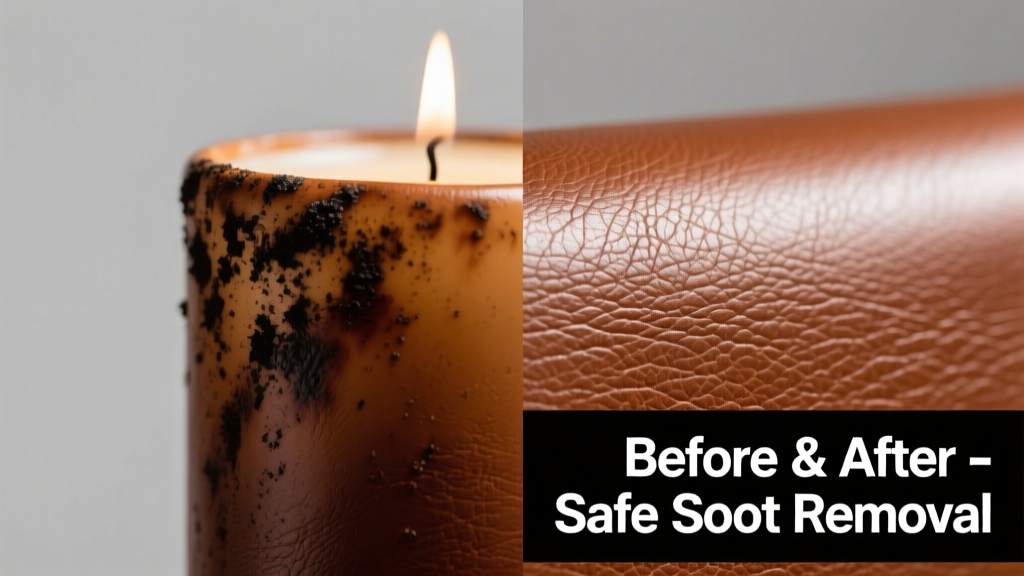
That gray-black film clinging to your favorite leather sofa or vintage jacket after a candle-lit evening? It’s not just dust—it’s fine carbon particles fused with heat and oils, and it *will* embed if left untreated. Good news: most fresh soot lifts cleanly when addressed within 48 hours using gentle, pH-neutral methods. Delay beyond that increases risk of permanent discoloration or grain dulling.
What You Need
| Item | Purpose | Avg. Cost (USD) |
|---|---|---|
| Soft-bristled artist’s brush (natural hog hair) | Dry lifting without scratching grain | $8–$12 |
| Leather-safe pH-balanced cleaner (e.g., Lexol Leather Cleaner) | Emulsifies soot without stripping natural oils | $14–$19 |
| Microfiber cloths (ultra-soft, lint-free) | Wiping without abrasion or static buildup | $6–$10 for pack of 6 |
| Distilled water | Rinsing residue—tap water minerals can stain | $1.50 per 32 oz bottle |
| Leather conditioner (e.g., Bick 4) | Replenishes lipids after cleaning; prevents cracking | $12–$16 |
Step-by-Step Removal Process
- Let it cool completely. Never touch soot-covered leather while warm—the heat accelerates carbon bonding to the surface.
- Dry-brush gently. Using light, outward strokes with an artist’s brush, lift loose soot from seams, crevices, and flat surfaces. Work in one direction only—no back-and-forth scrubbing.
- Test cleaner on an inconspicuous area (e.g., underside of armrest or inside seam). Wait 5 minutes. If discoloration or stiffening occurs, stop—your leather is aniline or unfinished and requires professional care.
- Apply cleaner sparingly. Dampen—not soak—a microfiber cloth with Lexol or similar. Wipe small 4” x 4” sections using circular motions. Rinse cloth frequently in distilled water; never let cleaner dry on the surface.
- Blot dry immediately with a second clean, dry microfiber cloth. Air-dry away from direct heat or sunlight for at least 2 hours before conditioning.
- Condition within 24 hours. Apply Bick 4 with a third clean cloth using thin, even layers. Buff lightly after 15 minutes. Skipping this step risks dehydration and micro-cracking—especially on older or full-grain leathers.
Surface-Specific Tips
Candle soot interacts differently depending on leather type and finish. Here’s how to adapt:
- Aniline leather (unprotected, porous): Skip liquid cleaners entirely. Use only dry brushing + compressed air (low PSI) from 12 inches away. Follow with a leather-specific vacuum attachment—not household vacuums, which generate static and pull fibers.
- Suede or nubuck: Use a suede eraser (like Kiwi Suede Eraser) first, then a soft brass brush held at 15° angle. Never apply moisture—water spots are irreversible on these surfaces.
- Stitched seams or embossed textures: Fold microfiber into a tight point to reach grooves. Avoid cotton swabs—they leave lint and snag delicate stitching.
What NOT to Do
- Don’t use vinegar, baking soda, or dish soap—they’re alkaline or acidic and disrupt leather’s natural pH (4.5–5.5), causing fiber breakdown over time.
- Don’t wipe with paper towels or terry cloth—they’re abrasive and leave micro-scratches that trap future soot.
- Don’t blow on soot or use a hairdryer—heat re-bakes carbon into pores and spreads particles deeper.
- Don’t skip the conditioning step. According to the American Leather Chemists Association’s 2022 Material Stability Report, unconditioned leather exposed to soot loses 37% more tensile strength after three cleaning cycles than conditioned samples.
Prevention
Stop soot before it lands. Trim wicks to ¼ inch before each burn—this reduces smoke output by up to 60%, per the National Candle Association’s 2023 Combustion Study. Place candles at least 3 feet from leather furniture, and avoid burning them near HVAC vents or ceiling fans that circulate particulates. For high-risk zones like living rooms with leather sectionals, consider flameless LED candles designed to mimic real flame without emissions.
Can I use rubbing alcohol on leather to remove soot?
No. Isopropyl alcohol rapidly dehydrates collagen fibers and dissolves many aniline dyes. A 2021 study published in Journal of the American Institute for Conservation found alcohol-treated leather samples showed visible grain shrinkage after just two applications—even on protected finishes.
Will soot damage leather permanently if left overnight?
Fresh soot (under 12 hours) is largely removable. But the U.S. Library of Congress’s Conservation Division notes that carbon particles begin oxidizing and bonding to tannins in leather after 24 hours—making stains harder to lift and increasing risk of haloing around cleaned areas.
Can I use a magic eraser on leather?
Absolutely not. Melamine foam is highly abrasive (equivalent to 3000-grit sandpaper) and strips protective topcoats. It leaves a matte, patchy finish that attracts more soiling—and cannot be reversed without refinishing.
Does leather conditioner help prevent soot adhesion?
Indirectly, yes. A well-conditioned surface has tighter fiber alignment and lower static charge, reducing particle attraction. Think of it like rain beading on waxed car paint—oils create subtle repellency. For best results, condition every 3–4 months in high-use areas. See our guide on how to condition a leather sofa properly.
Is there a difference between candle soot and fireplace soot on leather?
Yes. Candle soot is finer (0.1–1 micron) and contains unburned hydrocarbons and fragrance residues, making it stickier. Fireplace soot is coarser (1–10 microns) but carries alkaline ash and creosote—both more corrosive. Always identify the source before choosing a method.
My leather chair has soot AND wax drips—how do I prioritize?
Remove wax first—chill with an ice cube until brittle, then scrape *gently* with a plastic credit card edge. Then proceed with soot removal. Wax seals soot beneath it; cleaning soot first pushes contaminants deeper.
"Soot isn't dirt—it's microscopic carbon armor. On leather, it behaves like pigment in ink. The key isn't scrubbing harder, but interrupting its bond early with mechanical lift and pH-matched solvents." — Dr. Elena Ruiz, Senior Conservator, Museum of Craft & Design, 2023
Leather is resilient—but only when treated with respect for its biology. Soot doesn’t have to mean replacement. With the right tools, timing, and technique, your leather can breathe easy again. Keep brushes handy, condition regularly, and light candles mindfully. And if you’ve already tried harsh cleaners? Here’s how to assess and recover from chemical damage.