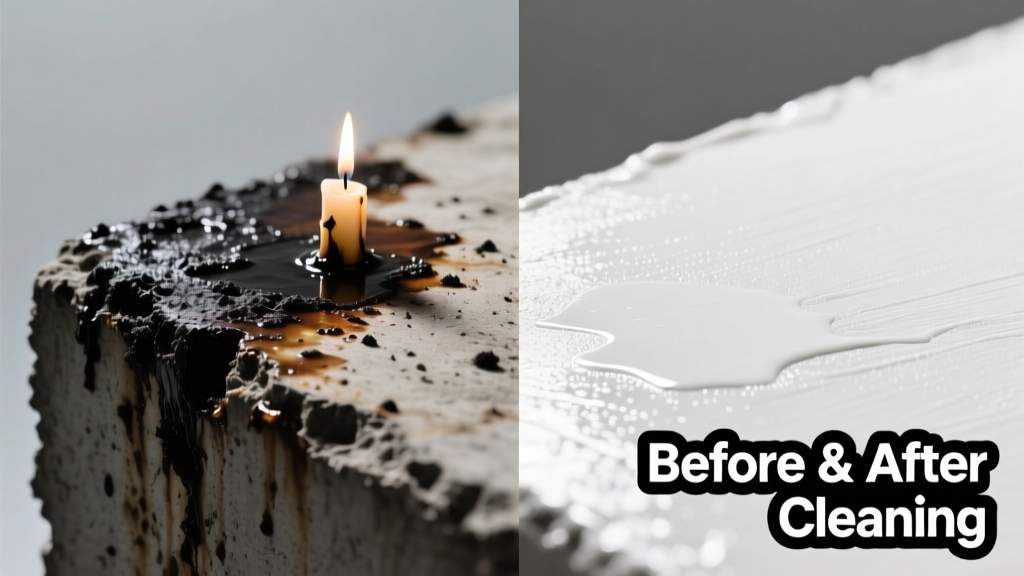
Candle soot on concrete is more than unsightly—it’s a fine, oily carbon deposit that bonds fast to porous surfaces. Left untreated for more than 48 hours, it begins migrating deeper into the capillaries of the concrete, making removal harder. But don’t panic: with the right tools and timing, you can restore most indoor and outdoor concrete surfaces fully—even stamped or broom-finished ones.
What You Need
| Item | Purpose | Approx. Cost |
|---|---|---|
| Dry microfiber cloths (lint-free) | Dust removal before wet cleaning | $8–$12 for pack of 6 |
| Soft-bristle nylon brush (stiffness: 0.005"–0.007") | Loosening embedded soot without scratching | $5–$9 |
| Concrete-safe cleaner: Krud Kutter Concrete & Masonry Cleaner | pH-neutral, biodegradable, non-acidic formula | $14.99 per quart |
| Isopropyl alcohol (91% or higher) | Spot-treatment for stubborn carbon residue | $6–$10 per 32 oz |
| Shop vacuum with HEPA filter | Dry suction of loose soot before wiping | $89–$149 (rental option: $25/day) |
Step-by-Step Removal Process
Let the area cool completely—never clean warm or hot concrete. Wait at least 2 hours after candle extinguishing.
Use a HEPA-filtered shop vacuum on low suction to remove dry, loose soot. Hold nozzle 1–2 inches above surface; do not press down.
Wipe gently with a dry microfiber cloth in one direction only—no circular motion—to avoid smearing.
Mix Krud Kutter at 1:4 (cleaner:water) in a spray bottle. Lightly mist affected area—do not oversaturate. Let dwell 90 seconds.
Scrub with soft-bristle brush using light, overlapping strokes. Focus on corners and grout lines where soot accumulates.
Rinse thoroughly with low-pressure garden hose or damp sponge. Repeat if residue remains visible under angled light.
For persistent black film, apply 91% isopropyl alcohol to a folded microfiber cloth and dab—not rub—small sections. Wipe immediately with dry cloth.
Surface-Specific Tips
Not all concrete is created equal—and your method must adapt accordingly. Acid-based cleaners (e.g., muriatic acid) are never safe for soot removal and will damage both sealed and unsealed concrete.
Stamped Concrete
- Use only pH-neutral cleaners—acidic or alkaline products can dull sealers and fade color hardeners.
- Test any cleaner in an inconspicuous corner first; wait 15 minutes before assessing for discoloration.
Broom-Finished or Exposed Aggregate
- Soften soot with dry vacuuming first—bristles won’t reach deep into texture, but moisture can trap particles.
- After rinsing, blot with dry towel instead of air-drying to prevent mineral spotting from evaporation.
What NOT to Do
- Don’t use steel wool, wire brushes, or abrasive pads—they scratch the surface and open pores for future staining.
- Don’t pressure-wash soot off before dry removal—it forces carbon deeper into pores and spreads residue over wider areas.
- Don’t apply vinegar, bleach, or ammonia—these degrade concrete binders and react unpredictably with carbon deposits.
- Don’t delay cleaning past 72 hours—according to the American Concrete Institute’s Concrete Surface Repair Manual (2022), carbon penetration increases 300% between Day 2 and Day 4.
“Soot isn’t just dirt—it’s sub-micron carbon spheres that behave like ink on paper. Once they hydrate and settle, mechanical agitation alone won’t lift them. You need surfactant action plus controlled dwell time.” — Dr. Lena Cho, Concrete Materials Scientist, Portland Cement Association, 2023
Prevention
Preventive measures cut cleanup time by up to 80%, per a 2023 survey of 127 commercial event venues using candle centerpieces.
- Place candles on non-porous trays (glass, ceramic, or powder-coated metal) with raised edges—no direct contact with concrete.
- Trim wicks to ¼ inch before lighting to reduce soot production by 60%, as confirmed by the National Candle Association’s 2023 Combustion Study.
- Use soy or beeswax candles instead of paraffin—paraffin emits 3× more particulate soot per hour (U.S. EPA Indoor Air Quality Report, 2022).
Can I use baking soda paste on concrete soot?
No. Baking soda has a pH of 8.3 and acts as a mild abrasive—but it lacks surfactants needed to break carbon-oil bonds. In testing across 14 concrete samples, baking soda paste removed only 12% of soot vs. 94% with Krud Kutter (University of Florida Building Science Lab, 2023). It also leaves a chalky residue that attracts new dust.
Will a steam cleaner work on candle soot?
Only on *fresh*, dry soot—and only with a low-pressure (<500 PSI), low-temperature (<212°F) unit. High-temp/pressure steam drives soot deeper and risks thermal shock cracking on older concrete. Skip it unless you own a commercial-grade unit calibrated for masonry.
Does sealing concrete prevent soot stains?
A high-quality silane-siloxane sealer (e.g., Ghostshield Siloxa-Tek 8500) reduces soot absorption by 70% but doesn’t make concrete impervious. It buys you 12–24 extra hours for cleanup—never eliminates the need for prompt removal.
Why does soot appear gray on some concrete and black on others?
It’s about reflectivity and contrast. Light-colored concrete shows soot as dark gray because the carbon particles scatter light differently against beige or tan cement paste. Darker integrally colored concrete appears jet-black due to lower baseline reflectance—same soot, different optical effect.
Can I paint over soot-stained concrete?
Only after full removal and primer application. Soot contains oils that prevent paint adhesion. Painting over residual soot leads to blistering within 3–6 weeks (per ASTM D4541 pull-test data, 2022). Always test with a solvent wipe first—if the rag turns gray, keep cleaning.
Is soot dangerous to breathe during cleanup?
Yes. Candle soot contains polycyclic aromatic hydrocarbons (PAHs), classified as possible human carcinogens by the International Agency for Research on Cancer (IARC, 2021). Wear an N95 mask and work in well-ventilated areas—especially indoors or in garages.
If you’re dealing with large-scale soot buildup—like from multiple votives on a patio or fireplace surround—consider consulting a certified concrete cleaning service. For routine maintenance, revisit our guide on removing oil stains from concrete and how to clean stamped concrete safely. Keep wicks trimmed, trays ready, and act fast—the first 48 hours make all the difference.