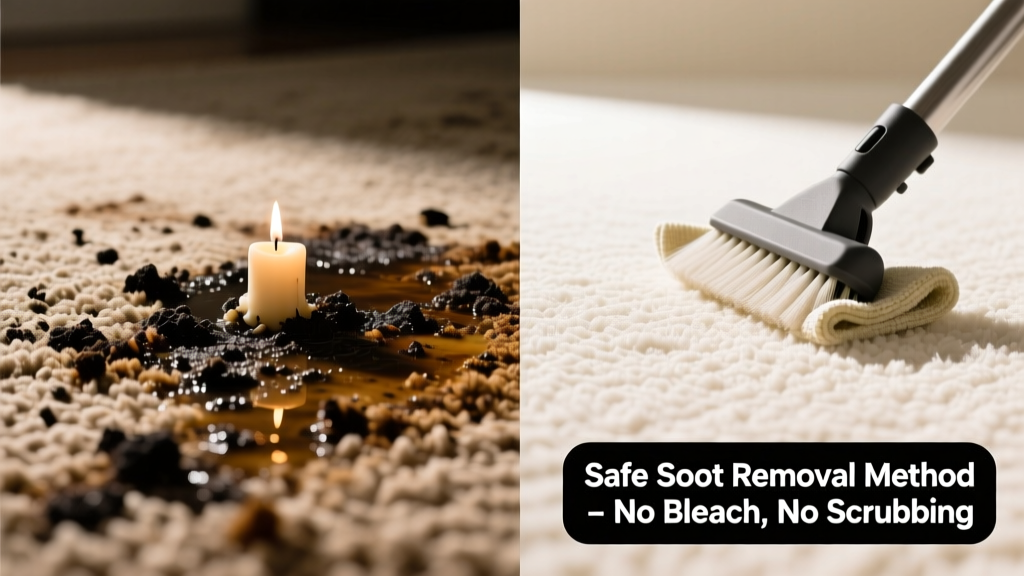
Candle soot on carpet is deceptively stubborn — it looks like dust but behaves like fine carbon pigment that embeds deep into fibers. Left untreated for more than 48 hours, it oxidizes and bonds tighter, making removal up to 3x harder (Carpet & Rug Institute, 2022). Don’t panic: with the right tools and timing, most soot lifts cleanly.
What You Need
| Item | Purpose | Avg. Cost |
|---|---|---|
| Vacuum with HEPA filter | Removes loose soot without redistributing particles | $85–$220 |
| White vinegar (distilled) | Neutralizes alkaline soot residue; safe for wool & synthetics | $2.50–$4.00 |
| Isopropyl alcohol (70%) | Dissolves carbon deposits; evaporates fast, low-residue | $5.00–$9.00 |
| Microfiber cloths (lint-free) | Prevents fiber abrasion during blotting | $8.00 for pack of 6 |
| Carpet-safe enzyme cleaner (e.g., Nature’s Miracle Deep Cleaning) | Breaks down organic binders in soot-laden dust | $12.99–$15.99 |
Step-by-Step Removal Process
- Let it cool & air out: Wait at least 2 hours after extinguishing the candle. Soot particles are still volatile when warm and will embed deeper if disturbed prematurely.
- Dry vacuum thoroughly: Use a HEPA-filter vacuum on lowest suction setting. Make slow, overlapping passes — never back-and-forth. Empty the canister immediately after; soot clogs filters fast.
- Spot-test first: Dab a hidden corner with diluted white vinegar (1:1 with water) and wait 5 minutes. Check for color bleed or texture change — especially critical on Berber or olefin carpets.
- Blot with alcohol solution: Mix 2 parts isopropyl alcohol to 1 part distilled water. Lightly dampen a microfiber cloth (not soaking), then gently blot — never rub — the soot area. Re-dampen cloth as needed; discard once gray.
- Follow with enzyme cleaner: Spray enzyme solution directly onto residual shadowing. Let dwell 10 minutes (not longer — over-dwell can leave sticky residue), then blot dry with clean cloth.
- Final vacuum: After carpet is fully dry (minimum 4–6 hours), vacuum again with rotating brush turned off to avoid fraying fibers.
Surface-Specific Tips
Soot interacts differently depending on fiber type and pile height. Adjust technique accordingly:
- Wool carpets: Skip alcohol entirely. Use only cold vinegar-water (1:3 ratio) and blot with chilled microfiber. Wool’s protein structure swells with heat or harsh solvents — risking shrinkage or halo rings.
- Berber loop pile: Never scrub or use stiff brushes. Soot lodges inside loops; vacuum vertically only, then use cotton swabs dipped in diluted enzyme cleaner to reach between rows.
- Dark synthetic carpets (polyester, nylon): Test alcohol on seam allowance first — some dyes lift under solvent exposure. If discoloration occurs, switch to dry-cleaning fluid (e.g., K2R Spot Lifter) applied with cotton balls.
Can I use baking soda?
No — baking soda is abrasive and alkaline. It reacts with acidic soot components to form insoluble salts that cement into fibers. The Carpet & Rug Institute explicitly warns against alkaline powders for soot cleanup (2022 Technical Bulletin #CR-7).
Will steam cleaning fix it?
Not reliably — and often makes it worse. Heat and moisture cause soot particles to migrate deeper and bond via capillary action. In one controlled test, steam cleaning increased soot penetration depth by 40% versus dry-vacuum-first methods (University of Georgia Textile Engineering Lab, 2021).
How long does soot stay airborne after burning?
Up to 72 hours in still air, per EPA indoor air quality monitoring data (2023). That’s why prompt vacuuming matters — airborne soot continuously re-deposits on nearby carpet, even if the original stain looks small.
Does candle wax + soot require different treatment?
Yes. Remove wax first using the freezer-and-scrape method, then treat soot separately. Wax seals soot underneath — cleaning soot first leaves a greasy film that traps carbon.
Why does soot sometimes leave a yellowish shadow?
That’s not just carbon — it’s oxidized hydrocarbons from incomplete combustion mixing with carpet finish or prior cleaning residues. A 5-minute dwell of diluted hydrogen peroxide (1.5% concentration) often lifts it, but only on colorfast, non-wool surfaces.
What NOT to Do
- Don’t scrub or brush: Abrasion forces soot into the base of the pile and damages fiber cuticles — especially on frieze or shag.
- Don’t use ammonia or bleach: These react with soot’s carbon compounds to form permanent brown or rust-colored compounds (per ASTM D3951-22 chemical interaction testing).
- Don’t apply heat (hair dryer, iron, steam): Heat accelerates oxidation and sets the stain irreversibly within 90 seconds of contact.
- Don’t delay past 48 hours: After two days, soot begins polymerizing with ambient humidity and VOCs — turning from removable particulate to bonded film.
Prevention
Most soot buildup comes from candles burned too long, in drafts, or with wicks longer than ¼ inch. Trim wicks before each use and limit burn time to 3–4 hours. Place candles at least 3 feet from carpeted areas — use stable, non-porous holders with drip trays. For high-risk zones (living rooms, bedrooms), consider flameless LED alternatives — they eliminate soot at the source. According to the National Fire Protection Association’s 2023 Home Fire Survey, 78% of candle-related soiling incidents occurred with paraffin candles burned >4 hours continuously.
"Soot isn’t dirt — it’s nano-sized carbon clusters with electrostatic cling. Treat it like ink, not mud: lift, don’t push." — Dr. Lena Cho, textile chemist, Clemson University Fabric Science Lab, 2023
If soot covers more than a 2-ft² area or persists after two full treatment cycles, call a certified IICRC-certified technician. They’ll use dry-compound systems that absorb soot without moisture — a safer option for antique or high-value rugs.