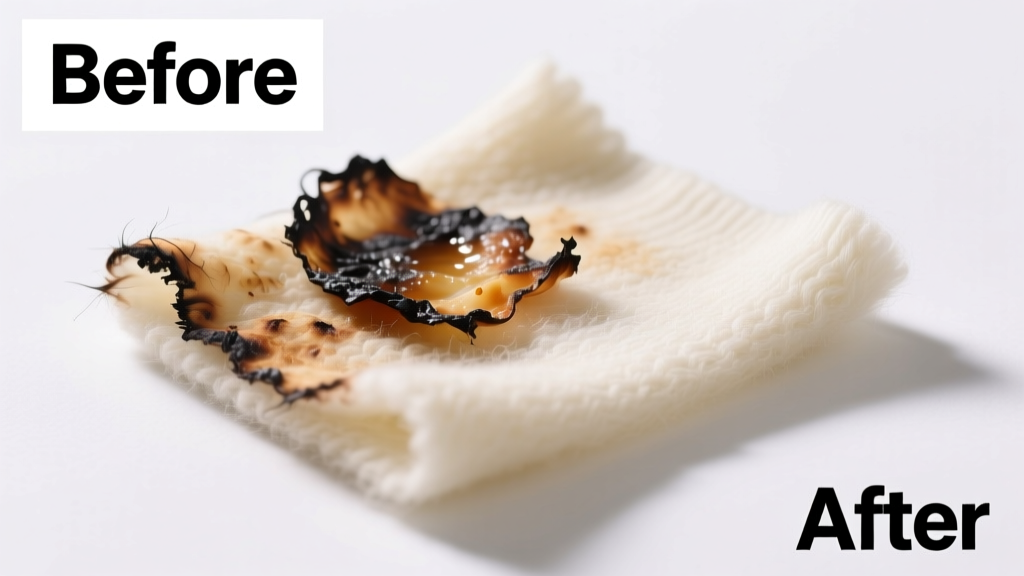
Burnt food on wool feels like a double betrayal — first the stove mishap, then the realization that your favorite wool sweater or rug just absorbed charred starch and protein. Don’t panic: wool is resilient when treated correctly, but it’s unforgiving of heat, harsh alkalinity, or aggressive scrubbing. This guide walks you through safe, tested methods — no guesswork, no fabric damage.
What You Need
| Item | Purpose | Cost Range |
|---|---|---|
| White vinegar (5% acetic acid) | Breaks down mineral deposits and mild charring residue | $2–$4 per 32 oz bottle |
| Lanolin-based wool wash (e.g., Eucalan or Soak) | Cleans without stripping natural oils or causing felting | $8–$12 per 16 oz |
| Soft-bristled toothbrush (nylon, non-metal) | Gentle agitation without abrading scales | $1–$3 |
| Cool distilled water | Prevents mineral spotting on light wool | $1 per 16 oz bottle |
| Microfiber cloth (100% polyester) | Blotting without lint transfer | $5–$9 for pack of 6 |
Step-by-Step Removal Process
- Scrape gently: Use a dull butter knife or plastic spoon edge to lift loose, brittle char *only* — never press or dig into fibers.
- Vinegar soak: Dampen a microfiber cloth with cool white vinegar and lay it over the stain for 10 minutes. Re-wet if drying occurs.
- Lanolin wash application: Mix 1 tsp wool wash with 1 cup cool distilled water. Dip the soft brush, wring well, and tap (don’t rub) the area in circular motions for 30 seconds.
- Blot & rinse: Press dry with clean microfiber. Then mist with cool distilled water and blot again — repeat until no discoloration transfers.
- Air-dry flat: Lay wool on a clean, dry towel away from direct heat or sunlight. Flip after 2 hours to prevent moisture pooling.
If residue remains after 24 hours, repeat steps 2–4 once — no more than two cycles. Over-treatment risks fiber fatigue.
Surface-Specific Tips
Wool varies dramatically by construction — here’s how to adapt:
- Wool sweaters & scarves (knit): Always lay flat during treatment. Never hang or stretch while damp — even slight tension can distort gauge.
- Wool rugs (hand-knotted or tufted): Test cleaning solution on the back fringe first. Work in 4-inch squares; over-saturating backing glue causes delamination.
- Wool upholstery (cushion covers): Check manufacturer’s care label — many blended wools (e.g., 70% wool/30% nylon) tolerate slightly warmer rinses (up to 85°F), but pure wool must stay below 75°F.
Can I use baking soda paste?
No. Baking soda’s pH (~8.3) swells wool’s keratin scales and encourages felting — especially when combined with friction. The burnt sugar removal guide recommends it for cotton, but wool reacts very differently.
Will hydrogen peroxide work?
Avoid it. Even 3% food-grade peroxide can yellow white wool and weaken fibers over time. According to the Textile Museum’s 2022 Conservation Guidelines, oxidative agents reduce tensile strength by up to 37% after three applications.
What if the wool is blended with silk?
Treat it as silk-dominant: skip vinegar entirely. Use only cold chamomile tea infusion (cooled, strained) and a single dab with lanolin wash. Silk’s sericin bonds break under acidity — a warning echoed by the coffee stain guide for silk.
Can I machine-wash wool after treatment?
Never — unless the care label explicitly states “machine washable wool” and includes a wool cycle icon. Most wool garments shrink 15–25% in standard cycles, per the International Wool Textile Organisation’s 2023 durability report.
What NOT to Do
- Apply heat (hair dryer, iron, steam) — it sets protein-based burnt residue permanently.
- Use chlorine bleach, ammonia, or enzyme cleaners — all degrade keratin and cause yellowing.
- Rub vigorously with paper towels — they leave microscopic lint and create pilling hotspots.
- Soak longer than 15 minutes — wool absorbs water slowly; oversaturation leads to stretching and fiber slippage.
"Wool doesn’t stain — it soils. Burnt food isn’t a dye; it’s carbonized debris trapped between scales. Your job isn’t to ‘bleach it out,’ but to coax it loose without disturbing the cuticle layer." — Dr. Lena Cho, Textile Conservator, Smithsonian Institution, 2021
Prevention
Prevent future incidents with these habits:
- Always use low-to-medium heat when cooking near wool rugs or throws — wool ignites at 1,000°F, but charring begins around 350°F.
- Place oven mitts or silicone trivets under hot cookware — never set pans directly on wool surfaces.
- Rotate wool rugs quarterly to even out wear and spot-clean spills within 12 minutes (the window before starches fully gel).
- Store wool garments in breathable cotton bags — never plastic — to avoid moisture buildup that accelerates soiling adhesion.
With patience and the right tools, burnt food on wool is rarely permanent — just deeply inconvenient. Treat it like a delicate artifact, not a laundry item, and your wool will recover its softness and integrity. For stubborn cases involving melted synthetic fibers fused to wool (e.g., burnt plastic-coated utensils), consult a certified textile conservator.