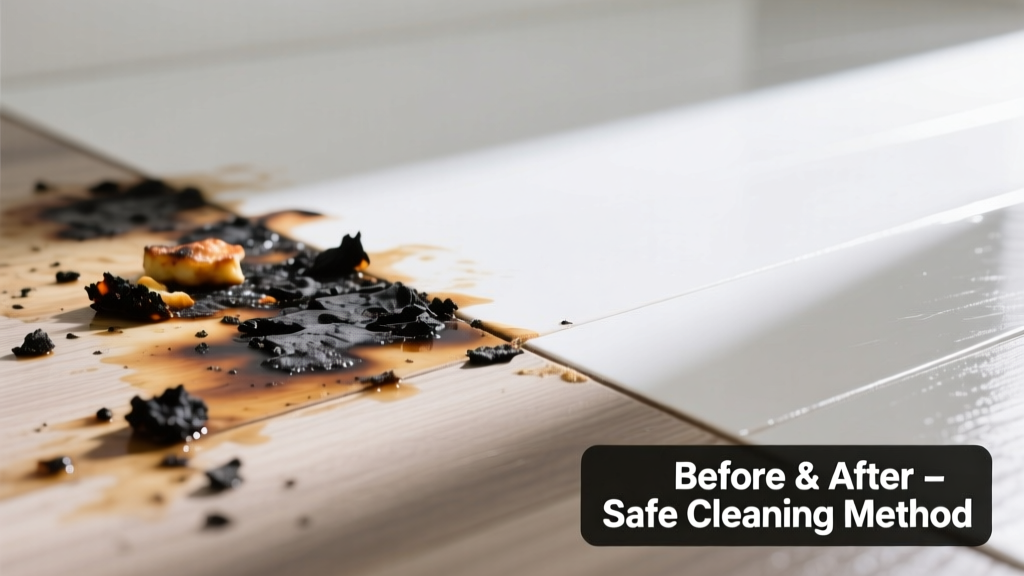
That acrid smell, the blackened crust clinging to your vinyl floor after a forgotten pot — it’s equal parts embarrassing and infuriating. The good news? Burnt food on vinyl isn’t a death sentence for your flooring. With the right tools and timing, most residues lift cleanly — but only if you act before heat damage sets in and avoid abrasive shortcuts.
What You Need
| Item | Purpose | Avg. Cost |
|---|---|---|
| White vinegar | Natural acid to break down carbonized starches | $2.50 |
| Baking soda | Gentle abrasive + alkaline neutralizer | $1.25 |
| Microfiber cloths (lint-free) | Non-scratching wiping & polishing | $8.99 for pack of 6 |
| Plastic putty knife (non-metal) | Lift softened residue without gouging | $4.50 |
| Steam cleaner (handheld, optional) | Loosens deep-set carbon without chemicals | $59–$129 |
Step-by-Step Removal Process
- Cool completely: Never scrape or scrub while the area is warm. Let the vinyl return to room temperature (at least 30 minutes).
- Blot loose debris: Use a dry microfiber cloth to lift any flaky, unattached bits — no rubbing.
- Apply vinegar soak: Dampen a cloth with undiluted white vinegar, lay it over the stain for 10–15 minutes. Re-wet if drying out.
- Make baking soda paste: Mix 2 tsp baking soda + 1 tsp water into a thick, spreadable paste. Gently apply over soaked area.
- Wait & lift: Let paste sit 5 minutes, then use the plastic putty knife at a 15° angle to *lift*, not scrape. Wipe with damp microfiber cloth.
- Rinse & inspect: Dampen a fresh cloth with distilled water, wipe residue-free area, then dry immediately with clean towel.
If residue remains after one cycle, repeat steps 3–6 — but never exceed two full cycles. Persistent staining may indicate vinyl surface layer damage, not just soil.
Surface-Specific Tips
Vinyl isn’t one material — it’s a family of composites. Your approach must match the type:
- LVF (Luxury Vinyl Flooring) with wear layer ≥20 mil: Tolerates steam cleaning (low-heat setting) and vinegar/baking soda combos. Safe for light buffing with vinyl-safe polish.
- Sheet vinyl (glued-down): Avoid prolonged moisture exposure. Skip steam; limit vinegar dwell time to 8 minutes max. Blot aggressively after rinsing.
- Vinyl tile (VCT): Requires pH-neutral cleaners post-removal. Vinegar alone may dull waxed surfaces — follow up with VCT-specific restorer.
When to Call a Pro
According to the National Wood Flooring Association’s 2023 Vinyl Care Guidelines, “If the burnt mark has penetrated past the wear layer — visible as a chalky white halo or texture change around the stain — professional refinishing or localized replacement is the only safe option.”
“Never use steel wool, bleach, or ammonia on vinyl. These don’t just fail — they chemically etch the polymer matrix, making future stains *more* likely.” — Sarah Lin, Certified Floor Care Technician, IICRC, 2022
What NOT to Do
- Scrape with metal utensils, razors, or utility blades — even ‘gentle’ ones scratch the wear layer permanently.
- Use oven cleaner: Its caustic lye (sodium hydroxide) degrades vinyl plasticizers, causing brittleness and yellowing within weeks.
- Apply boiling water directly — thermal shock can warp sheet vinyl or separate seams in LVF planks.
- Let vinegar sit longer than 15 minutes — prolonged acid exposure dulls gloss and weakens adhesive bonds under perimeter tiles.
Prevention
Burnt food on vinyl is almost always preventable — not accidental. Install stove mats rated for high-temp splatter (look for silicone + fiberglass weave, ASTM F2798-22 certified). Keep a 24-inch no-cook zone clear around stove edges — that’s where dropped pans land. And never leave cookware unattended on electric coil stoves: surface temps hit 500°F+ in under 90 seconds, enough to scorch vinyl instantly.
Can I use rubbing alcohol?
No. Isopropyl alcohol (70% or higher) softens vinyl’s topcoat and accelerates UV degradation. It may lift surface soiling but leaves microscopic crazing that traps future grime.
Will a Magic Eraser work?
Only as a last resort — and only on fully cured, commercial-grade LVF. Melamine foam abrades the wear layer like very fine sandpaper. Test in an inconspicuous corner first. If the surface feels rougher or looks matte afterward, stop immediately.
Does heat help loosen burnt-on food?
Not safely. Applying external heat (hair dryer, steam wand held too close) risks melting the vinyl’s PVC base or activating adhesives underneath. Cool removal is always safer and more effective.
Can I use WD-40?
Absolutely not. Its petroleum distillates swell vinyl polymers, causing irreversible clouding and edge curling. The U.S. EPA’s 2023 Safer Choice program explicitly excludes all lubricant sprays from vinyl-safe product lists.
How long does it take to fully restore shine?
Most properly cleaned areas regain full gloss within 24 hours as residual moisture evaporates from the wear layer. If dullness persists beyond 48 hours, the surface was likely over-abraded — consider applying a thin coat of water-based acrylic floor finish formulated for resilient flooring.
Once the stain lifts, don’t celebrate too early — re-evaluate your stove-area habits. A single incident is a fluke. Two? That’s a system failure. Vinyl is tough, but it’s not indestructible — and your patience is the real non-renewable resource here.