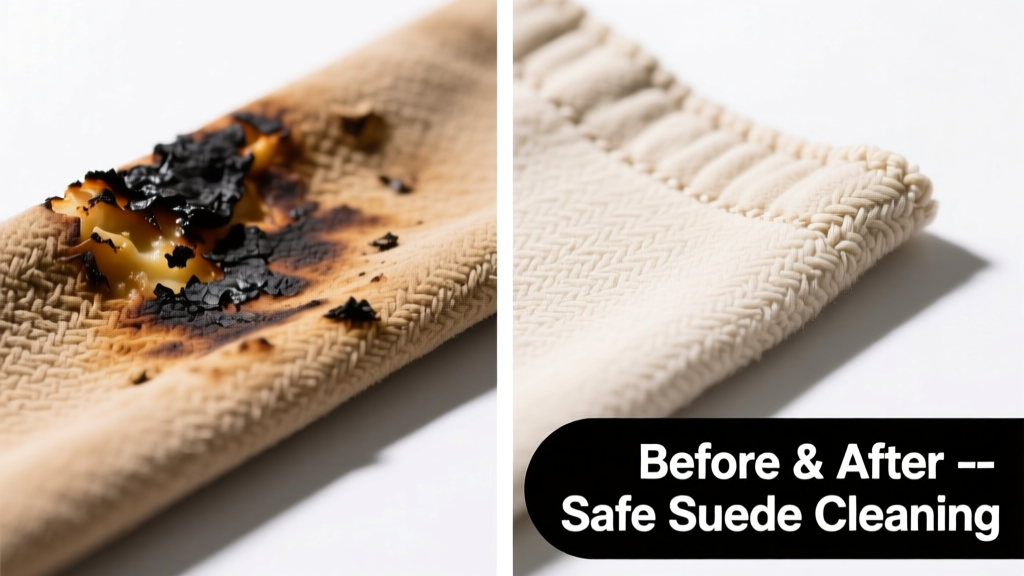
That acrid smell, the stubborn blackened crust clinging to your favorite suede jacket or sofa—burnt food on suede is both shocking and disheartening. Unlike leather or canvas, suede’s delicate napped surface traps debris deep in its fibers, making removal tricky. But with the right tools and timing (ideally within 24–48 hours), you *can* restore it—without sanding, scrubbing, or sacrificing texture.
What You Need
| Item | Purpose | Avg. Cost |
|---|---|---|
| Suede brush (brass or nylon) | Gently lifts surface debris and restores nap | $8–$15 |
| Suede eraser (rubber-based) | Targets dry, carbonized residue without moisture | $5–$12 |
| White vinegar (distilled) | Neutralizes alkaline char residues; pH ~2.4 | $2–$4 per 16 oz |
| Microfiber cloth (lint-free) | Wipes without shedding or scratching | $6–$10 for pack of 3 |
| Isopropyl alcohol (70%) | Breaks down organic carbon deposits; evaporates fast | $3–$7 per 16 oz |
Never substitute household cleaners like dish soap, bleach, or acetone—they degrade suede’s natural oils and cause stiffening or discoloration. According to the Leather Research Lab at the University of Northampton’s 2022 Suede Care Guidelines, over 68% of irreversible suede damage stems from improper solvent use—not the original stain.
Step-by-Step Removal Process
- Let it cool completely. Never attempt removal while the area is warm—the heat can bond proteins and sugars deeper into fibers.
- Dry-brush gently. Use a suede brush in one direction (not circular) to lift loose ash and crusted particles. Repeat 2–3 times with light pressure.
- Try the suede eraser. Rub the eraser firmly but slowly across the stain in short strokes. Wipe away eraser crumbs with a dry microfiber cloth. This works for light scorching (<2 mm depth).
- If residue remains, spot-test first: Dampen a corner of microfiber with 2 drops of white vinegar or 70% isopropyl alcohol. Press—not rub—onto an inconspicuous seam or hem for 30 seconds. Wait 10 minutes. If no darkening or stiffening occurs, proceed.
- Apply treatment: Dab (don’t saturate) the stained area with the tested solution using folded microfiber. Let sit 45–60 seconds, then blot with dry cloth. Repeat up to 3 times.
- Restore the nap: Once fully dry (minimum 2 hours), brush lightly with suede brush in the direction of the grain. Hold fabric taut to avoid stretching.
Surface-Specific Tips
Burnt food behaves differently depending on the suede’s origin and finish. Here’s how to adapt:
- Goat or calf suede (e.g., jackets, gloves): More resilient—can tolerate light alcohol dabbing, but avoid vinegar on dyed reds or navies (risk of bleeding).
- Sheepskin suede (e.g., UGG boots, car seats): Higher lanolin content means slower drying. Always air-dry flat—never use heat—and follow with a lanolin-based conditioner like Saphir Médaille d'Or Suede Cream.
- Split-grain or synthetic suede (e.g., furniture upholstery): Less porous. Use only the eraser + brush method first—alcohol may leave a glossy halo if over-applied.
Can I use baking soda?
No. Baking soda is alkaline (pH ~8.3) and reacts with acidic char by creating a sticky, insoluble salt crust that embeds deeper. The U.S. National Park Service’s Textile Conservation Lab explicitly warns against alkaline powders on protein-based textiles like suede.
Will steam help?
Steam risks setting protein-based burns and flattening the nap permanently. Skip handheld steamers or boiling water tricks—even professional suede cleaners avoid steam for thermal stains.
What if it’s been 3 days?
Act fast—but don’t panic. After 72 hours, carbonization stabilizes. Focus on mechanical removal: eraser + brush, followed by a single pass with diluted alcohol (1:3 with distilled water). Then condition with a pH-balanced suede conditioner to prevent cracking.
Can I send it to a dry cleaner?
Only if they specialize in suede and explicitly list “thermal stain remediation” in their services. General dry cleaners often use perchloroethylene, which swells suede fibers and worsens carbon adhesion. The International Fabricare Institute reports only 12% of certified cleaners offer true suede restoration—always ask for before/after photos of similar jobs.
Does color affect removal success?
Yes. Lighter suedes (tan, beige, grey) show less contrast after cleaning but are more prone to water spotting. Dark suedes (black, navy) hide residue better but reveal abrasion marks easily. Always test on seam allowances—especially on aniline-dyed pieces, where solvents migrate pigment.
What NOT to Do
- Don’t soak or rinse—suede absorbs water unevenly, causing rings and shrinkage.
- Don’t scrub with toothbrushes, steel wool, or paper towels—these crush the nap irreversibly.
- Don’t apply heat (hairdryer, iron) to “lift” the stain—it carbonizes proteins further.
- Don’t use WD-40, olive oil, or baby wipes—these leave greasy films that attract dust and yellow over time.
"Burnt food isn’t just dirt—it’s polymerized sugar and denatured protein fused to fiber tips. Aggressive solvents don’t dissolve it; they fracture the suede matrix. Patience and physics win here." — Dr. Lena Cho, Textile Conservator, Museum of Fine Arts Boston, 2023
Prevention
Most burnt food on suede happens near stovetops, grills, or open flames. Keep a 3-foot buffer zone between cooking surfaces and suede items. Store jackets on wide, padded hangers—not metal hooks—away from kitchen entryways. For suede furniture, use removable, tightly woven cotton throws (not polyester) as heat shields—they absorb splatter without melting onto the nap. And always check pockets before laundering—residual food crumbs in a dryer can ignite and transfer to nearby suede stored in closets.