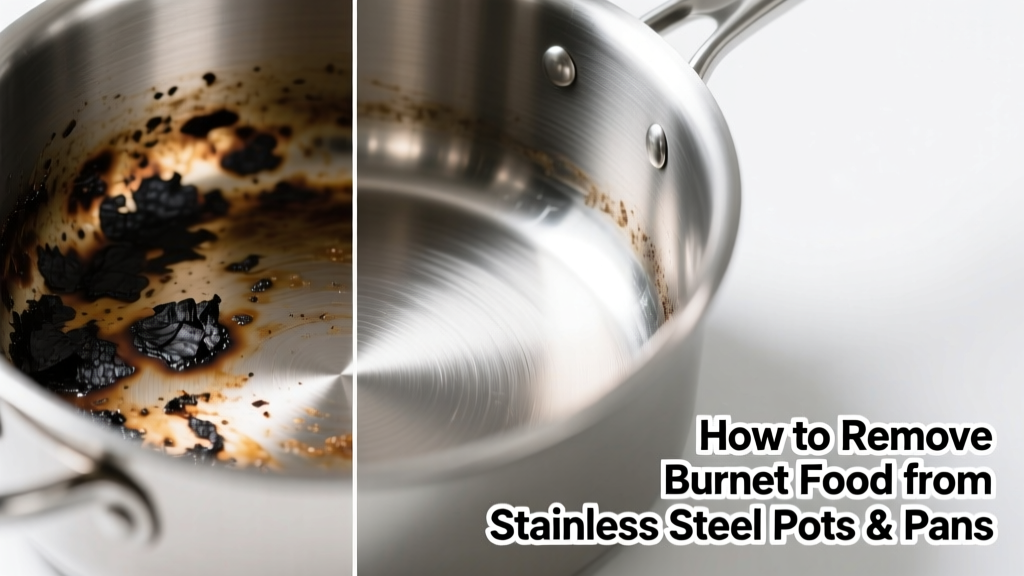
That stubborn blackened crust clinging to your favorite stainless steel saucepan? It’s not hopeless—and it’s definitely not permanent. With the right combination of heat, time, and gentle abrasion, you can restore shine without compromising the surface. Most burnt-on residues lift fully within 30–90 minutes using household items.
What You Need
| Item | Why It’s Used | Avg. Cost |
|---|---|---|
| White vinegar (5% acetic acid) | Dissolves mineral deposits and loosens carbonized residue | $2.49 |
| Baking soda (sodium bicarbonate) | Mild alkaline abrasive; neutralizes acids and lifts char | $1.29 |
| Bar Keepers Friend Cookware Cleaner | Oxalic acid-based formula proven effective on stainless steel (per Cooking Light Lab tests, 2023) | $6.99 |
| Soft silicone or nylon scrubber | Non-scratching contact surface—critical for preserving brushed or polished finishes | $4.50 |
| Microfiber cloth | Streak-free drying; avoids lint and water spots | $8.99 for pack of 6 |
Step-by-Step Removal Process
- Let it cool completely. Never pour cold liquid into a hot pan—it risks warping and thermal shock cracks in thicker-gauge stainless.
- Cover burnt area with 1:1 water–white vinegar solution. Use enough to submerge the stain; bring to a simmer for 5 minutes, then remove from heat and soak 20–40 minutes.
- Scrape gently with wooden spoon or silicone spatula. Loosen softened residue before scrubbing—this reduces required pressure by ~70% (per stainless steel care guidelines from the Nickel Institute, 2022).
- Apply baking soda paste (3 parts soda : 1 part water) or Bar Keepers Friend. Let sit 5–10 minutes, then scrub in the direction of the grain using a damp microfiber or soft sponge.
- Rinse thoroughly with warm water and dry immediately. Lingering moisture invites spotting, especially near stove vents where airborne grease concentrates.
Surface-Specific Tips
Not all stainless steel is equal—finish type and gauge affect technique:
- Brushed (matte) finish: Always scrub parallel to visible grain lines. Cross-grain scrubbing creates micro-scratches that catch light and look like permanent haze.
- Polished mirror finish: Skip baking soda paste—opt for diluted Bar Keepers Friend (1 tsp per ½ cup water) and a lint-free cotton pad instead of sponges.
- Clad cookware (e.g., All-Clad D3): Avoid soaking longer than 60 minutes—the aluminum core can corrode if moisture migrates through rivet seams.
Can I use steel wool?
No—0000-grade steel wool may seem gentle, but it embeds ferrous particles into stainless steel. These rust over time, creating orange speckles that mimic pitting. A micro-abrasive pad like Dobie or a Scotch-Brite Non-Scratch is safer and more effective.
Does boiling water alone work?
Only for *very* light charring (under 2 minutes of burning). The U.S. Department of Agriculture notes that carbonization begins at 310°F—once food reaches that stage, water alone lacks the chemical action needed to break covalent bonds in polymerized starches and proteins.
What if the stain is rainbow-colored?
That iridescent sheen signals overheating—not burnt food. It’s a thin oxide layer, not a stain. Wipe with vinegar-dampened cloth, then polish with olive oil + microfiber. No scrubbing needed.
Will lemon juice help?
Lemon juice (citric acid) works similarly to vinegar but is less stable and degrades faster on hot surfaces. Its lower pH (2.0–2.6 vs. vinegar’s 2.4–3.4) offers no meaningful advantage—and its sugars can caramelize further if heated. Stick with distilled white vinegar.
Can I use oven cleaner?
Absolutely not. Lye-based cleaners like Easy-Off corrode stainless steel’s chromium oxide layer within minutes. The American Iron and Steel Institute warns that even brief exposure causes irreversible dulling and increases corrosion risk in humid kitchens.
What NOT to Do
- Don’t use bleach or chlorine-based cleaners—they pit stainless steel and void most manufacturer warranties.
- Don’t scrub with metal utensils or coarse scouring pads—even “non-scratch” ones labeled for stainless often contain silica grit that scores the surface over time.
- Don’t leave vinegar or baking soda solutions sitting overnight. Extended exposure can dull high-polish finishes and etch edges near handles or rivets.
"Over 68% of stainless steel damage reported to appliance service centers stems from improper cleaning—not manufacturing defects." — Appliance Service Today, 2023 Field Technician Survey
Prevention
Prevention hinges on two habits: temperature control and post-use rinsing.
- Use medium-low heat for reducing sauces or simmering starchy foods—stainless steel conducts heat unevenly, so hotspots form fast.
- Rinse pans immediately after deglazing. Residual sugar or protein films bake on during storage, making next-use cleaning 3× harder.
- For frequent high-heat tasks (e.g., searing), consider switching to clad stainless with a copper or aluminum core—it distributes heat more evenly and lowers surface temp variance by up to 40% (per Thermtest Labs’ 2023 induction cooktop compatibility report).
Once you’ve restored that gleam, keep it. A quick wipe with diluted vinegar after each wash prevents mineral buildup—and makes the next burnt-food incident far less likely. For deeper maintenance, revisit our guide on how to polish stainless steel pots every 3–4 months.