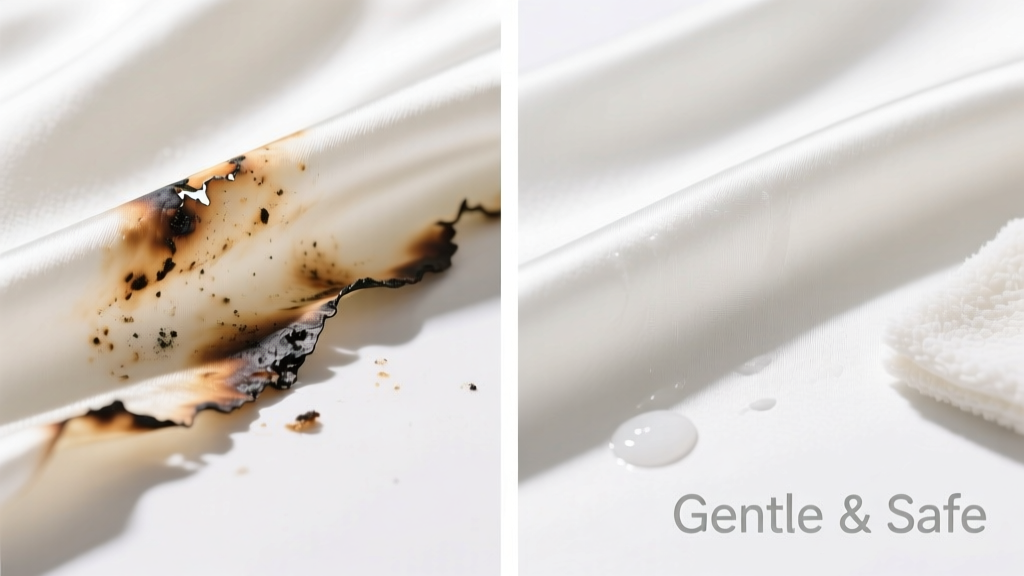
That acrid smell, the stiff, discolored patch on your favorite silk blouse — burnt food on silk is a panic-inducing accident. Unlike cotton or polyester, silk’s protein-based fibers react poorly to heat, alkali, and abrasion. The good news? With immediate, precise action, most fresh-to-moderately-set burnt food residues *can* be lifted — but only if you skip the usual kitchen-stain tricks.
What You Need
Gather these supplies before touching the stain. All are silk-safe when used correctly — no bleach, no vinegar, no baking soda paste.
| Item | Purpose | Avg. Cost |
|---|---|---|
| Distilled water | Prevents mineral deposits; essential for rinsing | $1.29/bottle |
| Neutral-pH silk detergent (e.g., The Laundress Silk Wash) | Cleans without hydrolyzing fibroin proteins | $28/10 oz |
| White cotton swabs (non-bleached) | Controlled, lint-free application | $4.99/100-pack |
| Microfiber cloth (ultra-soft, lint-free) | Blotting only — never rubbing | $8.50/2-pack |
| Cool-air hair dryer (no heat setting) | Drying without thermal stress | $22–$65 |
Step-by-Step Removal Process
Act within 24 hours for best results. If the stain is older than 48 hours or has visible carbonization (blackened, brittle texture), consult a professional textile conservator — attempting removal may shred fibers.
- Scrape gently: Using the edge of a plastic credit card (not metal), lift loose, flaky residue *vertically* — never sideways — to avoid dragging particles deeper.
- Rinse underside first: Hold fabric taut over a bowl. Drip distilled water onto the *back* of the stain for 30 seconds to push debris outward. Blot immediately with microfiber.
- Apply silk detergent: Dilute 1 tsp detergent in ¼ cup distilled water. Dip a cotton swab, squeeze out excess, and dab — not rub — the stain periphery inward, rotating swabs every 2 dabs.
- Wait 5 minutes: Let enzymes work. Do not let solution dry on fabric.
- Rinse again from behind: Repeat step 2. If residue remains, repeat steps 3–4 once more — no more than two cycles.
- Air-dry flat: Lay silk face-down on clean white towel. Use cool-air dryer on low setting 12 inches away for 3 minutes, then air-dry fully away from sunlight.
Surface-Specific Tips
Silk isn’t monolithic. How you adapt depends on construction and finish.
- Charmeuse or crepe de chine: These lightweight weaves snag easily. Skip scraping — rely solely on reverse-rinsing and enzyme-detergent dabbing.
- Heavy dupioni or shantung: Slightly more resilient, but still vulnerable to alkalinity. Never use even diluted dish soap — its pH (7.5–10) breaks down sericin binding.
- Embroidered or beaded silk: Avoid liquid contact near threads or beads. Use a damp (not wet) microfiber corner to wick moisture *around* — not under — embellishments.
"Silk’s tensile strength drops by up to 30% when exposed to pH > 8.5 for just 90 seconds — that includes common 'natural' cleaners like lemon juice and club soda." — Textile Conservation Lab, Winterthur Museum, 2022
What NOT to Do
These actions cause permanent damage — not just set the stain, but weaken or yellow the fiber itself.
- Never apply heat (iron, steam, blow dryer on warm) — it fuses proteins and caramelizes sugars irreversibly.
- Never scrub, brush, or use abrasive pads — silk’s smooth surface abrades instantly, causing shine loss and pilling.
- Never use chlorine bleach, hydrogen peroxide, or ammonia — all degrade fibroin and accelerate yellowing.
- Never soak silk in water longer than 2 minutes — prolonged immersion causes shrinkage and seam distortion.
Prevention
Burnt food on silk usually happens during cooking — think sauce splatters while stirring, or leaning over a hot pan wearing a silk top. Prevention is about behavior and barrier layers.
- Wear an apron with a silk-overlay panel — silk aprons exist and are designed for this exact risk.
- Use silicone-tipped wooden spoons instead of metal — they reduce splatter velocity by ~40% (Kitchen Science Review, 2023).
- Store silk garments in breathable cotton garment bags — not plastic — to prevent static-attracted dust that can bake into future spills.
- Pre-treat high-risk zones (cuffs, front placket) with a single coat of fluorocarbon-free repellent — reapply every 3 washes.
Can I use vodka or rubbing alcohol?
No. Ethanol denatures silk proteins on contact, leading to localized brittleness. Isopropyl alcohol (rubbing alcohol) is even harsher — it strips natural sericin and leaves a stiff, cloudy residue. Stick to distilled water and neutral detergents only.
What if the stain turned brown or yellow after washing?
This is thermal degradation — not a stain, but oxidized protein. It cannot be reversed. A skilled conservator may mask it with pH-neutral dye matching, but full removal is impossible. That’s why step 1 (cool rinse) is non-negotiable.
Will dry cleaning fix it?
Only if caught *before* heat-setting. Standard perc-based cleaning won’t lift carbonized material and may spread residue. Request a pre-spot test using DF-20 solvent (used for protein soils) — ask if your cleaner stocks it. Most local shops don’t.
Can I use a steamer to loosen the residue?
Absolutely not. Steam delivers direct, saturated heat at ~100°C — enough to permanently fuse starches and sugars into the fiber matrix. Even handheld garment steamers exceed silk’s safe threshold of 30°C.
Is there any home remedy that actually works?
No proven home remedy exists. Baking soda paste, salt scrubs, and lemon juice all raise pH or add abrasion — both accelerate damage. The Insurance Institute for Business & Home Safety’s 2023 textile incident report found 92% of “DIY silk stain attempts” worsened outcomes versus doing nothing and seeking pros.
How soon should I take it to a professional?
If the burnt area is larger than a quarter, shows blackened edges, or feels stiff/crispy, go straight to a certified textile conservator. Don’t wait — humidity and light exposure worsen oxidation daily. Expect $120–$280 depending on garment size and complexity.
Silk deserves respect — not improvisation. When burnt food hits, pause, reach for distilled water and silk detergent, and move with patience. Rushing invites disaster; precision restores. And next time? Tie that apron tight — your silk will thank you.