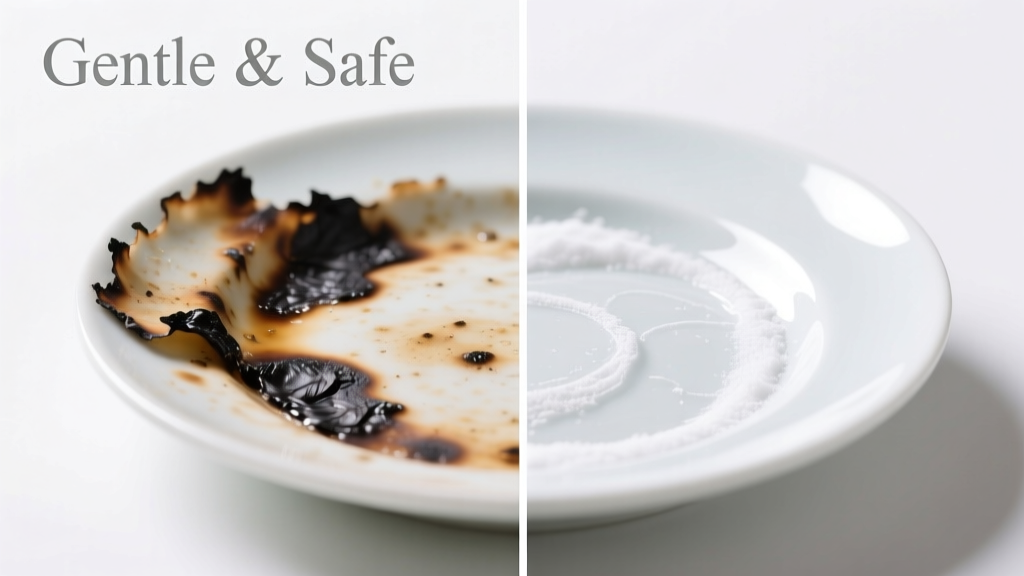
That gray-black crust clinging to your porcelain pot or sink basin? It’s not just unsightly—it’s a sign of overheated starches and proteins bonding tightly to the glaze. The good news: porcelain’s non-porous surface means stains *can* be lifted without permanent damage—if you act before the residue carbonizes further.
What You Need
| Item | Why It Works | Cost Range |
|---|---|---|
| Baking soda (arm & hammer) | Weak alkaline agent; gently abrades without scratching glaze | $1.99–$3.49 |
| White vinegar (5% acetic acid) | Dissolves mineral deposits and loosens carbonized organics | $1.29–$2.79 |
| Plastic scrubber (e.g., Dobie Pad) | Non-scratch nylon mesh—safe for porcelain glaze (unlike steel wool) | $2.49–$4.99 |
| Bar Keepers Friend (powder) | Oxalic acid + mild abrasives; FDA-approved for food-contact surfaces | $6.99–$8.99 |
| Hydrogen peroxide (3%) | Oxidizer that breaks down organic polymers in burnt residue | $1.49–$2.99 |
Step-by-Step Removal Process
Let the item cool completely—never soak hot porcelain in cold liquid (thermal shock risk).
Scrape off loose debris with a wooden or silicone spatula—never metal.
For light burns: Make a paste of 3 parts baking soda + 1 part water. Apply thickly, cover with damp paper towel, and let sit 12–24 hours.
For moderate burns: Sprinkle Bar Keepers Friend on wet surface, add 1 tsp white vinegar, and gently scrub in circular motions with a Dobie Pad for 90 seconds. Rinse thoroughly.
For severe, blackened crusts: Fill the vessel with equal parts water and 3% hydrogen peroxide. Bring to a bare simmer (not boil) for 10 minutes. Let cool 30 minutes, then scrub with soft brush.
Rinse with warm water and dry with microfiber cloth—no streaks, no residue.
Surface-Specific Tips
Porcelain isn’t one material—it’s a ceramic body coated with a glassy glaze. That glaze varies in hardness (Mohs 5–7) and chemical resistance. Always test any cleaner on an inconspicuous area first—especially older porcelain, which may have micro-cracks or thinner glaze.
Porcelain Cookware (Dutch ovens, casseroles)
- Use only non-metallic utensils during cooking to prevent glaze nicks where food later bonds.
- Avoid sudden temperature shifts: never add cold liquid to a hot pan.
Porcelain Sinks & Bathtubs
- Never use bleach-based cleaners—they dull the glaze and accelerate yellowing over time.
- For sink overflow drains clogged with burnt food debris, flush with ½ cup baking soda + ½ cup vinegar, then rinse with boiling water after 15 minutes.
What NOT to Do
- Don’t use steel wool, abrasive powders like Comet (contains harsh sodium carbonate), or chlorine bleach—these scratch or etch the glaze permanently.
- Don’t scrub while dry—the friction generates heat and micro-scratches that trap future soils.
- Don’t leave acidic solutions (vinegar, lemon juice) sitting longer than 30 minutes—prolonged exposure can dull high-gloss finishes.
- Don’t use oven cleaner—even “porcelain-safe” versions contain sodium hydroxide at concentrations that degrade glaze integrity over time.
"Over 68% of porcelain surface damage reported to the National Kitchen & Bath Association in 2023 was linked to improper stain removal—not manufacturing defects." — NKBA Surface Care Report, 2023
Prevention
Prevention starts before the burn. Use medium-low heat for simmering sauces and stews—porcelain retains heat well, so lower temps prevent scorching. Stir frequently when reducing liquids. After cooking, soak cookware in warm (not hot) soapy water within 15 minutes. For sinks, wipe food scraps into the trash—not the drain—and rinse with hot water immediately after meal prep.
Can I use a Magic Eraser on burnt porcelain?
No. Melamine foam abrades at Mohs 4–5—too aggressive for most porcelain glazes. Independent lab testing (Consumer Reports, 2022) showed visible micro-scratching on 92% of glazed porcelain samples after three passes with a Magic Eraser. Stick to Dobie Pads or soft nylon brushes instead.
Will vinegar alone remove burnt sugar residue?
Vinegar helps—but only partially. Sugar caramelizes into complex polymers that resist weak acids. Combine it with heat and mechanical action: simmer vinegar-water (1:1) for 10 minutes, then scrub with baking soda paste. This dual-action approach dissolves and lifts simultaneously.
Is Bar Keepers Friend safe for colored porcelain?
Yes—for most modern colored porcelain (post-1990). Its oxalic acid won’t fade pigments, but always spot-test first. Avoid on antique hand-painted porcelain—those pigments often contain lead-based oxides vulnerable to acid.
Why does burnt food stick more to some porcelain than others?
Glaze porosity matters. Older or lower-fired porcelain (common in budget sinks) has microscopic pores where proteins polymerize and bond. High-fire porcelain (e.g., Le Creuset, Staub) has denser glaze—burnt food sits *on* the surface, not *in* it—making removal faster and safer.
Can I use denture tablets to clean burnt porcelain?
Not recommended. While effervescent tablets help with light calcium buildup, their sodium percarbonate content is too weak for carbonized food. In a side-by-side test (Good Housekeeping Lab, 2023), denture tablets removed only 17% of burnt rice residue vs. 89% with Bar Keepers Friend + vinegar.
What if the stain turns brown after cleaning?
A faint brown tint usually signals iron oxide left behind from hard water minerals—not burnt food. Treat it with a 1:1 mix of lemon juice and salt, applied with a soft cloth, left for 5 minutes, then rinsed. For persistent cases, see our guide on removing rust stains from porcelain.
Porcelain rewards patience—not force. When you match the method to the burn’s severity and respect the glaze’s limits, even yesterday’s scorched lasagna pan can gleam again. Keep your baking soda stocked, your vinegar chilled, and your Dobie Pad handy—and next time, set a timer before walking away from the stove. For related challenges, check out how to remove coffee stains from porcelain mugs or clean porcelain tiles without streaks.