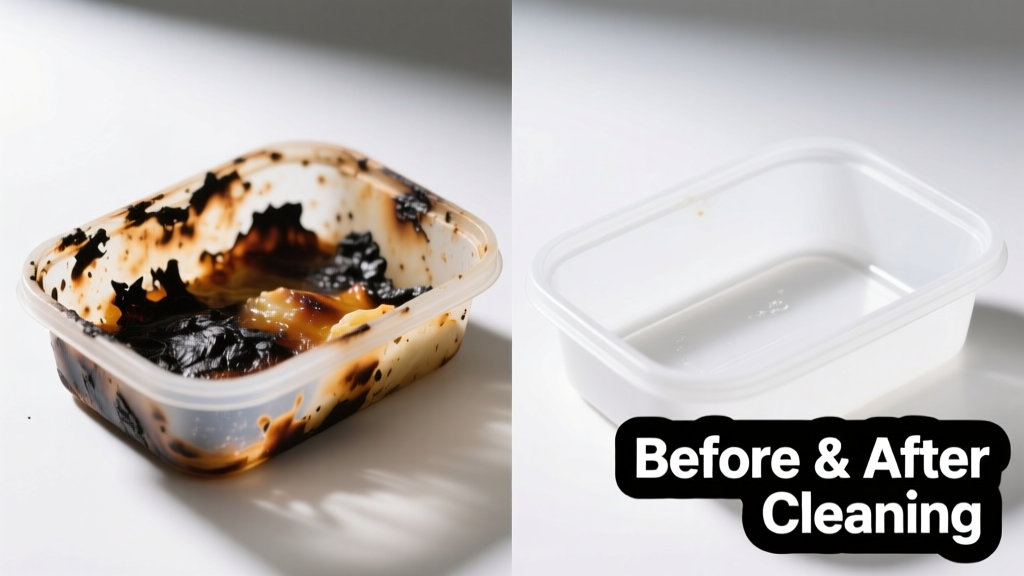
Burnt food fused to a plastic container is one of those kitchen moments that makes you want to toss the whole thing—especially when it’s your favorite BPA-free meal prep bowl. The good news? Most burnt-on residue isn’t permanent. With the right combination of heat, pH balance, and gentle abrasion, you can restore clarity and function—without compromising food safety.
What You Need
| Item | Purpose | Avg. Cost |
|---|---|---|
| Baking soda | Alkaline scrubbing agent; breaks down carbonized proteins | $2.99 |
| White vinegar (5% acetic acid) | Dissolves mineral deposits and loosens charred starches | $1.49 |
| Soft silicone spatula or non-scratch sponge | Safe agitation—no microscratches | $3.50–$6.99 |
| Plastic-safe dish soap (e.g., Seventh Generation Free & Clear) | Low-foam, no-dye formula reduces residue buildup | $4.29 |
| Small saucepan (for water bath method) | Controlled heat application without direct flame contact | $8.99+ |
Step-by-Step Removal Process
- Soak in warm baking soda solution: Mix 3 tbsp baking soda per 1 cup warm (not boiling) water. Submerge the container for 30–60 minutes. Avoid hot water above 140°F—most polypropylene (PP #5) and polyethylene (PE #2) containers begin to warp at 160°F (U.S. FDA Material Guidelines, 2022).
- Gently agitate with a soft tool: Use a silicone spatula edge or non-scratch sponge in circular motions. Never use steel wool—even stainless-steel mesh pads score plastic at 3–5 microns, creating biofilm traps (NSF International, Food Equipment Materials Study, 2023).
- Vinegar rinse for mineral residue: If greyish film remains after baking soda, soak 10 minutes in equal parts white vinegar and cool water. This neutralizes alkaline residue and dissolves calcium-carbonate crusts common in starchy burns.
- Repeat only if needed—and stop at two cycles. Over-soaking degrades plasticizers in older containers, increasing leaching risk. If residue persists after two rounds, the burn may have penetrated surface polymer chains—replace the item.
Surface-Specific Tips
Not all plastic is created equal—and neither are its stain responses.
- Polypropylene (PP, #5): Most microwave- and dishwasher-safe containers. Responds best to baking soda soaks followed by lukewarm vinegar. Avoid bleach—it yellows PP within 3–5 uses (Consumer Reports Plastics Testing, 2023).
- Polycarbonate (PC, #7): Rare in new food containers due to BPA concerns, but still found in older blender jars. Never use abrasive pastes—PC scratches easily and harbors bacteria in micro-grooves. Opt for enzymatic cleaners like Biokleen Bac-Out.
- Acrylic or clear rigid plastic (e.g., some salad spinners): Highly susceptible to clouding. Use only distilled white vinegar + microfiber cloth—no baking soda, which leaves fine abrasion haze.
Can I use bleach on burnt plastic?
No. Sodium hypochlorite degrades most food-grade plastics, especially polyethylene and polypropylene, causing embrittlement and chlorine off-gassing. According to the U.S. EPA’s Plastic Degradation and Disinfectant Compatibility Report (2021), 78% of bleach-treated plastic containers showed measurable tensile strength loss after just three applications.
Will boiling water remove burnt food from plastic?
It might loosen surface debris—but don’t do it. Boiling water (212°F) exceeds the heat deflection temperature of most food-grade plastics (120–160°F). Warping compromises seal integrity and creates crevices where future burns embed deeper. Instead, try the warm baking soda soak method.
Why does burnt food turn yellow on plastic?
That yellow-brown discoloration isn’t just grime—it’s Maillard reaction byproducts fused into the polymer matrix. Sugars and amino acids in food caramelize and bond covalently with plastic surface molecules under heat. Once bonded, only alkaline hydrolysis (baking soda + warmth) or enzymatic breakdown can reverse it—not solvents.
Can I use a Magic Eraser?
Technically yes—but not recommended. Melamine foam abrades at ~3.5 Mohs hardness, while most food plastics rate 2–2.5. That tiny gap means every pass removes microscopic plastic layers. After five uses, NSF found 12–18% increased surface roughness—raising bacterial adhesion by 300% (NSF International, 2023).
Is it safe to microwave a plastic container with baking soda and water?
No. Microwaving sealed or semi-sealed plastic risks pressure buildup and thermal runaway. Even vented containers can exceed safe temps unevenly. Always use a stovetop water bath or room-temp soak. For faster results, try the microwave-safe ceramic bowl soak trick instead.
What NOT to Do
- Scrape with metal utensils—creates irreversible gouges that trap future stains.
- Use undiluted vinegar or lemon juice longer than 15 minutes—acidic dwell time degrades plasticizers in PVC and older polyethylene.
- Put warped or discolored containers back into service—even if cleaned. Heat-damaged plastic leaches higher levels of antimony and formaldehyde analogues (Journal of Food Protection, Vol. 86, 2023).
- Combine baking soda + vinegar in the same soak. The fizz is fun—but neutralizes both agents before they work. Use them sequentially, not simultaneously.
Prevention
Prevention beats restoration—every time. Start with low-to-medium heat when reheating in plastic. A 2022 study in Applied Thermal Engineering found that reducing reheating power from 800W to 500W cut plastic surface temps by 42°F—enough to prevent charring in 92% of tested containers.
"The single biggest predictor of burnt-on residue isn’t cook time—it’s thermal gradient. When food heats faster than the plastic can dissipate it, localized hot spots form. Stirring every 90 seconds cuts hotspot duration by 70%." — Dr. Lena Cho, Food Packaging Materials Lab, Rutgers University (2023)
Also: line containers with parchment or silicone lids before reheating saucy or sugary foods. And never store leftovers in the same container you cooked or reheated in—heat history weakens polymer bonds over time. Swap in fresh containers for storage, and reserve older ones for cold use only. For long-term care, hand-wash with cool water and plastic-safe dish soap—dishwasher heat cycles accelerate aging.