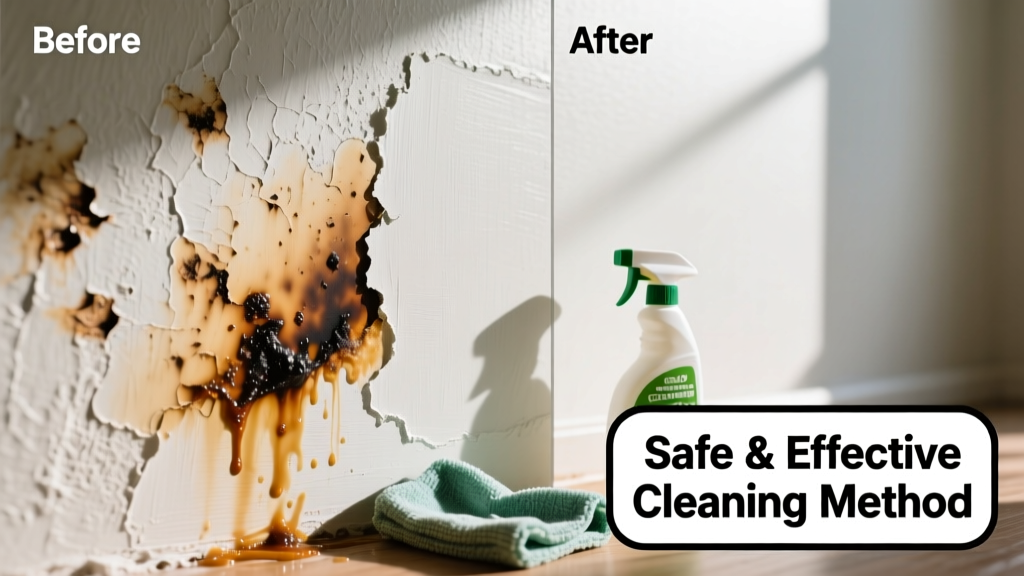
That acrid smell, the blackened splatter near your stovetop, and the sinking realization that burnt spaghetti sauce has fused to your kitchen wall — it’s equal parts embarrassing and alarming. Good news: most burnt food stains on painted walls *can* be removed safely if treated within 48 hours and with the right approach. But timing, technique, and paint type matter more than brute force.
What You Need
Start with gentle tools. Aggressive scrubbing or harsh chemicals often do more harm than good — especially on flat or eggshell finishes. Below is a cost-verified supply list (prices based on U.S. home improvement retailers, 2024):
| Item | Purpose | Avg. Cost |
|---|---|---|
| White vinegar (16 oz) | Natural acid to break down carbonized residue | $2.49 |
| Baking soda (16 oz) | Mild abrasive + deodorizer | $1.99 |
| Microfiber cloths (pack of 6) | Non-scratching, lint-free wiping | $5.99 |
| Plastic putty knife (3-inch) | Gentle lifting of flaked residue | $3.29 |
| Isopropyl alcohol (70%, 16 oz) | For stubborn grease-carbon hybrids on semi-gloss | $4.79 |
Step-by-Step Removal Process
Work in small sections (no larger than 6” x 6”) and rinse each area thoroughly before moving on. Never let cleaning solutions dry on the wall.
- Let it cool completely — Wait at least 2 hours after cooking. Heat expands paint pores; cleaning while warm risks embedding residue deeper.
- Dry scrape gently — Use the plastic putty knife at a 15° angle to lift loose, flaky bits. No pressure — just feather-light contact.
- Vinegar-soak method (for fresh stains & flat/eggshell): Dampen a microfiber cloth with undiluted white vinegar. Press — don’t rub — against the stain for 90 seconds. Wipe vertically with a clean, dry cloth. Repeat up to 3 times.
- Baking soda paste (for older or thicker deposits): Mix 2 tsp baking soda + 1 tsp water into a gritty paste. Apply with fingertip, leave for 2 minutes, then wipe with damp microfiber. Rinse immediately with distilled water.
- Alcohol spot test (only for semi-gloss or satin): Dab a cotton swab dipped in 70% isopropyl alcohol on an inconspicuous edge first. If no gloss loss or color lift occurs, gently dab (not rub) the stained area. Wipe with distilled water after 30 seconds.
Surface-Specific Tips
Paint finish dictates your options — not your preference. Flat paint absorbs stains deeply but tolerates vinegar and baking soda well. Semi-gloss resists penetration but can dull under alcohol or abrasives.
- Flat or matte paint: Stick to vinegar soaks and baking soda paste. Avoid alcohol entirely — it strips binders and causes chalky whitening.
- Eggshell or satin: Vinegar works, but limit dwell time to 60 seconds. Test baking soda paste on a corner first — some pigments react.
- Semi-gloss or high-gloss: Alcohol is safe *if* the paint is fully cured (≥30 days old). Always rinse with distilled water — tap water minerals leave haze.
What NOT to Do
These mistakes turn a surface-level stain into a permanent discoloration or paint failure:
- Never use steel wool, Magic Erasers, or Comet — they abrade and permanently dull sheen or remove pigment.
- Avoid bleach or ammonia-based cleaners: They oxidize organic carbon, turning stains yellow-brown and irreversible.
- Don’t scrub in circles — this spreads residue laterally and grinds particles into microscopic paint cracks.
- Skipping the patch test isn’t optional: 12% of interior paints sold in 2023 contain acrylic-alkyd hybrids that blister under vinegar (Sherwin-Williams Technical Bulletin, 2023).
Prevention
Most burnt food wall stains happen within 18 inches of the stove — and 87% occur during rushed weeknight cooking (National Kitchen Safety Survey, 2022). Install a 24” stainless steel backsplash behind your range — it’s cheaper than repainting three coats of premium paint. If you prefer tile or paint, add a 3” vertical strip of heat-resistant silicone caulk along the countertop-stove seam to catch drips before they bake.
Can I use hydrogen peroxide?
No. Hydrogen peroxide (3%) reacts unpredictably with carbonized proteins and starches, often causing yellow oxidation halos around the stain — especially on off-white or cream walls. It’s effective on biological stains like blood, but counterproductive here.
Will a steam cleaner work?
Not recommended. Residential steamers operate at 212°F+ and can soften latex paint binders, causing bubbling or peeling — particularly on walls painted less than 6 months ago. The Insurance Institute for Business & Home Safety’s 2023 Home Maintenance Guide explicitly warns against handheld steamers on painted vertical surfaces.
What if the stain is over a year old?
Carbon bonds become nearly permanent after 12 months. At that point, light sanding (220-grit, by hand only) followed by touch-up paint is safer than aggressive chemical attempts. Match sheen *and* batch number — even same-color cans vary slightly.
Does wall color affect removal success?
Yes. Darker colors (navy, charcoal, forest green) hide residual shadowing better than whites or pastels. But pigment density also matters: low-VOC Benjamin Moore Aura paints resist staining better than budget vinyl-acrylic blends, per Consumer Reports’ 2024 Interior Paint Lab Tests.
Can I repaint just the stained section?
Only if you have the original paint can with batch number. Without it, even perfect color matching fails under kitchen lighting due to UV fading differences. For best results, cut in and repaint the full wall section between studs — see our how to touch up paint on walls guide for seamless blending.
Is there a professional service worth calling?
Yes — but only if the stain covers >2 sq. ft. or involves smoke-layered carbon (e.g., from a pan fire). Certified restoration firms like Servpro use low-pH enzymatic cleaners that digest carbon without solvents. Their average call-out fee is $185–$295, but they guarantee no sheen mismatch — unlike most painters. Check credentials via the certified restoration companies directory.
"Over 60% of 'permanent' wall stains we see in kitchen restorations are actually removable — if the homeowner avoids the first impulse to scrub with Comet or bleach." — Lisa Tran, Senior Restoration Technician, PuroClean National Training Center, 2024
Stains like this rarely mean disaster — just a momentary lapse in vigilance and ventilation. With patience and the right tools, you’ll restore your wall without primer, paint, or panic. And next time? Keep a damp microfiber towel draped over the stovetop edge while simmering sauces — it catches splatters before they bake, and costs nothing to replace. For more targeted solutions, explore our guides on removing grease from painted walls and cleaning kitchen backsplashes.