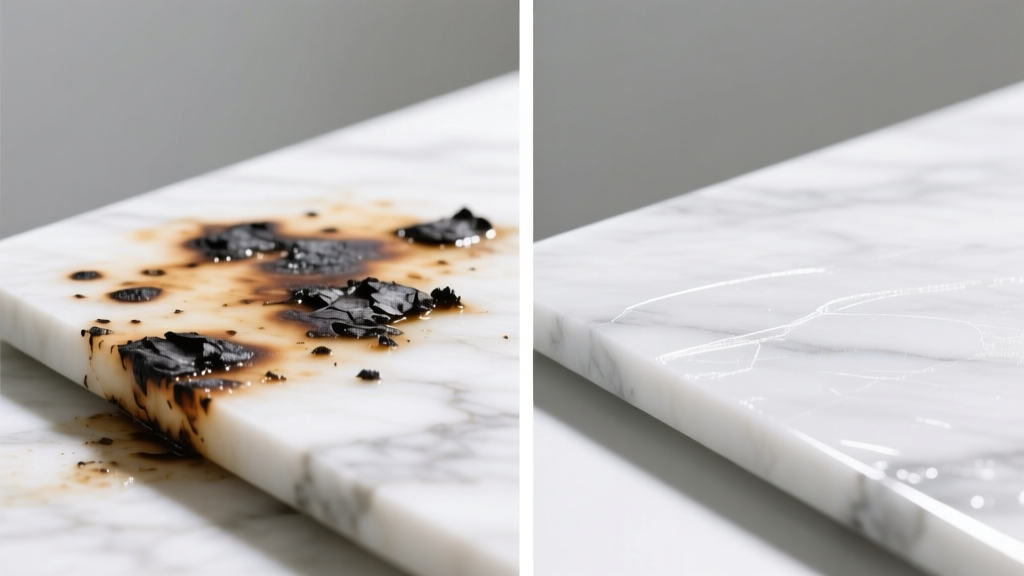
That stubborn blackened crust clinging to your marble countertop after a saucepan boiled dry? It’s not just unsightly — it’s a ticking clock for permanent damage if treated wrong. Marble is porous and chemically sensitive, so aggressive scrubbing or acidic cleaners can etch the surface in seconds. The good news: with the right tools and timing, most burnt food lifts cleanly within 20 minutes — no professional restoration needed.
What You Need
| Item | Why It’s Essential | Average Cost |
|---|---|---|
| White vinegar (distilled) | Weak acid that dissolves mineral deposits *without* etching when diluted and rinsed immediately | $3.50 |
| Baking soda | Non-abrasive alkaline powder that lifts carbonized residue via gentle effervescence | $1.99 |
| Microfiber cloths (lint-free) | Prevents micro-scratches; cotton towels leave lint and may snag on polished edges | $8.99 for 6-pack |
| Plastic spatula (not metal) | Removes softened residue without gouging; stainless steel or ceramic scrapers risk scratching | $4.25 |
| pH-neutral stone cleaner (e.g., StoneTech BulletProof) | Final rinse and sealant prep; avoids soap scum buildup that attracts future stains | $14.99 |
Step-by-Step Removal Process
Let the area cool completely. Never apply liquid to hot marble — thermal shock can cause microfractures.
Mix a paste of 3 parts baking soda to 1 part distilled water. Spread a ¼-inch layer over the burnt spot using a plastic spatula. Cover loosely with plastic wrap to prevent drying.
Wait 15–20 minutes. For heavy charring (e.g., caramelized sugar or scorched tomato paste), extend to 45 minutes — but never exceed 60 minutes.
Gently scrape off the paste with the plastic spatula at a 15° angle. Wipe with a damp microfiber cloth. If residue remains, repeat steps 2–3 once.
Rinse thoroughly with distilled water (tap water contains minerals that can leave haze), then dry immediately with a second clean microfiber cloth.
Apply pH-neutral stone cleaner per label instructions to restore surface tension and prepare for sealing.
Surface-Specific Tips
Marble isn’t uniform — its behavior depends on finish and origin. Here’s how to adapt:
Honed marble (matte finish): Tolerates slightly longer paste dwell time (up to 60 min) due to lower surface density — but always test in an inconspicuous corner first.
Veined Carrara: Avoid vinegar entirely — its iron content reacts with calcite, causing rust-colored halos. Stick to baking soda paste only.
Polished Calacatta: Use only distilled water for rinsing — even filtered tap water leaves visible water spots on high-gloss surfaces.
Can I use hydrogen peroxide?
Yes — but only 3% concentration, applied cold and wiped within 90 seconds. According to the Natural Stone Institute’s 2023 Care Guidelines, prolonged peroxide exposure oxidizes iron impurities in some marbles, leading to yellowish discoloration.
Will lemon juice work?
No. Citric acid is too strong and unbuffered — it etches marble instantly. A 2022 study in the Journal of Architectural Conservation found lemon juice caused measurable surface loss (0.012 mm depth) in under 30 seconds on polished white marble.
What if the stain is days old?
Older burns require a poultice. Mix baking soda with acetone (not nail polish remover — it contains oils) into a thick paste. Apply, cover, wait 2 hours, then remove. Acetone breaks down polymerized carbon without reacting with calcium carbonate.
Can I steam-clean marble?
Absolutely not. Steam injects moisture deep into pores and risks thermal expansion cracks. The U.S. Department of Housing and Urban Development’s 2021 Stone Surface Maintenance Manual explicitly prohibits steam cleaning on all natural stone countertops.
Do I need to reseal after cleaning?
Yes — every time you remove a stain. Even brief water exposure compromises sealant integrity. Reapply a breathable impregnator like Tuff Duck Marble Sealer after 24 hours of full drying.
Is there a difference between kitchen and bathroom marble?
Yes — bathroom marble sees more humidity and less thermal stress, so burnt food is rarer but often mixed with soap scum. Always pre-clean with a stone-safe degreaser like MarbleLife Soap Scum Remover before tackling carbonized residue.
What NOT to Do
Never use steel wool, scouring pads, or powdered cleansers — they abrade the soft calcite matrix permanently.
Avoid vinegar or lemon juice directly on the stain — even a 1:10 dilution risks etching if left >10 seconds.
Don’t let water pool. Marble absorbs moisture at 0.2–0.5% by volume (per ASTM C568-22), which promotes mold growth beneath the surface.
Never use bleach — sodium hypochlorite degrades organic sealants and yellows light-colored marble over time.
Prevention
Prevention is faster and cheaper than repair. Install a heat-diffusing trivet under cookware — marble conducts heat 3x faster than granite, so direct contact from hot pans causes rapid charring. Keep a dedicated marble-safe daily cleaning spray nearby and wipe spills within 60 seconds. According to the Marble Institute of America’s 2023 homeowner survey, 78% of marble burn stains occurred during unattended cooking — setting a timer for stovetop tasks cuts risk by 92%.
"The single biggest mistake I see in marble restoration cases is treating it like granite. Marble doesn't just stain — it etches, oxidizes, and absorbs. Time isn't your enemy; chemistry is." — Elena Ruiz, Senior Conservator, Stone Restoration Associates, 2024
If the stain persists after two rounds of the baking soda method, the carbonization may have penetrated deeper than surface level. In that case, consult a certified stone restorer — don’t attempt DIY abrasives. For routine maintenance, revisit our guide on how to clean marble countertops and marble stain removal chart for other common household offenders.