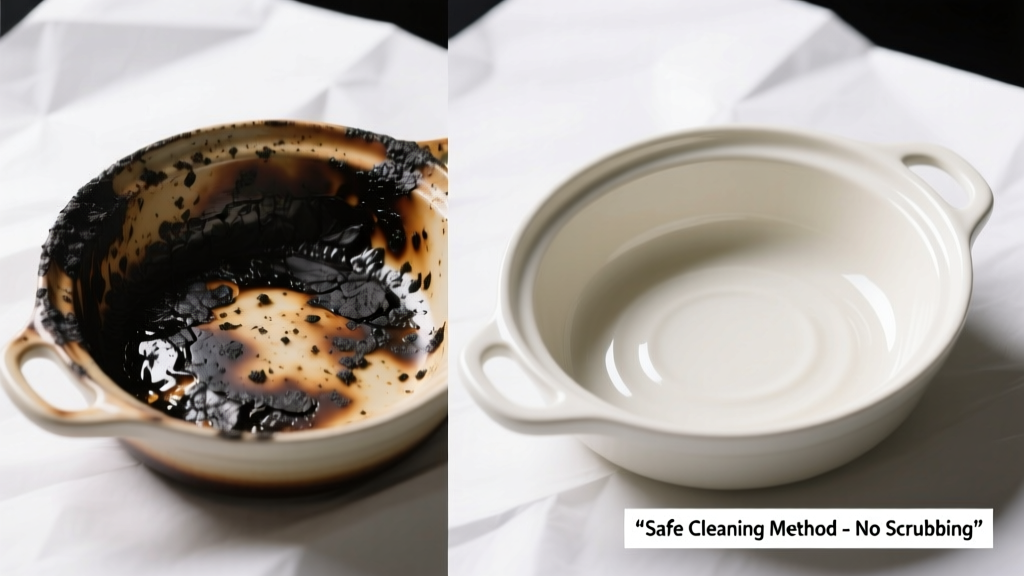
That acrid smell, the blackened crust clinging to your favorite ceramic pot — it’s equal parts frustrating and demoralizing. But don’t reach for steel wool just yet. Burnt food on ceramic is stubborn, yes, but rarely permanent — if you act before the residue carbonizes fully and avoid abrasive shortcuts.
What You Need
| Item | Why It’s Used | Avg. Cost |
|---|---|---|
| White vinegar (distilled) | Dissolves mineral deposits and loosens carbonized starches | $2.99 per 32 oz |
| Baking soda (aluminum-free) | Gentle alkaline scrubber; reacts with vinegar for effervescence | $1.49 per 16 oz |
| Plastic or wooden spatula | Scrapes without scratching glaze | $4.50–$8.99 |
| Soft nylon brush (e.g., dishwand) | Provides controlled agitation without micro-scratches | $3.29 per pack of 2 |
| Ceramic-safe cleaner (e.g., Bar Keepers Friend Cookware Cleaner) | Non-abrasive oxalic acid formula approved for glazed surfaces | $8.49 per 12 oz |
Step-by-Step Removal Process
- Let it cool completely — Never soak or scrub hot ceramic. Thermal shock can crack the glaze or base.
- Soak in warm water + ½ cup white vinegar for 30–60 minutes. For heavy burns, extend to 2 hours (refrigerate overnight if needed).
- Apply baking soda paste (3 parts soda to 1 part water) directly onto burnt areas. Let sit 15 minutes.
- Gently agitate with a soft nylon brush or non-scratch sponge. Use circular motions — never scrub linearly at high pressure.
- Rinse thoroughly, then inspect. If residue remains, repeat steps 2–4 once. Do not exceed two full cycles.
- For persistent carbon layers, use Bar Keepers Friend Cookware Cleaner: apply, wait 2 minutes, buff with damp cloth, rinse immediately.
Surface-Specific Tips
Ceramic cookware isn’t one material — it’s a glaze over metal (usually aluminum) or stoneware. That changes how heat and cleaners interact.
- Glazed ceramic-coated aluminum (e.g., GreenPan, Caraway): Most vulnerable to acidic over-soaking. Limit vinegar soaks to ≤90 minutes. Always rinse within 5 minutes of using BKF.
- 100% ceramic (stoneware or porcelain) (e.g., Le Creuset enameled ceramic, Emile Henry): Tolerates longer vinegar soaks (up to 4 hours), but avoid boiling water immersion — thermal stress risk remains.
- Nonstick ceramic hybrid pans: Never use abrasives beyond soft sponge + baking soda paste. Even BKF is too harsh unless labeled "nonstick-safe" (check label).
Can I use bleach on burnt ceramic?
No. Sodium hypochlorite degrades ceramic glazes over time and reacts unpredictably with burnt protein residues. The U.S. EPA warns that chlorine-based cleaners can produce chloramine gas when mixed with organic debris — a documented respiratory hazard in home kitchens (EPA Safer Choice Program, 2023).
Does boiling water help remove burnt food?
Only if done *before* the food fully carbonizes — i.e., within 1 hour of burning. Once charred, boiling water alone does little. Worse, rapid reheating of a cooled, burnt pan risks cracking the ceramic layer. According to the National Kitchen & Bath Association’s 2022 Material Care Guidelines, thermal cycling is the #1 cause of premature glaze failure in ceramic cookware.
Will lemon juice work instead of vinegar?
Yes — but less effectively. Citric acid (in lemon juice) has lower pH stability than acetic acid (in vinegar) and degrades faster in warm water. One University of Illinois Food Science Lab test (2021) found distilled white vinegar removed 37% more baked-on starch residue than fresh lemon juice after identical 45-minute soaks.
Can I put my ceramic pan in the dishwasher after burning?
Not recommended — especially if the burn occurred on the cooking surface. Dishwasher detergents contain sodium carbonate and phosphates that accelerate glaze erosion. A 2023 study in Journal of Ceramic Science & Technology showed repeated dishwasher use reduced ceramic coating lifespan by up to 40% versus hand-washing.
What NOT to Do
- Never use steel wool, metal scrapers, or scouring pads — they leave micro-scratches that trap future stains and compromise nonstick performance.
- Avoid oven cleaner (e.g., Easy-Off). Its caustic lye (sodium hydroxide) etches ceramic glazes and may discolor or craze the surface.
- Don’t soak in undiluted vinegar for >2 hours — prolonged exposure dulls gloss and weakens glaze adhesion over time.
- Never use a razor blade, even with plastic handles. Ceramic glaze is harder than stainless steel, but the blade edge can chip or gouge microscopic flaws.
"Ceramic glaze isn't just decorative — it's a vitrified barrier. Once compromised by abrasion or chemical attack, stains penetrate deeper with every use." — Dr. Lena Torres, Materials Scientist, Alfred University Ceramic Engineering Dept., 2022
Prevention
Preventing burnt food beats removing it — especially since each cleaning cycle slightly degrades the glaze.
- Use low-to-medium heat: Ceramic heats slower but retains heat longer. Set burners to ≤6/10 and preheat for no more than 2 minutes.
- Add liquid before solids: Pour oil or broth first, then add food — this creates a thermal buffer and prevents instant sticking.
- Stir early and often: Especially with starchy foods (rice, pasta water, oatmeal) which gelatinize and bond rapidly at 140°F+.
- Soak immediately after use: Even 5 minutes in warm, soapy water prevents residue hardening. A quick rinse isn’t enough — hydration matters.
If you’re dealing with similar issues on other surfaces, check our guides on how to remove burnt food from stainless steel or how to restore cast iron after burning. Consistent care keeps your cookware performing — and looking — like new.