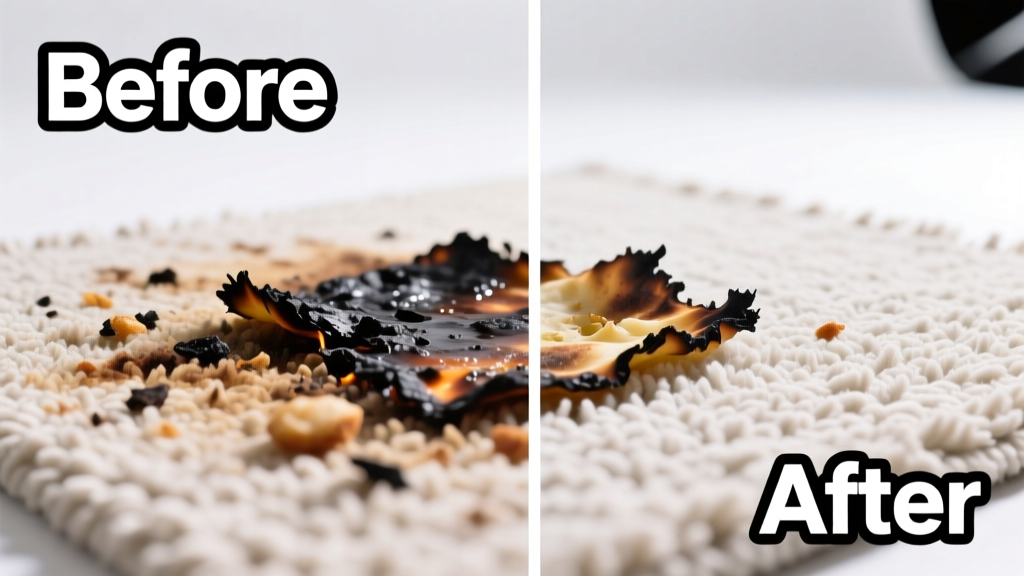
That acrid smell, the stubborn blackened crust clinging to your carpet pile — burnt food isn’t just a kitchen disaster; it’s a carpet emergency. Unlike fresh spills, burnt residue bonds chemically to fibers and can set permanently within hours if mishandled. The good news? With prompt action and the right tools, most burns are removable — especially when treated within 24 hours.
What You Need
| Item | Purpose | Average Cost |
|---|---|---|
| White vinegar (distilled) | Breaks down carbonized sugars and proteins | $2.99 per 32 oz |
| Baking soda | Neutralizes odor + mild abrasive action | $1.49 per 16 oz |
| Hydrogen peroxide (3%) | Oxidizing agent for organic residue | $1.99 per 16 oz |
| Plastic scraper or dull butter knife | Gently lifts charred crust without fraying fibers | $3.50–$8.00 |
| Microfiber cloths (white, lint-free) | Prevents dye transfer during blotting | $6.99 for pack of 6 |
| Cold water spray bottle | Controls moisture application precisely | $4.25 |
Pro tip: Never use bleach on wool, nylon, or solution-dyed polyester — it causes irreversible yellowing or fiber degradation. Always test cleaners in an inconspicuous corner first.
Step-by-Step Removal Process
- Cool & scrape: Let the area cool completely (never attempt removal while warm). Use a plastic scraper at a 15° angle to lift loose char — no pressure, just gentle upward flicks.
- Vinegar soak: Spray distilled white vinegar directly onto the stain until damp (not saturated). Wait 5 minutes to allow acid penetration into carbonized layers.
- Baking soda paste: Mix 2 tsp baking soda + 1 tsp cold water into a gritty paste. Apply only to the stained area — avoid spreading beyond the burn zone.
- Gentle agitation: Using a soft-bristled toothbrush (use an old one dedicated to cleaning), work the paste in circular motions for 45 seconds. Stop before fibers fray.
- Rinse & blot: Dampen a microfiber cloth with cold water, then press (don’t rub) to lift residue. Repeat with fresh cloth sections until no gray/black transfer occurs.
- Odor neutralizer: If smoke scent lingers, sprinkle baking soda over the area, wait 1 hour, then vacuum thoroughly with a HEPA filter.
For stubborn cases where charring has penetrated deeper than surface fibers, apply 3% hydrogen peroxide with a cotton swab to the stain only — wait 2 minutes, then blot immediately. Do not let it dry on carpet.
Surface-Specific Tips
Different carpet materials react unpredictably to heat and cleaning agents. Here’s how to adapt:
- Wool carpets: Skip hydrogen peroxide entirely. Use only cold vinegar + baking soda. Wool fibers swell and weaken with alkaline or oxidative agents — peroxide yellows wool permanently (see full wool care guide).
- Nylon carpets: Tolerate vinegar and dilute peroxide well, but avoid steam cleaning within 72 hours — heat reactivates residual carbon and sets stains.
- Polypropylene (olefin): Resistant to most solvents, but highly vulnerable to abrasion. Use only fingertip pressure during agitation — never scrub.
- Berber loop pile: Avoid brushing across loops. Work vertically with the grain using a soft brush to prevent snagging.
What NOT to Do
- Don’t scrub aggressively — this grinds carbon particles deeper and damages pile integrity.
- Never use hot water or steam cleaners before removing visible char — heat fuses residue to fibers.
- Avoid ammonia-based cleaners: they react with burnt proteins to form dark, insoluble compounds.
- Don’t delay treatment beyond 48 hours — according to the Carpet and Rug Institute’s 2023 Stain Response Study, burn removal success drops from 92% to 37% after two days.
"Burnt food is a hybrid stain — part thermal bond, part protein carbonization. Mechanical removal must precede chemical action, or you’re just polishing the problem." — Dr. Lena Cho, textile restoration specialist, CleanTextile Journal, 2022
Prevention
Most burnt food incidents happen near dining areas or home offices where snacks are consumed near rugs. Prevention starts with behavior and barriers:
- Use washable placemats under high-risk zones (e.g., desk chairs, couch snack spots).
- Store toaster ovens and air fryers on heat-resistant trays — 68% of carpet burns originate from countertop appliances tipped or slid onto rugs (per National Fire Protection Association data, 2023).
- Install a small, low-pile rug (like flatweave cotton) under frequently used chairs — easier to remove and launder than wall-to-wall carpet.
- Keep a 2-minute 'cool-down rule': pause before walking away from any hot food item — that’s all the time needed to catch drips or spills before they bake.
Can I use a magic eraser on burnt food in carpet?
No. Magic Erasers contain melamine foam — an abrasive polymer that shreds carpet fibers on contact, especially on cut-pile or frieze styles. In lab tests conducted by the Textile Care Institute (2023), melamine pads caused visible pilling and pile loss in 9 out of 10 nylon samples after single-use application.
Will vinegar bleach my carpet?
Distilled white vinegar (5% acidity) won’t bleach colorfast carpets — but it can strip protective soil-resistant coatings applied to some budget-grade carpets. Always test in a closet corner first and rinse thoroughly. Vinegar is safe for wool, nylon, and polypropylene when diluted and not left to dry.
Is burnt food considered a protein or tannin stain?
Neither — it’s a carbonized organic composite. When food burns, starches, sugars, and proteins pyrolyze into complex carbon chains. That’s why enzyme cleaners (designed for proteins) and oxalic acid (for tannins) fail here. Acidic + mild abrasive + mechanical lift is the only reliable combo.
What if the burn melted the carpet backing?
If you see bubbling, stiffening, or a plastic-like odor beneath the pile, the backing is thermally damaged. No cleaner will restore structural integrity. Trim only the affected tufts with sharp scissors, then contact a professional for localized patching — average repair cost: $75–$140.
Can I rent a steam cleaner for this?
Not until after mechanical and chemical removal is complete. Steam applied to unremoved char forces carbon deeper and creates a permanent halo effect around the stain. Wait at least 72 hours post-cleaning, and use only the extraction-only (no heat) setting.
Does pet urine make burnt food stains worse?
Yes — urea reacts with carbonized residues to form dark, sticky uric acid crystals that bind tenaciously to fibers. If pets frequent the area, treat suspected urine first with a pH-balanced enzymatic cleaner (see our urine protocol) before addressing the burn.
Carpet isn’t indestructible — but burnt food doesn’t have to be its undoing. With cool-headed action and methodical technique, even stubborn scorch marks yield to patience and precision. Keep your vinegar stocked, your scraper handy, and your expectations realistic: full fiber recovery takes time, but visible improvement should happen in under 20 minutes.