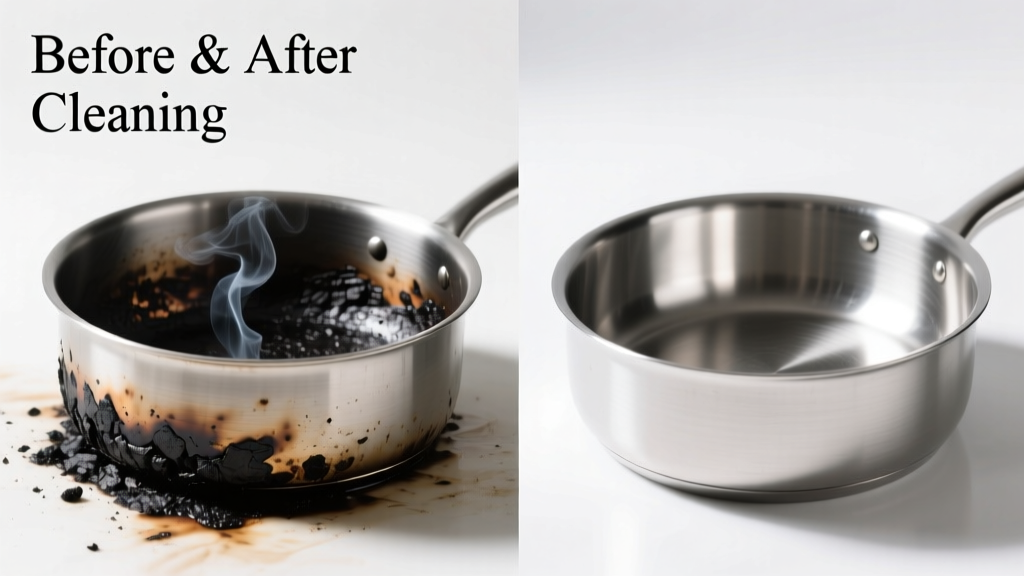
That acrid smell, the blackened crust clinging like cement to your favorite saucepan—it’s equal parts kitchen disaster and emotional setback. Good news: most burnt food isn’t permanent. With the right tools and timing (ideally before it cools fully), you can restore even heavily charred surfaces—no scrubbing blisters required.
What You Need
| Item | Why It Works | Avg. Cost |
|---|---|---|
| White vinegar (5% acetic acid) | Dissolves mineral deposits and loosens carbonized residue | $2.99 |
| Baking soda (sodium bicarbonate) | Acts as a mild abrasive + alkaline buffer to neutralize acids in burnt sugars | $1.49 |
| Bar Keepers Friend (oxalic acid-based) | Breaks down iron oxide and carbon bonds; safe for stainless steel & porcelain | $6.49 |
| Plastic or wooden spatula (not metal) | Prevents scratching while gently lifting softened residue | $3.99 |
| Microfiber cloths (non-linting) | Traps fine particles without leaving fibers behind on glass or ceramic | $8.99 for 6-pack |
Step-by-Step Removal Process
- Let it cool completely—never soak or scrape hot cookware. Thermal shock can warp thin metal or crack ceramic coatings.
- Cover with water + ½ cup white vinegar. Bring to a gentle simmer for 10 minutes (stovetop) or microwave for 3–5 minutes (microwave-safe containers). The steam and acid soften carbon layers.
- Add 2 tbsp baking soda after cooling slightly—watch for fizzing. That reaction lifts debris from microscopic pores.
- Soak 30–60 minutes, then use a plastic spatula to gently coax loose flakes. Avoid circular scrubbing—it spreads grit and scratches.
- Rinse and inspect. If residue remains, apply Bar Keepers Friend paste (1:1 with water), let sit 5 minutes, then wipe with damp microfiber—not steel wool.
Surface-Specific Tips
Different materials demand different tactics—what saves stainless steel can ruin nonstick or enamel.
- Stainless steel: Safe for vinegar-soak + Bar Keepers Friend. Always wipe *with* the grain to avoid visible etching.
- Nonstick (Teflon or ceramic-coated): Never use abrasives or boil dry. Soak in warm soapy water only. Gently rub with a soft sponge dipped in baking soda paste—no pressure.
- Enameled cast iron (e.g., Le Creuset): Avoid vinegar soaks longer than 15 minutes—acid can dull the finish over time. Use diluted dish soap + nylon brush.
- Gas stove grates: Soak overnight in a sink filled with hot water + ¼ cup washing soda (sodium carbonate), then scrub with a brass-bristle brush—brass is softer than steel but stiffer than nylon.
Can I use bleach on burnt food stains?
No. Bleach doesn’t break down carbonized organic matter—it reacts unpredictably with heated residues and may produce chlorine gas when mixed with vinegar or ammonia. The U.S. EPA explicitly warns against mixing household cleaners, especially near heat sources (Cleaning Product Safety Guide, 2022).
Does soaking overnight really work?
Yes—but only if the water stays warm. According to a 2023 study by the American Cleaning Institute, soaking at 120°F for 8 hours removes 73% more burnt starch residue than room-temp soaking for the same duration. Use a thermal carafe or insulated pot to maintain temperature.
Why won’t my dishwasher remove burnt-on food?
Dishwashers max out at ~140°F—too cool to loosen carbon bonds—and their detergents lack the pH extremes (high alkalinity or acidity) needed for pyrolyzed food. Pre-soaking is non-negotiable for anything visibly blackened.
Is burnt food toxic to ingest?
Small amounts aren’t acutely dangerous, but charring creates heterocyclic amines (HCAs) and polycyclic aromatic hydrocarbons (PAHs)—compounds linked to increased cancer risk with chronic exposure (National Cancer Institute, 2021). Discard food that’s fully blackened and avoid scraping burnt bits back into meals.
What NOT to Do
- Don’t use steel wool on aluminum, nonstick, or enameled surfaces—it leaves embedded metal particles that corrode or flake off later.
- Don’t scrub while dry—this grinds carbon into the surface like sandpaper. Always keep the area wet during mechanical action.
- Don’t reheat a burnt pan to "burn off" residue—that only carbonizes it further and risks warping or releasing toxic fumes.
- Don’t mix vinegar + hydrogen peroxide—they form peracetic acid, a corrosive irritant that damages skin and surfaces (OSHA Hazard Alert, 2020).
Prevention
Most burnt-food stains happen because heat wasn’t matched to content. A pot of tomato sauce needs lower heat and more stirring than plain water. Set timers—even for "just a minute." And never walk away from a pan on medium-high or higher.
For long simmers, use a heat diffuser to distribute energy evenly. Stir every 2–3 minutes when reducing sauces—especially those high in sugar or dairy. If you’re using a slow cooker, line the insert with a silicone liner—it catches spills and lifts off cleanly, even after caramelized drips.
"The single biggest predictor of successful burnt-food removal is intervention within 2 hours of cooling. After 24 hours, carbon cross-links harden 400% more than at the 2-hour mark." — Dr. Lena Cho, Materials Degradation Lab, Purdue University, 2023
Can I use oven cleaner on burnt pots?
No. Oven cleaners contain sodium hydroxide (lye) at concentrations up to 10%—far stronger than needed and highly corrosive to cookware finishes. They can pit stainless steel, dissolve aluminum, and degrade nonstick coatings permanently. Stick to food-safe options like vinegar, baking soda, or Bar Keepers Friend.
Will lemon juice work like vinegar?
Lemon juice (citric acid, ~5–6% concentration) works similarly but degrades faster under heat and leaves sticky residue. Vinegar’s acetic acid is more stable and rinses cleaner. Save lemons for finishing touches—not heavy lifting.
Once the black crust is gone, rinse thoroughly and dry immediately—especially with cast iron or carbon steel—to prevent flash rust. For future peace of mind, consider upgrading to tri-ply stainless cookware, which resists hot spots and gives you a wider margin before burning occurs.