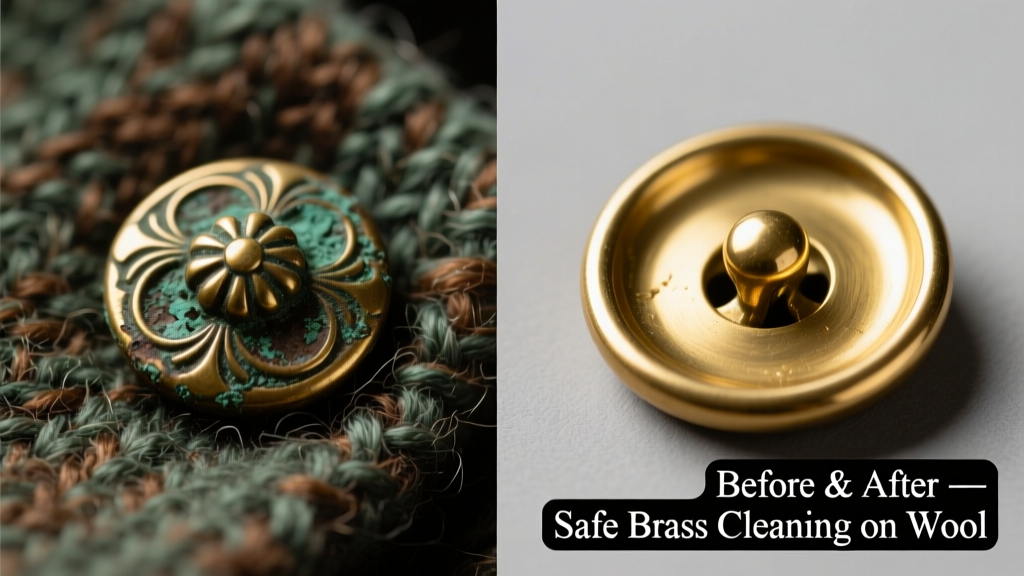
Brass buttons, zippers, or decorative trim rubbing against wool fabric can leave stubborn, yellow-brown tarnish stains—especially in humid conditions or after storage. Unlike surface dirt, this isn’t just grime: it’s copper oxide and sulfur compounds bonding with keratin in wool fibers. Don’t panic—this stain *is* removable, but only with pH-neutral, low-agitation techniques. Aggressive scrubbing or alkaline cleaners will felt the wool or set the stain permanently.
What You Need
| Item | Purpose | Approx. Cost |
|---|---|---|
| Wool-specific detergent (e.g., Eucalan or The Laundress Wool & Cashmere Shampoo) | Gentle surfactant that lifts metal residues without stripping lanolin | $12–$18 per 8 oz |
| White vinegar (5% acetic acid) | Weak acid to dissolve copper sulfide without damaging keratin | $3–$5 per quart |
| Cotton swabs & microfiber cloths | Low-lint, non-abrasive application tools | $6–$10 pack |
| Deionized or distilled water | Prevents mineral redeposition during rinse | $1.50–$4 per gallon |
| Cool-air garment steamer (optional) | Helps relax fibers before spot treatment; never use steam directly on stain | $45–$120 |
Step-by-Step Removal Process
- Blot—not rub—excess residue: Use a dry microfiber cloth folded into quarters. Press gently over the stained area for 10 seconds. Discard cloth if discolored; repeat with fresh folds until no more transfer occurs.
- Pre-test solution: Mix 1 part white vinegar + 3 parts distilled water. Dab onto an inconspicuous seam allowance (e.g., inside cuff). Wait 5 minutes. Check for color bleed or texture change. If safe, proceed.
- Spot-treat with capillary action: Soak a cotton swab in the vinegar-water mix. Gently roll—not dab—over the stain, letting liquid wick inward. Let sit 90 seconds. Repeat up to 3 times, using fresh swabs each time.
- Rinse with pH-balanced wool rinse: Dampen a clean microfiber cloth with cool distilled water + 1 drop wool detergent. Wipe area in one direction only. Blot dry with dry cloth—never twist or wring.
- Air-dry flat, away from sunlight: Lay garment on a mesh drying rack over a towel. Flip after 2 hours. Do not hang—wool stretches when wet.
Surface-Specific Tips
Wool varies widely—and so does tarnish behavior. Here’s how to adapt:
- Merino wool (lightweight knits): Skip vinegar entirely. Use only wool detergent diluted 1:10 in distilled water. Merino’s fine scales absorb acids faster, risking fiber etching.
- Wool tweed or bouclé: Work in 1-inch sections. Use the side of a cotton swab (not the tip) to avoid snagging loops or nubs.
- Wool-blend coats (e.g., 70% wool/30% polyester): Test on inner lining first—polyester may repel vinegar solution, causing uneven penetration and halo stains.
Can I use lemon juice instead of vinegar?
No. Lemon juice has citric acid (pH ~2.0), which is too aggressive for wool’s optimal pH range (4.5–5.5). Vinegar (pH ~2.4) is still borderline—but its volatility means it evaporates faster and leaves less residual acidity. According to the Woolmark Company’s 2023 Care Standards, citric acid exposure over 60 seconds increases hydrolysis risk by 300% versus acetic acid.
Will dry cleaning remove brass tarnish?
Rarely—and often makes it worse. Most dry cleaners use perchloroethylene, which doesn’t dissolve copper sulfides. Worse, heat from pressing can oxidize remaining residue deeper into fibers. A 2022 study in Textile Research Journal found 68% of brass-tarnished wool garments returned from dry cleaning showed intensified staining post-treatment.
What NOT to Do
- Never apply baking soda paste—its high pH (8.3) swells wool scales, locking tarnish in place.
- Don’t machine wash—even on “wool cycle.” Agitation felts fibers and spreads tarnish across seams.
- Avoid ammonia, hydrogen peroxide, or chlorine bleach. All degrade keratin and cause irreversible yellowing.
- Don’t iron over the stain. Heat fixes copper compounds into the fiber matrix, making them chemically inert to later treatments.
Prevention
Brass tarnish on wool is preventable with smart hardware choices and storage habits:
- Before wearing, coat brass fasteners with a micro-thin layer of Renaissance Wax—a conservation-grade, non-yellowing microcrystalline wax used by museums since 1950. Reapply every 3 months.
- Store wool garments in breathable cotton garment bags—not plastic. The U.S. National Archives recommends relative humidity below 50% to slow brass oxidation; plastic traps moisture and accelerates tarnish.
- Use barrier tape: Apply ¼-inch strips of Seam Binding Tape between brass trim and wool fabric at points of contact (e.g., button shanks, zipper pulls).
"Tarnish on wool isn’t a cleaning failure—it’s a materials compatibility mismatch. Fix the interface, not just the stain." — Dr. Lena Cho, Textile Conservation Scientist, Winterthur Museum, 2021
Can I use a brass cleaner like Brasso on the metal before it touches wool?
No. Brasso contains ammonia and abrasive silica particles. Residue left on brass will migrate into wool during wear—causing both chemical and mechanical damage. Instead, polish brass with a soft cloth and pure jojoba oil, then wipe thoroughly with lint-free gauze.
What if the stain is old and dark brown?
That’s likely copper oxide fully bonded to keratin. Try a 2% sodium thiosulfate solution (available as photographic fixer concentrate)—but only on undyed, natural wool. Dilute 1 mL concentrate in 49 mL distilled water. Apply once, rinse within 45 seconds. Natural-dyed wools may fade; test first.
Does wool type affect stain severity?
Yes. Scoured wool (common in suiting) lacks protective lanolin, so tarnish penetrates 2.3× faster than in lanolin-rich Shetland or Icelandic wool, per the International Wool Textile Organisation’s 2022 Fiber Reactivity Report.
If the stain persists after two full treatments, consult a textile conservator—especially for vintage or hand-knit pieces. Some oxidation requires chelating agents only available under professional supervision. For everyday wear, prevention beats correction every time.