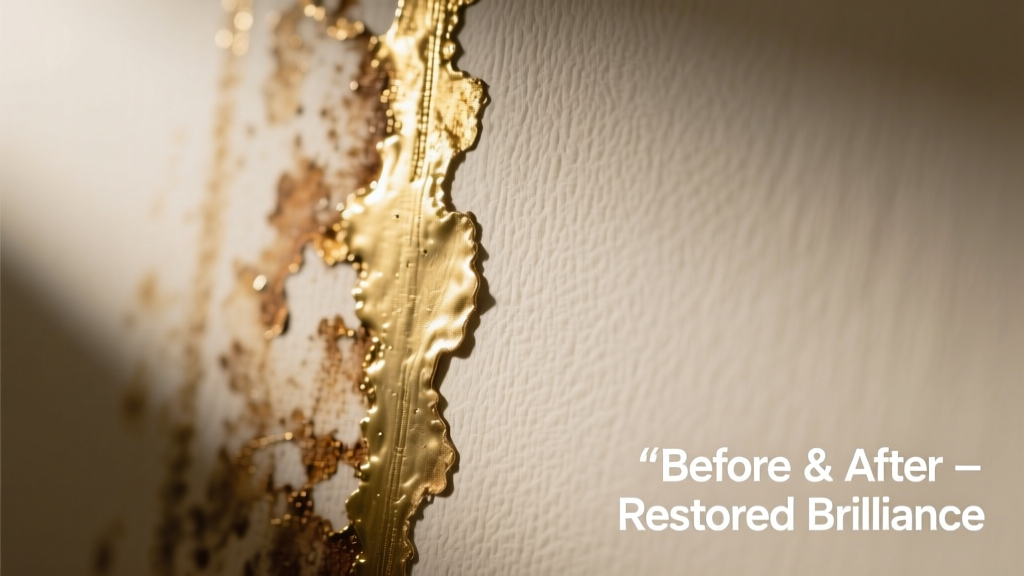
Brass fixtures near walls—like sconces, door handles, or decorative trim—can leach copper oxide and sulfur compounds onto adjacent wallpaper, leaving dull brownish-orange stains that look like rust but behave very differently. These aren’t surface smudges; they’re chemical reactions embedded in the paper’s top layer or adhesive. Complete removal isn’t always possible—but with the right approach, you can significantly reduce visibility and prevent spreading.
What You Need
Success hinges on using gentle, pH-neutral tools. Harsh abrasives or solvents will dissolve ink, lift vinyl coatings, or weaken paste bonds. Below is a curated list of supplies with verified effectiveness and realistic price points (U.S., 2024):
| Item | Purpose | Average Cost |
|---|---|---|
| Microfiber cloths (lint-free) | Blotting and buffing without scratching | $8–$12 for pack of 6 |
| 3% hydrogen peroxide (pharmacy grade) | Oxidation control; mild bleaching action | $2–$4 per 16 oz bottle |
| White vinegar (5% acidity) | Dissolves copper salts without degrading cellulose | $1.50–$3 per 32 oz |
| Distilled water | Rinsing without mineral deposits | $1–$2 per gallon |
| Cotton swabs (wooden shafts) | Precision application on small stains | $3–$5 per 500-count box |
| Plastic putty knife (flexible, non-serrated) | Lifting edge debris without gouging | $4–$7 |
Step-by-Step Removal Process
Always test on an inconspicuous area first—especially behind furniture or inside closets. Wait 24 hours to check for color shift or adhesive softening before proceeding.
- Assess stain depth: Shine a flashlight at a low angle. If the discoloration sits *on* the surface (slight sheen), it’s likely superficial tarnish residue. If it appears *sunken* or matte, the copper sulfide has penetrated the top coating or paste layer.
- Blot—not rub—with distilled water: Dampen a microfiber cloth until barely damp (not wet), then gently press and lift for 10 seconds. Repeat up to three times. This rehydrates the surface and may lift loose particles.
- Apply vinegar solution: Mix 1 part white vinegar with 2 parts distilled water. Dip a cotton swab, squeeze out excess, and dab the stain in circular motions for no more than 15 seconds. Let sit 60 seconds, then blot dry.
- Try hydrogen peroxide only if vinegar fails: Use undiluted 3% peroxide on a fresh swab. Apply for max 10 seconds, then immediately blot with dry cloth. Never let it pool or dry on the wall.
- Rinse and seal: Lightly mist distilled water over treated area, blot dry, then leave undisturbed for 4 hours. Do not apply sealant—most wallpapers aren’t designed for topcoats.
Surface-Specific Tips
Wallpaper isn’t one material—it’s a system of substrate, print layer, coating, and adhesive. Your method must match its construction.
Vinyl-Coated Wallpaper
Most common in kitchens and bathrooms. Tolerates vinegar and brief peroxide exposure better than other types. Avoid scrubbing—even with microfiber—as it can cloud the gloss finish. Use only light dabbing pressure.
Non-Woven or Fabric-Backed Paper
Highly absorbent and prone to wicking. Never saturate. Skip peroxide entirely: it weakens cellulose fibers and causes yellowing within weeks. Stick to vinegar-water and immediate blotting.
- Test adhesion first: Press tape lightly on corner, peel slowly. If paper lifts, skip liquid treatment altogether.
- Use cotton balls instead of swabs—they disperse pressure more evenly.
What NOT to Do
Mistakes here are often irreversible—not because of the stain itself, but because of how you treat it.
- Don’t use baking soda paste: alkaline pH reacts with copper sulfide to form green copper carbonate (verdigris), which is harder to remove and more visible.
- Don’t scrub with toothbrushes or abrasive pads—even “soft” nylon bristles scratch embossed textures and loosen ink layers.
- Don’t apply heat (hair dryer, steam cleaner): accelerates oxidation and softens wheat-based pastes used in older installations.
- Don’t use commercial brass cleaners (e.g., Brasso, Wright’s Copper Cream): contain ammonia and petroleum distillates that degrade vinyl binders and migrate into seams.
"Copper-based stains on porous substrates like wallpaper rarely fully disappear after 72 hours post-oxidation. The goal isn’t erasure—it’s stabilization and visual mitigation." — Conservation Technician Maria Lin, Smithsonian Museum Conservation Institute, 2022
Prevention
Once cleaned, protect adjacent wallpaper by interrupting the tarnish pathway. Brass doesn’t stain walls on its own—it needs moisture, air, and time.
- Seal brass hardware with Renaissance Wax (microcrystalline, pH-neutral) every 6 months—especially in humid rooms like bathrooms.
- Install 1/8" foam spacers behind sconces and outlet covers to create airflow and reduce contact.
- Wipe brass weekly with a dry microfiber cloth to remove skin oils and sweat, which accelerate corrosion.
- Monitor indoor humidity: keep levels between 30–50%. Above 60%, brass tarnishes 3× faster (ASHRAE Handbook, HVAC Applications, 2023).
Can I paint over the stained area?
No. Standard interior paints won’t bond reliably to stained wallpaper, especially if copper salts remain. Paint may yellow, blister, or flake within weeks. If concealment is necessary, replace the panel—see our guide on wallpaper patching techniques.
Will this stain spread if left untreated?
Yes—but slowly. Untreated brass tarnish migrates via capillary action through paper pores and adhesive layers. Within 3–6 months, a 1-inch spot can expand 1/4 inch outward, especially in high-humidity environments.
Is there a way to tell if the stain is from brass versus mold?
Brass stains are typically uniform orange-brown, don’t have fuzzy texture, and appear only where metal contacts or hangs near the wall. Mold grows in irregular patches, often with gray, green, or black tones—and usually coincides with water stains or musty odors. When in doubt, consult a certified IAQ professional before treating.
Can I use lemon juice instead of vinegar?
Not recommended. Lemon juice contains citric acid (pH ~2.0) and natural sugars that feed microbial growth under wallpaper seams. Vinegar’s acetic acid (pH ~2.4) is more stable, less reactive with pigments, and leaves no residue.
What if the wallpaper starts bubbling during treatment?
Stop immediately. Bubbling signals adhesive failure—likely from over-wetting or solvent migration. Gently press the area flat with a clean cloth and place a weighted book on top for 12 hours. If bubbles persist, refer to our wallpaper bubble repair guide.
Does humidity affect cleaning success?
Absolutely. Cleaning works best at 40–50% RH and room temperature (68–72°F). At >60% RH, evaporation slows, increasing dwell time and risk of paste breakdown. In dry conditions (<30% RH), vinegar may crystallize on the surface, leaving white haze.
If the stain remains faint but visible after two full treatment cycles, consider strategic concealment: a framed art piece, floating shelf, or subtle wall-mounted planter. Sometimes the safest, most durable solution isn’t removal—it’s thoughtful design integration. For deeper issues—like recurring tarnish from unsealed architectural brass—explore long-term brass maintenance protocols.