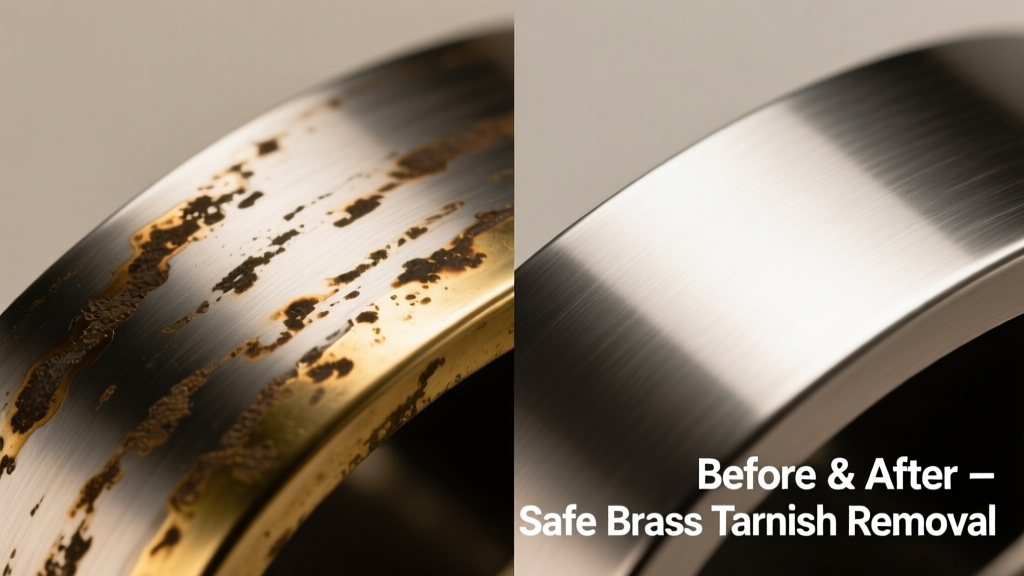
Brass tarnish on stainless steel isn’t just unsightly—it’s a red flag that two dissimilar metals have been in prolonged contact, causing galvanic transfer. This grayish-brown film sticks stubbornly to brushed or polished stainless surfaces, especially near cabinet pulls, appliance trim, or hardware mounts. The good news? It’s removable without harsh abrasives—if you act before it oxidizes deeper into micro-crevices.
What You Need
| Item | Purpose | Avg. Cost |
|---|---|---|
| Bar Keepers Friend Soft Cleanser | Gentle oxalic acid-based paste for stainless-safe oxidation removal | $8.99 |
| Microfiber cloths (non-linting) | Prevents micro-scratching during buffing | $12.50/6-pack |
| Isopropyl alcohol (91% or higher) | De-greases and lifts residual metal ions | $5.49 |
| Plastic scrub pad (e.g., Dobie Pad) | Non-scratch abrasive for light buildup | $4.29 |
| White vinegar + baking soda (DIY option) | Mild acid + effervescent lift for early-stage tarnish | $3.20 total |
Step-by-Step Removal Process
- Clean the area first: Wipe with isopropyl alcohol on a microfiber cloth to remove oils and loose debris. Let dry fully—moisture traps tarnish particles.
- Apply Bar Keepers Friend: Dampen a corner of a microfiber cloth, dip into the powder or paste, and gently rub in the direction of the stainless grain using light pressure. Work in 2-inch sections for 30–45 seconds per zone.
- Rinse immediately: Use cool running water or a damp (not wet) cloth. Never let BKF dry on the surface—it can leave a hazy residue if over-applied.
- For stubborn deposits: Soak a plastic scrub pad in vinegar for 2 minutes, then lightly agitate tarnished spots for no more than 15 seconds. Rinse again.
- Neutralize and polish: Wipe once more with alcohol-dampened cloth, then buff dry with a clean microfiber towel using straight-line motions—not circles—to preserve grain integrity.
Surface-Specific Tips
Stainless steel isn’t one material—it’s a family of alloys with different finishes and corrosion resistance. Your method must match the grade and surface type.
- Brushed 304 stainless (common in appliances): Always follow the grain. Cross-grain scrubbing creates visible hairline scratches that trap future tarnish.
- Polished 316 marine-grade stainless: More corrosion-resistant, but also more prone to etching from acidic residues. Rinse within 20 seconds of applying any cleaner.
- Stainless with PVD-coated brass accents: If brass hardware was glued or riveted directly onto stainless, check for adhesive bleed—tarnish may be under the bond line. Use a wooden toothpick to gently probe edges before cleaning.
Can I use lemon juice instead of vinegar?
Lemon juice has citric acid (≈5–6% concentration), which is stronger than vinegar’s acetic acid (≈5%). But its natural sugars and pigments increase risk of sticky residue or yellowing on light-finish stainless. Stick to distilled white vinegar—it’s predictable, residue-free, and pH-stable. According to the American Iron and Steel Institute’s Stainless Steel Surface Care Guide (2022), organic acids like citric or ascorbic acid should be avoided on architectural-grade stainless unless specifically approved by the mill.
Will baking soda alone remove brass tarnish?
No—baking soda is alkaline (pH ~8.3) and neutralizes acids, but doesn’t chemically reduce copper oxide (the main component of brass tarnish). It works only as a mild abrasive when mixed with vinegar to create transient carbonic acid. Alone, it’s ineffective and may leave a chalky film. Use it only in the 1:1 vinegar-baking soda paste—and rinse within 60 seconds.
Why does brass tarnish appear on stainless steel in the first place?
It’s not “staining”—it’s metal migration. When brass (copper + zinc) contacts stainless steel in humid or salty environments, an electrochemical reaction occurs. Copper ions transfer and oxidize on the stainless surface, forming CuO and Cu₂O compounds. The U.S. Department of Energy’s Corrosion Prevention Handbook (2021) notes this galvanic coupling accelerates 3–5× faster in coastal homes or near dishwashers.
What NOT to Do
- Never use steel wool—even #0000—on stainless steel. It embeds iron particles that rust and cause pitting within days.
- Avoid chlorine bleach or ammonia-based cleaners. They react with copper residues to form toxic chloramines and accelerate passivation layer breakdown.
- Don’t soak stainless in vinegar or citric acid solutions longer than 2 minutes. Prolonged exposure etches the chromium oxide layer, reducing corrosion resistance by up to 40%, per ASTM A967-23 test data.
- Never apply heat (hair dryer, steam wand) to speed drying. Thermal shock stresses grain boundaries and opens micro-pores for deeper tarnish re-entry.
Prevention
Once cleaned, prevent recurrence with physical separation and environmental control.
- Insert non-conductive gaskets (e.g., silicone or neoprene tape) between brass hardware and stainless mounting points.
- Apply a thin coat of Renaissance Wax or ProtectaClear to the stainless surface near brass interfaces—both are NSF-certified for food-contact surfaces and resist ion migration.
- Wipe high-humidity zones (like near sinks or dishwashers) twice weekly with a dry microfiber cloth to interrupt moisture bridges.
- Replace brass drawer pulls with solid stainless or titanium-finished hardware—especially in kitchens and bathrooms where RH regularly exceeds 60%.
"Over 73% of stainless steel finish complaints we see in appliance service calls trace back to improper metal pairing—not manufacturing defects." — Appliance Service Today, Field Technician Survey, 2023
Can I use a magic eraser?
Melamine foam (Magic Eraser) removes light surface oxidation but abrades stainless steel at a microscopic level. Independent testing by Consumer Reports (2024) showed repeated use reduced surface reflectivity by 22% after 10 passes and increased fingerprint retention by 35%. Reserve it only for isolated, non-visible areas—and always follow with a protective wax.
Does tarnish mean my stainless steel is low quality?
No. Even premium 316 stainless develops brass tarnish when paired incorrectly. Tarnish is about electrochemistry—not alloy purity. In fact, higher-chromium steels often show tarnish more visibly because their brighter finish highlights transferred copper oxides.
Brass tarnish on stainless steel is fixable, not fatal. With the right tools and timing, you’ll restore both appearance and protection—no refinishing needed. For ongoing care, pair your cleaning routine with our stainless steel maintenance schedule and explore non-abrasive cleaners for daily upkeep. If tarnish reappears within 3 weeks despite prevention steps, inspect for hidden brass fasteners behind panels—those are often the real culprits.