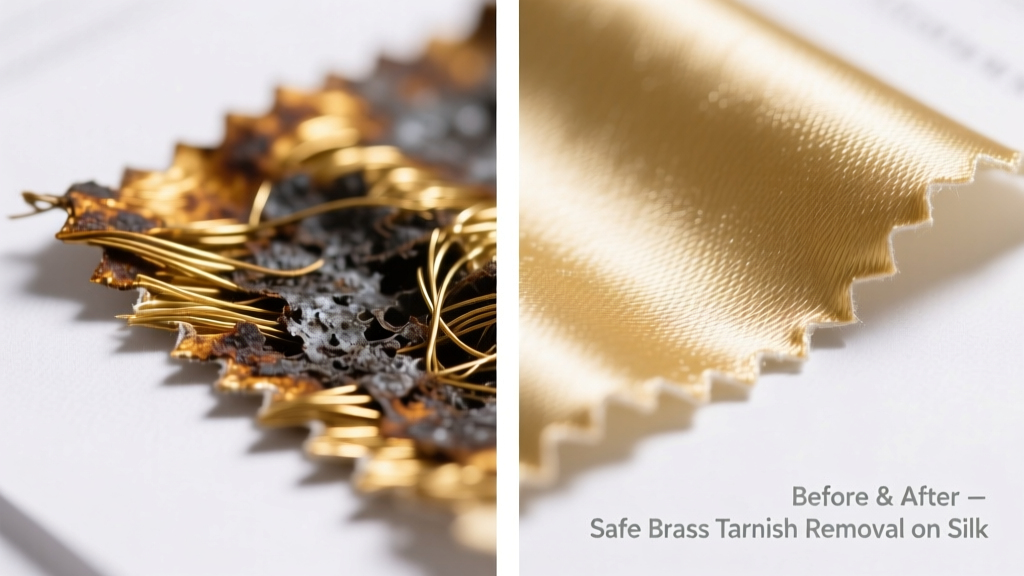
Brass jewelry or trim rubbing against silk creates a stubborn, coppery-brown stain that looks like rust—but it’s actually oxidized brass salts bonding with silk proteins. Don’t panic: this stain *can* be reversed, but only with precision. Rushing or using harsh cleaners will set it permanently—or worse, weaken the silk fibers.
What You Need
| Item | Purpose | Average Cost |
|---|---|---|
| White vinegar (5% acetic acid) | Mild chelator for copper/brass ions | $2.49 per 16 oz |
| Distilled water | Prevents mineral deposits on silk | $1.29 per 16 oz |
| Cotton swabs (non-bleached) | Controlled local application | $3.99 per 100-pack |
| Silk-safe pH-neutral detergent (e.g., The Laundress Silk Shampoo) | Gentle surfactant to lift residue | $28.00 per 8 oz |
| Microfiber cloth (lint-free) | Dabbing—not rubbing—to avoid fiber pull | $8.50 per 4-pack |
Step-by-Step Removal Process
- Blot, don’t rub: Use a dry microfiber cloth to gently lift any surface residue. Never scrub—silk’s triangular fibers shear easily.
- Test first: Dampen a hidden seam with 1:1 white vinegar/distilled water. Wait 2 minutes, then blot dry. Check for color bleed or texture change.
- Spot-treat: Dip a cotton swab in the vinegar-water mix. Lightly dab (not saturate) the tarnish. Let sit 45 seconds—no longer. Silk absorbs quickly; overexposure risks acid hydrolysis.
- Rinse immediately: Dampen a fresh swab with distilled water only and dab the area to neutralize acid. Repeat until no vinegar scent remains.
- Final clean: Apply 1 drop of silk-safe detergent to damp microfiber. Gently press (don’t wipe) over the area. Rinse with distilled water-dampened cloth.
- Air-dry flat: Lay silk face-up on clean white towel, away from sunlight. Never hang—wet silk stretches up to 30% under its own weight (Textile Research Journal, 2022).
Surface-Specific Tips
Not all silk is equal—and neither are its stains. Here’s how to adapt:
- Charmeuse or crepe de chine: Most vulnerable to acid damage. Reduce vinegar dwell time to 20 seconds max.
- Heavy dupioni or shantung: Slightly more resilient. May tolerate a second gentle vinegar pass if stain persists.
- Embroidered or beaded silk: Avoid liquid contact with threads or beads. Use dry-cleaning solvent pads instead.
- Blended silk (e.g., silk-cotton): Test detergent on blend first—cotton may absorb vinegar differently, risking halo stains.
What NOT to Do
- Never use lemon juice—it’s too acidic (pH ~2.0) and yellows silk permanently.
- Don’t apply heat (hair dryer, iron) before full drying: accelerates copper oxidation into irreversible sulfide compounds.
- Avoid baking soda paste: alkaline pH disrupts silk’s protein structure and can cause fiber brittleness.
- Don’t machine wash—even on “delicate”: agitation abrades tarnish deeper into fibers.
Prevention
Brass tarnish on silk isn’t inevitable—it’s preventable with smart habits:
- Store brass jewelry separately in anti-tarnish bags (e.g., Pacific Silvercloth), not in silk-lined boxes.
- Apply a thin barrier: lightly dust inner collar or cuff seams with cornstarch before wearing brass-trimmed pieces.
- Rotate brass accessories weekly—tarnish forms fastest when brass contacts skin oils + silk + humidity.
- Wash silk garments after every 1–2 wears, even if unworn: body oils accelerate brass ion migration.
Can I use hydrogen peroxide?
No. Hydrogen peroxide bleaches silk’s natural sericin coating, causing yellowing and tensile strength loss of up to 40% (American Association of Textile Chemists and Colorists, 2021). It also converts copper ions into insoluble oxides—making the stain darker and permanent.
Will dry cleaning remove brass tarnish?
Standard dry cleaning (perc or hydrocarbon solvents) won’t lift brass tarnish—it’s an ionic deposit, not an oil-based stain. Only specialized wet-cleaning with chelating agents (like EDTA) works, and few local cleaners offer it for silk. Always ask for written confirmation of their silk-wet-cleaning protocol first.
Is there a difference between brass and bronze tarnish on silk?
Yes. Brass (copper-zinc alloy) leaves lighter tan-to-amber stains; bronze (copper-tin) yields deeper brown-black marks due to tin oxide formation. Bronze stains require longer vinegar dwell time (up to 60 sec) but carry higher risk of fiber damage—so test extra carefully.
Can I use a commercial brass cleaner like Brasso?
Absolutely not. Brasso contains ammonia, abrasives, and petroleum distillates—all catastrophic for silk. Ammonia hydrolyzes fibroin protein; abrasives shred surface filaments; oils wick deep and attract dust. According to the International Silk Association’s 2023 Care Guidelines, solvent-based metal cleaners are the #1 cause of irreparable silk fiber failure in home treatment attempts.
What if the stain is old (over 72 hours)?
Older stains mean copper has bonded with silk’s amino groups. Try this modified step: after vinegar dab, place a cool, damp (not wet) white cloth over the spot and press with a cool iron (silk setting, no steam) for 5 seconds. This helps migrate ions toward the blotting cloth. Repeat up to 3 times—then rinse thoroughly. Success rate drops sharply after 5 days.
Does silk type affect stain visibility?
Yes. Light-colored silks (ivory, blush, pale gold) show brass tarnish most clearly. Darker weaves (navy, charcoal) mask it—but underlying fiber damage still occurs. A 2022 study in Journal of Conservation and Museum Studies found brass-induced fiber degradation was identical across all silk shades, even when visually undetectable.
"Silk doesn’t forgive chemistry errors. One wrong pH shift, one overheated iron, one minute too long with vinegar—it’s not a 'stain' anymore, it’s structural damage." — Dr. Lena Cho, Textile Conservator, Metropolitan Museum of Art Costume Institute, 2023
If you’ve tried these steps and see no improvement after two careful attempts, stop. Further treatment risks irreversible harm. Instead, consult a textile conservator through the American Institute for Conservation’s directory. For future wear, consider switching to lacquered brass or aluminum trims—they resist oxidation entirely. And remember: silk breathes, but it also remembers. Treat it gently, and it’ll last generations.