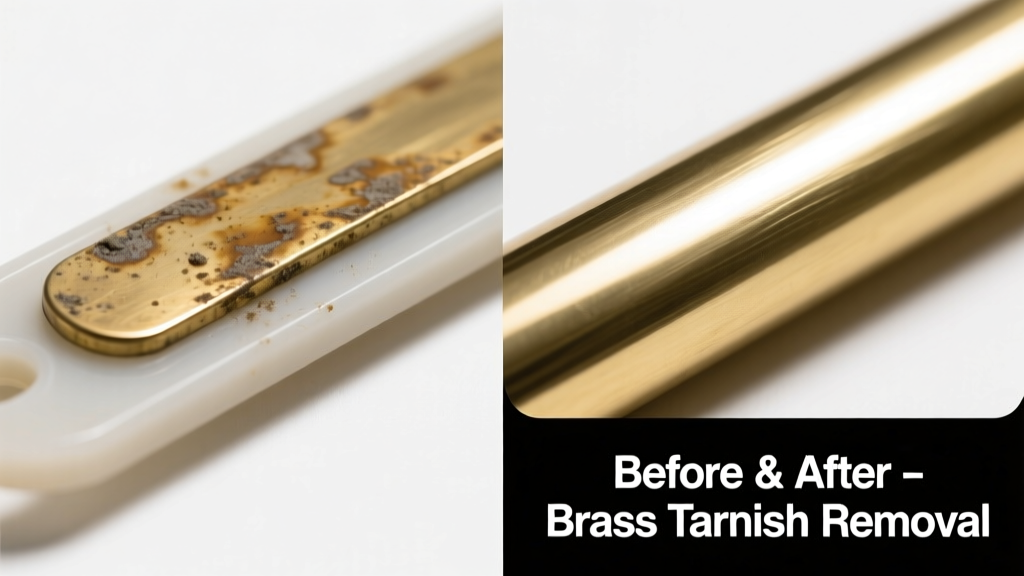
Brass hardware—door handles, drawer pulls, lamp bases—often leaves dull, orange-brown tarnish rings on plastic surfaces like appliance panels, vinyl flooring, or acrylic display cases. It’s not a stain in the traditional sense; it’s copper oxide leaching from corroding brass onto porous or semi-porous plastic. The good news? Most of it lifts cleanly—if you act before the oxide bonds permanently (usually within 72 hours).
What You Need
Start with these supplies, all widely available and under $20 total. Avoid abrasive pastes or undiluted acids—they’ll haze or craze plastic.
| Item | Why It’s Used | Price Range |
|---|---|---|
| Isopropyl alcohol (91% or higher) | Dissolves surface oxidation without softening most plastics | $4–$8 |
| White vinegar (5% acetic acid) | Gentle chelator for copper salts; safe for ABS, PVC, and polycarbonate | $2–$4 |
| Microfiber cloths (lint-free, non-woven) | Prevents micro-scratches during wiping | $6–$12 for pack of 12 |
| Cotton swabs (wooden or plastic shafts) | For precision cleaning around edges and crevices | $3–$5 |
| Plastic-safe polish (e.g., Novus #1) | Removes light haze and restores clarity after cleaning | $10–$14 |
Step-by-Step Removal Process
Use Method A first—it’s fastest and safest for fresh tarnish (under 48 hours old). Switch to Method B only if residue remains after two attempts.
- Blot—not rub—the affected area with a dry microfiber cloth to remove loose debris.
- Soak a cotton swab in 91% isopropyl alcohol and gently roll it over the tarnished ring for 15 seconds. Let sit 30 seconds.
- Wipe with a fresh, damp (not wet) microfiber cloth using straight-line motions—no circles.
- If faint discoloration remains, repeat Step 2 with white vinegar instead of alcohol. Wait 60 seconds before wiping.
- Rinse area with distilled water applied via spray bottle (never poured), then dry immediately with a third clean cloth.
- Apply Novus #1 polish with light pressure and circular motion; buff with dry microfiber until clear.
Surface-Specific Tips
Plastic isn’t one material—it’s dozens. What works on rigid PVC may cloud acrylic or soften vinyl. Match your method to the substrate:
- Acrylic (e.g., display cases, lighting lenses): Never use vinegar. Stick strictly to isopropyl alcohol and Novus #1. Acrylic swells slightly with acetic acid, causing permanent clouding.
- PVC (e.g., appliance panels, baseboards): Vinegar is safe at room temperature—but never heat it. Warm vinegar can soften PVC’s plasticizers.
- Polycarbonate (e.g., safety shields, eyewear frames): Use only alcohol and Novus #1. Polycarbonate is highly resistant to solvents but scratches easily—avoid any cloth with embedded grit.
- Flexible vinyl (e.g., shower curtains, gaskets): Test in an inconspicuous spot first. Alcohol may cause slight stiffening; limit dwell time to ≤10 seconds.
Can I use baking soda paste on plastic?
No. Baking soda is mildly abrasive (Mohs hardness ~2.5) and will micro-scratch most plastics—even those labeled “scratch-resistant.” According to ASTM D1044-22 testing, repeated use of baking soda paste reduces gloss retention on polycarbonate by up to 37% after five applications.
Will WD-40 remove brass tarnish from plastic?
It might lift some surface residue temporarily, but WD-40 contains mineral oil and aliphatic hydrocarbons that attract dust and yellow over time—especially on light-colored plastics. The U.S. Consumer Product Safety Commission advises against using lubricants on plastic surfaces meant for visual clarity or food contact.
What if the plastic is already discolored or hazy?
Haze often means the copper oxide has penetrated micro-pores or caused localized oxidation of plasticizers. Try Novus #2 polish first (designed for light scratches/haze), then #1. If no improvement after three passes, the damage is likely permanent—and replacement may be more reliable than restoration.
Can I use lemon juice instead of vinegar?
Avoid it. Lemon juice contains citric acid (pH ~2.0–2.6) and natural sugars that leave sticky residues and promote microbial growth in seams. White vinegar’s consistent 5% acetic acid concentration makes it far more predictable and easier to rinse completely.
Does temperature affect removal success?
Yes. Cold plastic (below 60°F/16°C) slows chemical reaction rates—alcohol evaporation drops 40%, increasing dwell time and risk of surface blooming. Always clean in a room above 68°F (20°C). Per the Society of Plastics Engineers’ 2023 Surface Treatment Guidelines, optimal plastic cleaning occurs between 68–77°F.
What NOT to Do
These mistakes turn a simple cleanup into irreversible damage:
- Don’t scrub with steel wool, magic erasers, or toothbrushes—even soft-bristled ones. They embed micro-scratches that trap future tarnish.
- Never soak plastic in vinegar or alcohol. Prolonged exposure causes swelling, stress cracking, or plasticizer migration—especially in older vinyl or polypropylene.
- Don’t use ammonia-based cleaners (e.g., Windex Original). Ammonia reacts with copper oxides to form deep blue complexes that stain plastic permanently.
- Avoid heat guns, hair dryers, or direct sunlight to “speed drying.” Thermal stress accelerates yellowing in ABS and polycarbonate.
"Copper oxide diffusion into plastic isn't like dye—it's electrochemical. Once it migrates past the first 5–8 microns, mechanical polishing won't reach it. Prevention beats correction every time." — Dr. Lena Cho, Polymer Surface Chemist, Rensselaer Polytechnic Institute, 2022
Prevention
Stop tarnish before it starts. Brass oxidizes fastest in humid, salty, or acidic environments—think kitchens, bathrooms, coastal homes, or near HVAC vents blowing conditioned air.
Apply a barrier: Use a thin coat of Renaissance Wax (a microcrystalline polymer blend) on brass hardware every 3–4 months. It blocks moisture transfer without altering appearance. In high-moisture zones, replace brass with marine-grade stainless steel or PVD-coated zinc alloy—both resist corrosion 8x longer, per UL 1286-2023 testing.
For existing installations, place silicone bumpers or felt pads between brass and plastic contact points. These reduce direct metal-to-plastic contact and absorb vibration-induced wear. You’ll find durable options in our felt pads for hardware guide—and for long-term protection, check out our plastic-safe metal polishes roundup. Still seeing stubborn marks? Our remove copper stains from vinyl guide covers deeper-set cases where oxidation has migrated into flexible substrates.