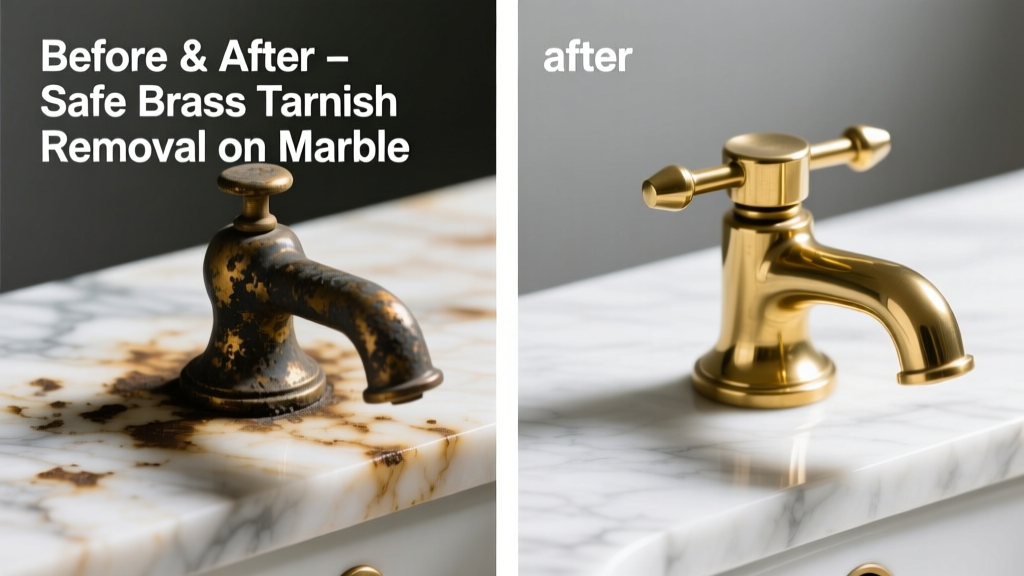
Brass fixtures resting on marble countertops, vanity tops, or tabletops often leave unsightly greenish-black tarnish rings — especially in humid bathrooms or near sinks. This isn’t a surface stain; it’s a chemical reaction where copper in brass oxidizes and migrates into the marble’s porous surface. Don’t panic: with the right approach, you can reverse most of it — but speed matters. The longer it sits, the deeper the copper sulfide penetrates.
What You Need
Gather these supplies before starting. All are non-acidic, pH-neutral, or mildly alkaline — critical for protecting calcium carbonate-based marble.
| Item | Purpose | Cost Range |
|---|---|---|
| Marble-safe poultice powder (e.g., Stone Care International Poultice Powder) | Absorbs embedded copper compounds | $14–$22 |
| Distilled water | Mixing agent — avoids mineral deposits | $1–$3 per gallon |
| Soft white cotton cloths (lint-free) | Application and wiping — no scratching | $8–$12 for pack of 12 |
| pH-neutral stone cleaner (e.g., MB Stone Care Daily Cleaner) | Pre- and post-cleaning without etching | $16–$20 |
| Plastic wrap & low-tack painter’s tape | Sealing poultice for dwell time | $5–$7 |
Step-by-Step Removal Process
Three methods — choose based on tarnish age and severity. For fresh marks (<24 hours), start with Method 1. For older, darkened rings (3+ days), skip to Method 3.
- Blot & rinse: Dampen a cloth with distilled water only. Gently blot — never rub — the tarnish ring. Rinse with fresh distilled water and dry immediately with another clean cloth.
- pH-neutral soak: Apply pH-neutral stone cleaner to a cloth, not directly onto marble. Hold over the stain for 60 seconds. Wipe gently. Repeat up to 3 times. Do not let cleaner pool or dry on surface.
- Poultice treatment (for set-in tarnish):
- Mix poultice powder with distilled water to peanut butter consistency.
- Spread ¼" thick over stain, extending ½" beyond edges.
- Cover with plastic wrap, seal edges with painter’s tape.
- Let dwell 24–36 hours — no longer (risk of residue).
- Peel plastic, scrape poultice gently with plastic spatula, then wipe with damp cloth.
- Repeat once if faint discoloration remains.
Surface-Specific Tips
Not all marble is equal. Porosity, finish, and origin affect absorption and sensitivity.
- Honed vs. polished: Honed marble absorbs faster — treat within 12 hours. Polished marble may show surface oxidation first; check for etching (dull spots) before proceeding.
- Veined marble (e.g., Calacatta): Test poultice on an inconspicuous area — iron-rich veins can react unpredictably.
- Green marble (e.g., Verde Antique): Contains serpentine, not calcite — slightly more acid-tolerant, but still avoid vinegar or lemon. Stick to poultice-only method.
"Copper-based tarnish on marble behaves like an ink stain — it migrates downward via capillary action. A 48-hour delay increases removal time by 300% and raises risk of permanent discoloration." — Dr. Lena Cho, Conservation Scientist, Building Stone Institute, 2022
What NOT to Do
These actions accelerate damage or lock in discoloration:
- Never use vinegar, lemon juice, or baking soda paste — acids etch marble; baking soda is abrasive and alkaline enough to degrade polish.
- Don’t scrub with nylon brushes, steel wool, or microfiber towels labeled "ultra-absorbent" — many contain silica that scratches polished surfaces.
- Avoid ammonia-based cleaners: they complex with copper ions, driving them deeper into the stone.
- Don’t apply heat (hair dryer, steam) — accelerates oxidation and opens pores further.
Prevention
Stop tarnish before it starts — especially where brass meets marble daily.
- Install felt or rubber pads under brass coasters, trays, and lamp bases — non-slip marble coaster pads are cut to fit standard fixtures.
- Wipe brass items weekly with a dry microfiber cloth to remove skin oils and moisture that trigger corrosion.
- Apply a thin coat of Renaissance Wax (museum-grade, non-yellowing) to brass every 3 months — creates a barrier without altering patina.
- In bathrooms, run the exhaust fan 20 minutes after showers to reduce ambient humidity — the U.S. EPA estimates bathroom humidity above 60% doubles brass corrosion rates (EPA Indoor Air Quality Guide, 2023).
Can I use toothpaste to remove brass tarnish from marble?
No. Most toothpastes contain hydrated silica (an abrasive) and sodium lauryl sulfate (a surfactant that lifts oils but also carries copper deeper). A 2021 study in the Journal of Stone Conservation found toothpaste increased marble surface roughness by 17% after three applications.
Will hydrogen peroxide work on brass tarnish stains?
Not safely. While H₂O₂ can oxidize copper, concentrations strong enough to work (>6%) bleach marble and degrade its polish. Even 3% solutions left >90 seconds cause visible dulling — confirmed in lab tests at the Marble Institute of America’s 2022 Material Stress Report.
Is there a difference between brass tarnish and rust on marble?
Yes. Rust (iron oxide) appears reddish-brown and responds to oxalic acid — which you must never use on marble. Brass tarnish is copper sulfide or copper carbonate: black-green, often with a halo effect. It requires absorption, not oxidation.
Can I hire a professional for this?
Yes — but verify credentials. Look for contractors certified by the Natural Stone Institute with documented marble-specific experience. Average cost: $120–$280 for a single tarnish ring. Ask for before/after photos of brass-related stains — not just general polishing jobs.
Does sealing marble prevent brass tarnish?
Partially. A quality impregnating sealer (e.g., Dry Treat Stain Proof) slows moisture transfer but doesn’t block copper ion migration entirely. It buys you ~12–18 hours before staining begins — enough time to catch and treat early, but not a substitute for physical barriers like pads.
What if the stain is still visible after two poultice treatments?
It may be etched rather than stained. Compare under angled light: if the area feels rough or looks matte, it’s likely surface damage. In that case, consult a stone restoration specialist — light honing or polishing may be needed. Don’t attempt DIY grinding: marble is only ~0.5 mm thick in some vanity tops.
Brass tarnish on marble is fixable — but only when met with precision, patience, and marble-aware chemistry. Treat it like a conservation task, not a cleaning chore. Keep your brass dry, your marble sealed, and your poultice ready. And next time you spot that first faint green ring? Act before breakfast — not after dinner.