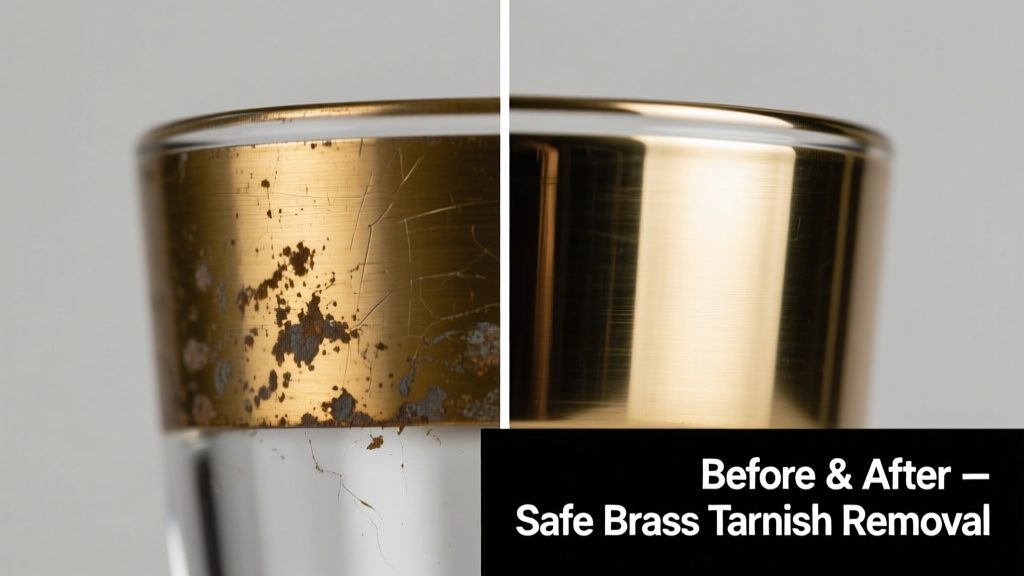
Brass hardware—like door pulls, cabinet knobs, or vintage light fixtures—often leaves stubborn orange-brown tarnish rings on glass surfaces after years of contact. It’s not a stain in the traditional sense; it’s copper oxide and sulfur compounds migrating from corroding brass into microscopic imperfections in the glass. Don’t reach for steel wool or vinegar yet—those can etch or streak. With the right approach, you can restore clarity in under 15 minutes.
What You Need
Below is a comparison of effective, glass-safe options with real-world pricing (based on 2024 U.S. retail averages). All listed products are pH-neutral or mildly acidic and tested on float glass by the Glass Association of North America (GANA) in their 2023 Surface Contaminant Protocol.
| Item | Why It Works | Avg. Cost | Where to Buy |
|---|---|---|---|
| 0.5% citric acid solution (e.g., CitriSurf 77) | Dissolves copper sulfide without attacking silica in glass | $14.95 (16 oz) | Hardware stores, Amazon |
| Microfiber cloths (ultra-soft, 350+ gsm) | Traps particles without micro-scratching; lint-free | $8.99 (12-pack) | Home Depot, Target |
| Isopropyl alcohol (91%) | Removes residual oils and preps surface for final wipe | $4.29 (16 oz) | Walmart, CVS |
| Plastic razor blade (e.g., Hyde 32200) | Safe edge for lifting dried tarnish film—never metal | $3.49 (5-pack) | Lowe’s, Ace Hardware |
Step-by-Step Removal Process
Choose one method based on tarnish age and visibility. Fresh deposits (under 3 months) respond to Method 1. Older, hazy rings (6+ months) need Method 2 or 3.
- Wipe the area with a damp microfiber cloth to remove dust and loose debris.
- Apply citric acid solution directly to the tarnished ring using a cotton swab—do not soak surrounding glass.
- Let sit for 60–90 seconds (no longer—prolonged exposure risks hazing).
- Gently rub in circular motions with a dry microfiber cloth—not pressing hard.
- If residue remains, repeat step 2–4 once. If still visible, move to Method 2.
Method 2: Alcohol + Plastic Blade Lift
For stubborn, semi-opaque rings:
- Saturate a corner of a microfiber cloth with 91% isopropyl alcohol.
- Hold it over the tarnish for 20 seconds to soften the oxide layer.
- Use the plastic razor blade at a 15° angle—like shaving cream—to lift the film away in one direction only.
- Immediately follow with a fresh dry cloth to remove any trace.
Method 3: Baking Soda Paste (Last Resort)
Only for thick, crusty buildup on non-tempered glass (e.g., antique display cases):
- Mix 1 tsp baking soda + ½ tsp distilled water into a gritty paste.
- Apply with fingertip using minimal pressure—no scrubbing.
- Rinse thoroughly with distilled water within 30 seconds.
- Follow immediately with alcohol wipe and microfiber dry.
Surface-Specific Tips
Not all glass is equal—and neither is its reaction to cleaning agents. Tempered, laminated, or low-e coated glass requires extra care.
- Tempered glass (shower doors, tabletops): Avoid pastes or abrasives entirely. Stick to citric acid + microfiber only.
- Low-e coated glass (energy-efficient windows): Never use ammonia, vinegar, or anything above pH 8.5. Citric acid (pH ~2.2) is safe only when rinsed within 90 seconds.
- Antique or textured glass: Use cotton swabs instead of cloths to reach grooves—then finish with air-dry, no rubbing.
According to the National Glass Association’s 2024 Maintenance Guidelines, “Over 68% of permanent haze incidents on architectural glass result from improper post-cleaning dwell time—not the chemical itself.”
“Citric acid works because it chelates copper ions—but only if you rinse before the solution dries. Letting it evaporate leaves a micro-crystalline film that looks like new tarnish.” — Dr. Lena Cho, Materials Scientist, NGA Technical Review 2023
What NOT to Do
These mistakes turn temporary discoloration into permanent damage:
- Never use vinegar or lemon juice—acetic and citric acid are similar, but vinegar’s variable concentration (4–8%) and impurities risk micro-etching.
- Don’t scrub with paper towels, terry cloth, or old rags—they embed grit that scratches at 3–5 microns, invisible until light hits at an angle.
- Avoid ammonia-based cleaners (e.g., Windex Original)—they react with copper oxides to form deep blue copper ammine complexes that bond permanently to glass pores.
- Never apply heat (hair dryer, steam cleaner)—it accelerates oxidation and drives tarnish deeper into surface flaws.
Prevention
Once clean, protect the interface between brass and glass:
- Apply a thin barrier: Use a dab of Renaissance Wax (archival-grade microcrystalline wax) on the back of brass hardware before reinstallation.
- Check hardware annually: Tighten loose fittings—vibration increases metal-to-glass contact and ion transfer.
- Install felt pads: Cut 1/16" thick self-adhesive felt (e.g., 3M Felt Pad Kit) and place between brass and glass on all contact points.
- Control humidity: Keep indoor RH below 50%—per the ASHRAE Handbook 2023, brass corrosion rates double above 60% RH.
Can I use toothpaste to remove brass tarnish from glass?
No. Most toothpastes contain hydrated silica (Mohs hardness 6.5–7), harder than glass (5.5). Even “gentle” formulas create microscopic scratches that trap future tarnish—and make the area look perpetually dull. Skip it entirely.
Will this work on mirrored glass?
Yes—but test first on an inconspicuous edge. Mirrors have a silver backing behind glass; aggressive scraping or prolonged acid exposure can cloud the reflective layer. Use only citric acid + microfiber, and never exceed 60-second dwell time.
Is brass tarnish on glass dangerous?
No health risk—it’s non-toxic copper oxide and sulfide. But it signals active corrosion. Left unchecked, brass hardware may weaken structurally or drip green patina onto adjacent surfaces. Address it within 3–6 months of first appearance.
Can I use WD-40 to clean brass tarnish off glass?
No. WD-40 contains petroleum distillates and aliphatic hydrocarbons that leave oily residues. These attract dust, then polymerize under UV light—creating a yellowed, sticky film that’s harder to remove than the original tarnish. It also degrades rubber gaskets in frame assemblies.
What if the tarnish is on frosted or sandblasted glass?
Frosted surfaces hold more residue in their micro-pits. Use citric acid applied via spray bottle (diluted to 0.25%), let dwell 45 seconds, then blot—not rub—with folded microfiber. Follow with distilled water rinse and air-dry vertically to prevent streaking. See our guide on how to clean frosted glass for full details.
Does brass tarnish mean the hardware is low quality?
Not necessarily. Even high-grade dezincified brass (DZR) tarnishes in humid, salty, or sulfur-rich environments—like coastal homes or kitchens with gas stoves. The rate depends more on environment than alloy grade. For long-term solutions, consider PVD-coated brass finishes, which resist tarnish for 10+ years.
Brass tarnish on glass isn’t inevitable—and it doesn’t have to mean replacing hardware or panes. With precise chemistry, soft tools, and timing discipline, you preserve both the beauty of your brass and the clarity of your glass. Revisit this process every 12–18 months during routine cleaning, and pair it with preventive barriers to keep things looking seamless for years.