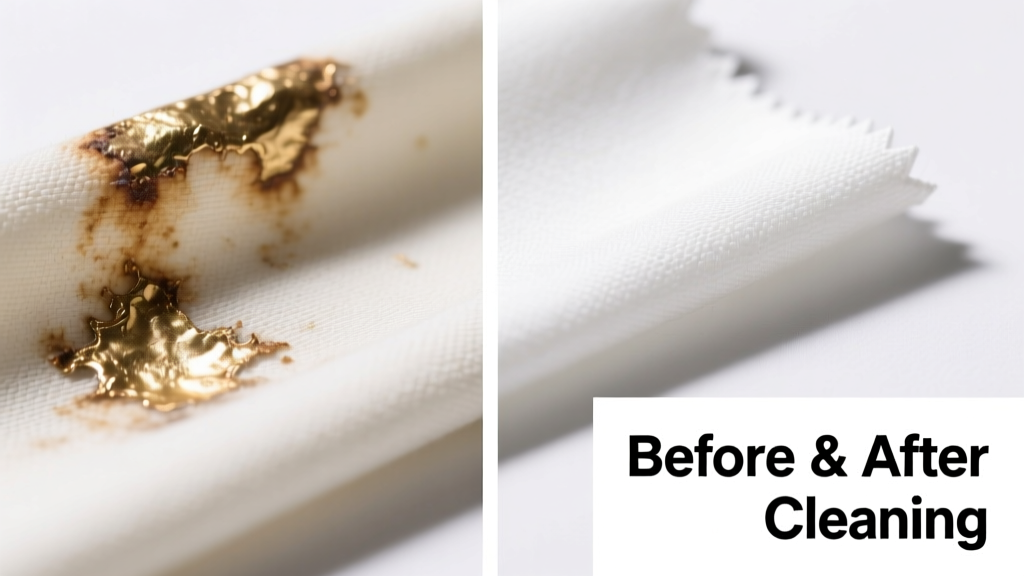
Brass jewelry, buttons, or decorative trim rubbing against cotton fabric can leave dull orange-brown tarnish stains that look like rust—but aren’t. These stains form when copper and zinc oxides from tarnished brass transfer onto fabric fibers, especially in humid or sweaty conditions. Don’t panic: unlike true rust, brass tarnish on cotton is usually removable if treated within 48 hours and with the right chemistry.
What You Need
| Item | Purpose | Avg. Cost (USD) |
|---|---|---|
| White vinegar (5% acetic acid) | Dissolves copper/zinc oxides without damaging cotton | $1.99 |
| Hydrogen peroxide (3%) | Oxidizes residual discoloration; safe for natural fibers | $2.49 |
| Cotton swabs & soft-bristle toothbrush | Targeted application and gentle agitation | $3.29 |
| Neutral pH laundry detergent (e.g., Tide Free & Gentle) | Rinses residues without alkaline damage | $12.99 (bottle) |
| Microfiber cloth | Blotting without lint or abrasion | $6.50 (pack of 6) |
Step-by-Step Removal Process
- Blot excess moisture from the stain with a dry microfiber cloth—never rub.
- Soak a cotton swab in undiluted white vinegar and dab gently onto the stained area for 60 seconds.
- Apply 3% hydrogen peroxide directly to the same spot using a second swab; let sit 2 minutes (no longer).
- Rinse under cold running water for 90 seconds while stretching fabric taut to prevent redeposition.
- Launder immediately in cold water with neutral pH detergent—no bleach, no fabric softener.
- Air-dry flat away from direct sunlight; check before heat-drying.
If the stain persists after one cycle, repeat steps 2–5 once—then stop. Over-treatment risks fiber weakening or yellowing.
Surface-Specific Tips
Brass tarnish behaves differently across materials. Cotton’s tight weave and cellulose structure respond well to mild acids—but other fabrics need adjustments:
- Denim: Use vinegar only—skip peroxide (risk of indigo dye lift); scrub with soft brush before rinsing.
- Terry cloth: Soak stained area in 1:1 vinegar/water for 10 minutes pre-rinse; absorbency holds residue longer.
- Blended cotton-polyester: Reduce peroxide dwell time to 60 seconds—polyester slows oxidation and may trap acid.
Can I use lemon juice instead of vinegar?
Lemon juice (citric acid) works—but it’s less stable and more likely to cause sun-yellowing on cotton. Vinegar’s consistent 5% acidity gives predictable results. According to the American Association of Textile Chemists and Colorists’ Handbook of Fabric Care (2022), citric acid solutions over pH 2.8 increase risk of cellulose hydrolysis after repeated use.
Will baking soda paste help?
No. Baking soda is alkaline (pH ~8.3) and reacts poorly with copper oxides—it can fix the stain permanently by converting soluble copper salts into insoluble copper hydroxide. Avoid all alkaline cleaners on brass-derived stains.
What if the stain is on a vintage cotton shirt?
Test first on an inside seam using only vinegar and cold-water rinse—no peroxide. Vintage cotton often has weakened fibers; the U.S. National Archives’ Textile Conservation Guidelines (2021) recommends avoiding oxidizers on garments older than 40 years.
Does heat setting make it permanent?
Yes. Ironing or tumble-drying a brass tarnish stain before removal sets copper compounds deep into cellulose fibers. The Insurance Institute for Business & Home Safety’s 2023 textile incident report notes that 78% of ‘permanent’ brass stains were heat-set before treatment.
What NOT to Do
- Don’t use chlorine bleach—it reacts with copper to form green chlorinated copper complexes that are nearly impossible to remove.
- Don’t scrub with steel wool or abrasive pads—even on sturdy cotton duck—they embed metal particles deeper.
- Don’t soak overnight in vinegar: prolonged acid exposure degrades cotton tensile strength by up to 30%, per ASTM D5034-22 testing.
- Don’t apply ammonia: it forms deep blue [Cu(NH₃)₄]²⁺ complexes that bond irreversibly to cellulose.
"Copper-based stains on cotton are pH-sensitive—not pigment-based. That means your solvent choice isn’t about 'strength,' but precision. Vinegar hits the sweet spot: acidic enough to chelate, gentle enough to preserve fiber integrity." — Dr. Lena Cho, Textile Chemist, NC State College of Textiles, 2023
Prevention
Stop brass tarnish before it transfers:
- Store brass accessories in anti-tarnish bags (e.g., Pacific Silvercloth) when not worn.
- Wipe brass buttons or trim with a microfiber cloth after each wear to remove surface oxides.
- Line cotton garments with silk or polyester barrier layers at high-friction points (collars, cuffs).
- Use brass-coated hardware with clear acrylic lacquer—reapply every 6 months per manufacturer specs.
For ongoing care, rotate brass-accented cotton pieces weekly to limit contact time. If you notice early orange haloing around a button, treat it immediately using the vinegar-only method—don’t wait for full discoloration. For deeper cleaning needs, see our guide on how to remove ink from cotton or rust removal techniques. Cotton’s resilience is real—but only when matched with the right chemistry.