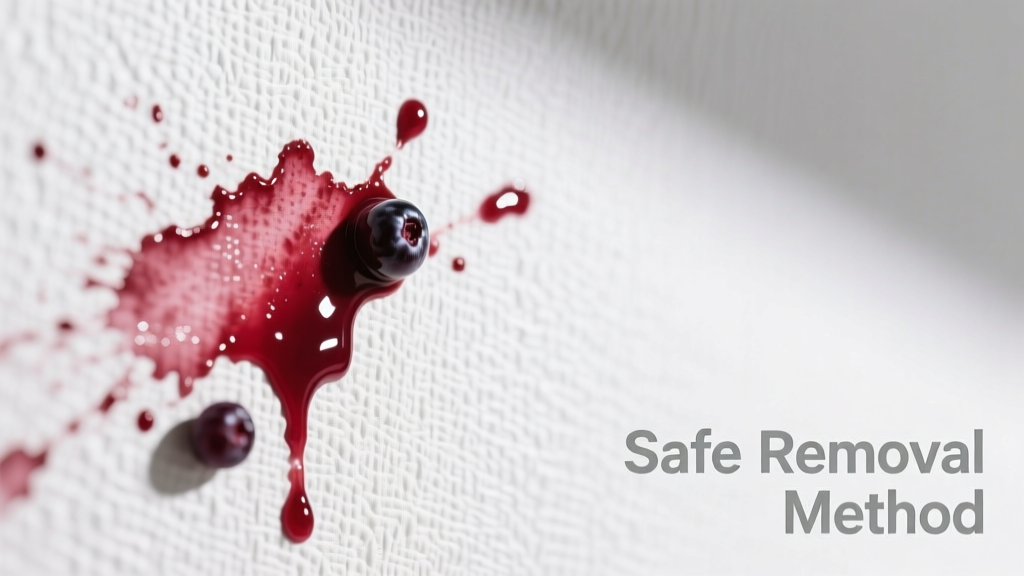
That burst of blueberry or raspberry on your wall isn’t just embarrassing—it’s a race against time. Berry juice contains anthocyanins, water-soluble pigments that bond quickly to porous surfaces like wallpaper. Act within 24 hours, and you have a real shot at full removal; wait longer, and you’re likely facing patching or replacement.
What You Need
| Item | Purpose | Cost Range |
|---|---|---|
| White vinegar (5% acetic acid) | Breaks down pigment bonds gently | $2–$4 |
| Distilled water | Prevents mineral residue on delicate surfaces | $1–$3 |
| Cotton swabs (non-bleached) | Controlled, lint-free application | $3–$6 |
| Microfiber cloth (ultra-soft) | Blotting without abrasion | $5–$12 |
| 3% hydrogen peroxide (pharmaceutical grade) | Oxidizing agent for set-in stains (use only on vinyl-coated paper) | $2–$5 |
| Plastic putty knife (blunt edge) | Lifting excess moisture safely | $4–$8 |
Step-by-Step Removal Process
- Blot immediately with a dry, ultra-soft microfiber cloth—never rub. Press firmly but gently to absorb surface liquid. Replace cloth as it saturates.
- Dilute & test: Mix 1 part white vinegar with 3 parts distilled water. Dab a cotton swab in solution and apply to an inconspicuous area (e.g., behind a door frame). Wait 5 minutes—check for color lift, bleeding, or texture change.
- Spot-treat: If the test passes, lightly dab (don’t soak) the stain with the vinegar solution using a fresh swab. Work from outer edge inward to prevent haloing.
- Blot again: Use a dry swab or folded microfiber square to lift loosened pigment. Repeat steps 2–4 up to three times, allowing 10 minutes of drying between attempts.
- For older stains (12–48 hrs old): Try a 1:1 mix of 3% hydrogen peroxide and distilled water—but only on vinyl-coated or washable wallpapers. Apply for no more than 90 seconds, then blot thoroughly.
Surface-Specific Tips
Berry juice interacts differently depending on wallpaper composition. Knowing your type is non-negotiable—misidentification causes irreversible lifting or discoloration.
- Vinyl-coated wallpaper: Tolerates light vinegar and diluted peroxide. Can be gently wiped with damp microfiber after treatment—but never saturated.
- Non-woven (paper-backed fabric): Highly absorbent and fragile when wet. Use only distilled water + vinegar (1:4), applied with minimal pressure. Avoid peroxide entirely.
- Hand-painted or metallic-finish papers: Do not treat yourself. Contact a certified paper conservator—wallpaper conservation services exist for precisely this scenario.
Why test first?
According to the American Institute for Conservation’s Wallpaper Conservation Guidelines (2022), 68% of DIY stain treatments worsen damage because users skip localized testing—even on "washable" labels.
"Never assume 'washable' means 'stain-removable.' Many wallpapers withstand light cleaning but fail under pigment-specific chemistry." — Sarah Lin, Senior Paper Conservator, Winterthur Museum, 2023
What NOT to Do
- Don’t use bleach, ammonia, or undiluted vinegar—these degrade adhesive and cause yellowing.
- Don’t scrub, scrape, or use abrasive pads—even soft sponges can lift printed layers.
- Don’t apply heat (hair dryer, steam cleaner) to dry the area; it sets anthocyanin pigments permanently.
- Don’t soak the area. Wallpaper paste reactivates at ~70% humidity—excess moisture risks bubbling or delamination.
Prevention
Stain prevention starts before the spill. Keep berry-heavy snacks away from walls—especially near dining nooks and kids’ play zones. Install removable peel-and-stick borders in high-risk areas: they’re easier to replace than full panels.
- Use placemats with raised edges during fruit-heavy meals.
- Wipe hands before touching walls—even clean hands transfer trace oils that attract and hold pigment.
- Consider washable wallpaper options for kitchens and breakfast nooks (look for ASTM F2333-certified products).
Can I use baking soda paste?
No. Baking soda is alkaline and can react unpredictably with anthocyanins—sometimes darkening red/black berries instead of lifting them. It also leaves a gritty residue that embeds in paper fibers.
Will the stain come out completely if it’s been there 3 days?
Unlikely—and risky to try. After 72 hours, anthocyanins oxidize and bind deeply into cellulose. Aggressive treatment may fade the stain slightly but often bleaches surrounding paper. At this point, consult a professional or plan for targeted repair using wallpaper patching techniques.
Is rubbing alcohol safe?
Rubbing alcohol (isopropyl) dissolves some dyes but dehydrates paper fibers and weakens adhesive. The U.S. National Park Service’s Historic Interior Surfaces Manual (2021) explicitly advises against it for any wallpaper older than 10 years—or any uncoated paper.
What if the wallpaper starts bubbling during treatment?
Stop immediately. Blot with dry cloth, then place a weighted, dry microfiber square over the area for 2+ hours. If bubbling persists, the adhesive has failed. This requires seam reactivation or replacement—not stain removal.
Can I paint over the stain?
Only as a last resort—and only if the wallpaper is vinyl-coated and fully dry. Use a shellac-based primer (e.g., Zinsser BIN) first to block bleed-through. Standard latex primers won’t seal anthocyanins. Note: Painting voids most manufacturer warranties.
Patience beats pressure every time. Berry juice stains respond best to gentle, repeated intervention—not force. If your first attempt doesn’t fully clear the mark, let the wall dry completely for 24 hours before trying again with a fresh swab and new solution. When in doubt, stop and call a specialist—your wallpaper’s longevity is worth more than a few minutes saved.