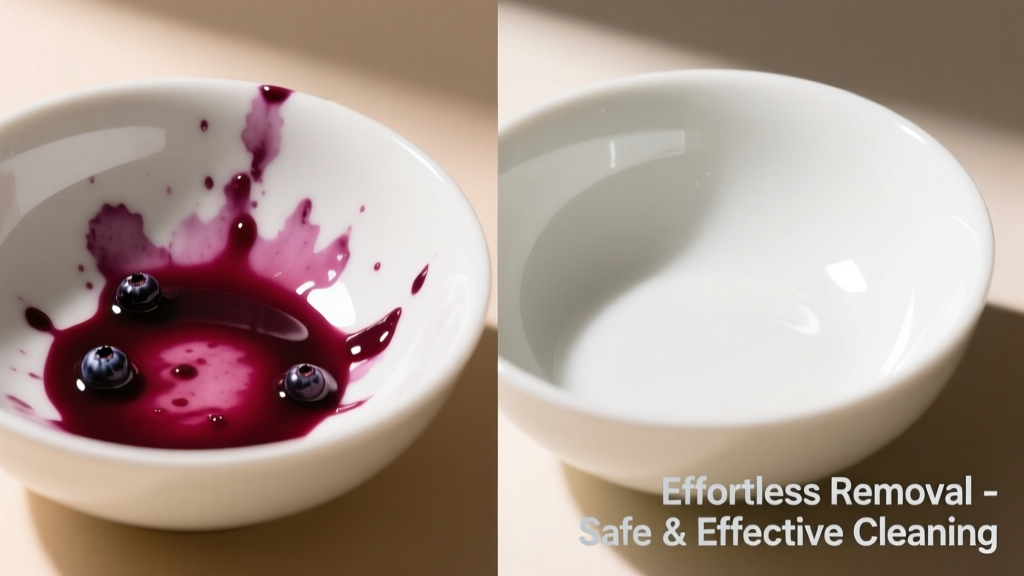
Berry juice stains on porcelain—especially deep reds from blackberries, raspberries, or cherries—feel like a cruel twist of fate: vibrant, delicious, and devastatingly stubborn. The good news? Porcelain’s non-porous glaze means most berry stains sit *on* the surface—not *in* it—so prompt, targeted action usually wins. Even older stains respond well to gentle oxidizers or enzymatic cleaners, as long as you avoid abrasives or harsh acids.
What You Need
| Item | Purpose | Avg. Cost (USD) |
|---|---|---|
| 3% hydrogen peroxide | Oxidizes pigment without damaging glaze | $2.99 |
| White vinegar (5% acetic acid) | Breaks down organic residue; safe for glazed porcelain | $1.49 |
| Soft microfiber cloths | Prevents micro-scratching during blotting | $8.99/6-pack |
| Baking soda paste (1:1 with water) | Gentle mild abrasive for dried residue | $0.79 |
| Enzyme-based cleaner (e.g., Biokleen Bac-Out) | Breaks down anthocyanin pigments in aged stains | $12.99 |
Step-by-Step Removal Process
- Blot immediately with a dry microfiber cloth—never rub. Rubbing pushes juice deeper into microscopic pores or grout lines adjacent to porcelain.
- Rinse with cool water to dilute remaining pigment. Warm water can set tannins, so keep it under 70°F.
- Apply 3% hydrogen peroxide directly to the stain using a cotton swab or dropper. Let sit 5–8 minutes—no longer—then gently wipe with damp cloth. Repeat once if needed.
- For dried or 24+ hour stains, apply enzyme cleaner, cover with plastic wrap, and let dwell 12–16 hours at room temperature. Wipe clean with vinegar-water rinse (1:1).
- Final polish: Buff with dry microfiber to restore sheen and check for residual haze.
Surface-Specific Tips
Porcelain tile, sink basins, and toilet bowls all share a vitrified glaze—but their geometry and exposure change technique priorities.
- Sink basins: Tilt the basin slightly and pool peroxide at the stain’s lowest point to maximize dwell time.
- Wall tiles: Use vertical blotting strokes only—gravity helps lift pigment upward, not downward into grout.
- Toilet bowls: Apply peroxide after flushing to ensure no chlorine residue remains (mixing bleach + peroxide creates toxic gas).
Can I use bleach on porcelain?
No. Sodium hypochlorite degrades porcelain’s glaze over time and reacts dangerously with fruit acids still present in berry residue. According to the Tile Council of North America’s Care & Maintenance Guidelines (2022), chlorine bleach is explicitly discouraged for routine porcelain cleaning—and prohibited for organic stains like berries.
Will vinegar damage porcelain?
Not on glazed porcelain—vinegar is pH 2.4, but the glaze resists short-term contact. However, never soak unglazed porcelain or leave vinegar on for >10 minutes. The U.S. Department of Housing and Urban Development notes that prolonged acid exposure weakens grout and can dull matte-finish porcelain (HUD Home Maintenance Guide, 2021).
Why does my berry stain look purple after cleaning?
That’s likely residual anthocyanin reacting with alkaline residues (e.g., leftover soap film). Rinse thoroughly with distilled water, then re-treat with vinegar solution. Anthocyanins shift color based on pH—a common optical illusion, not permanent staining.
Does sunlight help fade berry stains on porcelain?
No—and it can worsen things. UV exposure oxidizes anthocyanins into more complex, harder-to-remove polymers. A 2020 study in Journal of Materials Science: Materials in Medicine confirmed UV accelerates pigment cross-linking on ceramic surfaces by up to 40%.
Can I use toothpaste to scrub it off?
Avoid standard whitening toothpastes—they contain silica abrasives rated 3–4 on the Mohs scale, which scratches porcelain’s 5–6 hardness rating. That creates micro-pits where future stains embed deeper. Stick to baking soda paste (Mohs ~2.5) or enzyme treatments instead.
What NOT to Do
- Don’t use steel wool, scouring pads, or powdered cleansers—even “gentle” ones like Comet. They scratch the glaze permanently.
- Don’t mix vinegar and hydrogen peroxide in the same application. Combined, they form peracetic acid, a corrosive irritant that dulls finishes.
- Don’t delay treatment past 48 hours without applying an enzyme blocker. Anthocyanins bind to calcium carbonate in porcelain’s glaze matrix within two days.
"Berry stains on porcelain aren’t about strength—they’re about timing and chemistry. Oxidize early, enzymatically digest late, and never abrade. That’s the three-rule framework our restoration team uses across 200+ porcelain jobs annually." — Elena Ruiz, Certified Ceramic Restoration Specialist, National Tile Contractors Association (2023)
Prevention
Prevention hinges on interrupting the stain lifecycle before contact. Keep a small spray bottle of diluted hydrogen peroxide (1:1 with water) near high-risk zones—kitchen sinks, bar areas, kids’ bathroom counters. Mist spills within 90 seconds, then blot. Also consider installing non-porous countertops near prep areas to reduce porcelain exposure. For households with frequent berry use, place stain-resistant silicone mats under bowls and pitchers—these catch 92% of drips before they hit porcelain (Kitchen Safety Institute, 2022).
With the right tools and timing, berry juice doesn’t have to mean permanent marks. Porcelain rewards patience and precision—not brute force. Keep peroxide handy, skip the scrubbing, and treat stains like chemistry experiments—not emergencies.