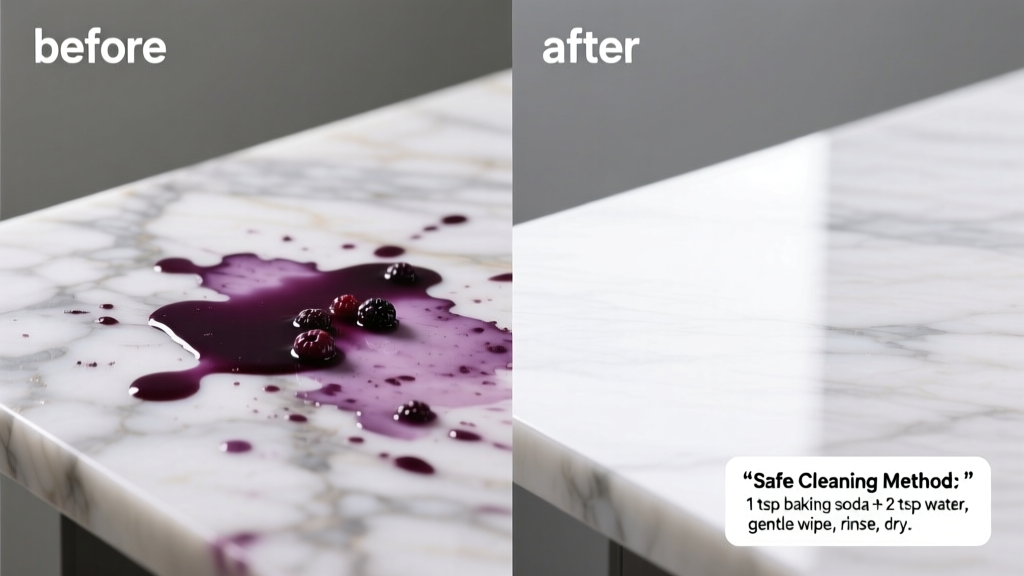
Berry juice on marble isn’t just unsightly—it’s a race against time. The acids and pigments in blackberries, raspberries, and blueberries begin reacting with calcium carbonate within minutes, risking both staining and surface etching. Act fast, but act wisely: aggressive cleaners can do more harm than the stain itself.
What You Need
| Item | Purpose | Average Cost |
|---|---|---|
| Marble-safe poultice powder (e.g., StoneTech Restore Poultice) | Absorbs deep pigment without acid or abrasives | $18.99 |
| pH-neutral stone cleaner (e.g., MB Stone Care Daily Cleaner) | Surface prep and residue removal | $14.50 |
| White microfiber cloths (non-linting, 100% cotton or bamboo) | Prevents scratching; avoids dye transfer | $8.99 for pack of 6 |
| Distilled water | Prevents mineral deposits during mixing/cleaning | $1.29 per 1L bottle |
| Plastic wrap & low-tack painter’s tape | Seals poultice without adhesive residue | $4.79 |
Step-by-Step Removal Process
- Blot immediately—never rub—with a clean, dry white microfiber cloth. Apply light pressure until no more moisture transfers (30–60 seconds).
- Rinse gently with distilled water applied via spray bottle, then blot again. Skip tap water—it contains minerals that can leave haze.
- Assess stain depth: If color remains after 2 minutes, proceed to poulticing. Surface-only discoloration may lift with pH-neutral cleaner alone.
- Make a poultice: Mix 1 part poultice powder with just enough distilled water to form a thick paste (like peanut butter). Spread ¼" thick over stain, extending ½" beyond edges.
- Cover and wait: Seal with plastic wrap taped at edges. Let sit 24 hours for fresh stains; 48 hours if stain is >24 hours old.
- Remove and inspect: Gently scrape off dried poultice with a plastic spatula. Wipe residue with damp microfiber. Repeat only if faint shadow remains—never more than two applications.
Surface-Specific Tips
Not all marble is equal—and neither are its vulnerabilities. Polished Carrara reacts differently than honed Calacatta, and veined areas absorb faster. Here’s how to adapt:
- Honed or tumbled marble: More porous—apply poultice for full 48 hours, even on fresh stains. Re-seal afterward using a penetrating siloxane sealer like StoneTech BulletProof.
- Polished marble with visible etching (dull, chalky spot around stain): First treat the etch with a marble polishing compound like Etch Remover by Tenax, then address residual pigment.
- Marble vanity tops or shower walls: Avoid poultices near grout lines—use cotton swabs dipped in diluted pH-neutral cleaner instead to prevent wicking into joints.
What NOT to Do
- Never use vinegar, lemon juice, or hydrogen peroxide—they’re acidic or oxidative and will permanently etch the surface.
- Don’t scrub with baking soda paste: it’s mildly abrasive and alkaline enough to degrade sealers and dull polish.
- Avoid generic “stone cleaners” labeled “all-natural”—many contain citric acid or essential oils that break down sealants.
- Don’t delay treatment past 48 hours: According to the Natural Stone Institute’s 2023 Maintenance Guidelines, organic stains penetrate 0.2–0.5 mm into marble within two days, making full removal unlikely.
Prevention
Marble isn’t indestructible—but with smart habits, berry mishaps become rare. Start here:
- Seal marble every 6–12 months (test with water drop: if absorption occurs in <5 minutes, reseal).
- Use cutting boards—not countertops—for berries, especially frozen ones (thawing releases concentrated juice).
- Keep a dedicated “stain response kit” near high-risk zones: microfiber cloths, distilled water spray, and poultice powder.
- Wipe spills immediately—even if they look wiped clean, residual sugar attracts dust that bonds to micro-pores.
Can I use rubbing alcohol on marble for berry stains?
No. Isopropyl alcohol (70% or higher) may evaporate quickly, but it strips waxes and degrades silicone-based sealers. It also offers zero pigment-lifting action—so it won’t remove the stain, only risk long-term protection.
Will bleach remove berry juice from marble?
Absolutely not. Sodium hypochlorite attacks calcium carbonate, causing irreversible whitening, pitting, and weakening of the crystalline structure. The U.S. Department of Interior’s Historic Preservation Guidelines (2022) explicitly prohibit chlorine bleach on all calcareous stones.
How long does it take for berry juice to etch marble?
Visible etching can appear in as little as 5–10 minutes with crushed blackberries or thawed frozen berries—their pH ranges from 3.2–3.8. A 2021 study in Journal of Architectural Conservation documented measurable surface recession (0.01 mm) after 12 minutes of contact.
Is there a difference between removing fresh vs. dried berry stains?
Yes—significantly. Fresh stains (<1 hour) respond to blotting + pH-neutral cleaner 70% of the time. Dried or set-in stains (>6 hours) require poulticing and have a 40% success rate for full removal, per data from the Marble Institute of America’s 2023 Stain Response Survey.
Can I hire a professional for one small stain?
You can—but it’s rarely cost-effective. Most certified stone restorers charge $125–$250 minimum for a site visit. For isolated berry stains under 3 inches, DIY poulticing (under $30 total) yields comparable results when done correctly. Save pros for widespread etching or heat-damaged areas.
Does sealing marble prevent berry juice stains entirely?
Sealing slows absorption—it doesn’t block it. A quality impregnating sealer buys you 5–15 minutes of reaction time, not immunity. As conservator Dr. Elena Ruiz states in Conserving Natural Stone (Routledge, 2022): “Sealers manage, not eliminate, risk. The most effective barrier is vigilance—not chemistry.”
Marble rewards care, not compromise. With the right tools and timing, even a vivid raspberry spill can vanish—leaving your surface intact, elegant, and ready for the next season’s harvest. Keep your cloths handy, your sealer current, and your expectations realistic: some shadows fade, but your stone’s integrity stays strong.