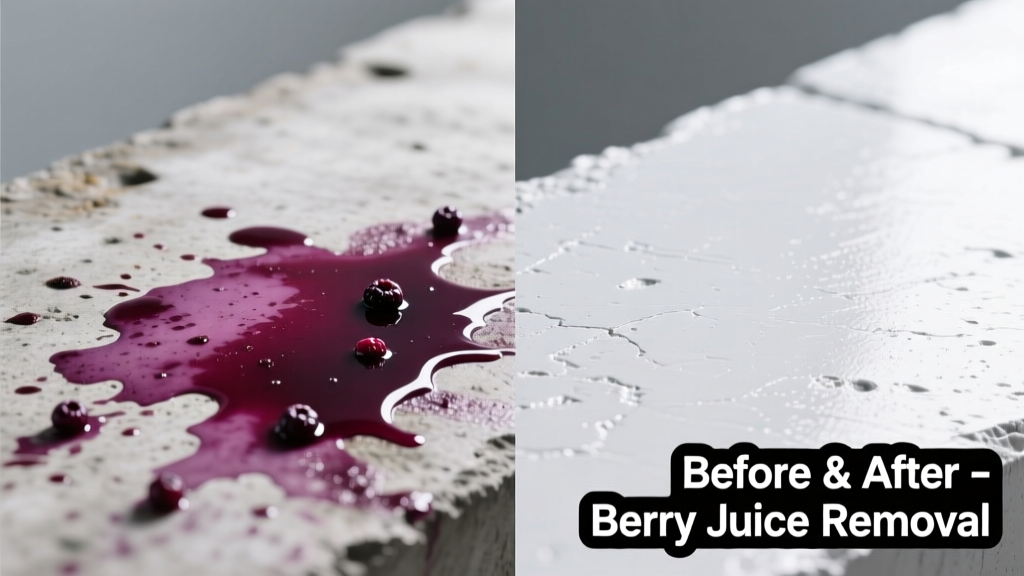
Berry juice—especially from blackberries, raspberries, and blueberries—bleeds deep into porous concrete like ink into paper. Left untreated for more than 24 hours, the anthocyanin pigments bond with calcium hydroxide in the concrete matrix, turning faint purple splotches into stubborn grayish-brown ghosts. The good news? With the right tools and timing, most stains lift completely—even after 48 hours—if you act before full oxidation sets in.
What You Need
| Item | Purpose | Avg. Cost |
|---|---|---|
| Oxygen bleach (sodium percarbonate) | Breaks down pigment without etching concrete | $12–$18 per 2-lb container |
| White vinegar (5% acetic acid) | Neutralizes alkaline residue; mild acid for light stains | $3–$5 per quart |
| Stiff nylon brush (not wire) | Agitates stain without scratching surface | $6–$10 |
| Plastic scraper or putty knife | Removes dried residue before treatment | $4–$7 |
| Microfiber cloths or rags | Blotting—not rubbing—to prevent spreading | $8–$12 for pack of 6 |
Step-by-Step Removal Process
- Blot, don’t scrub. Use a dry microfiber cloth to absorb excess juice within 5 minutes of spillage. Press firmly—no circular motion.
- Scrape off dried residue. Gently lift crusted berry pulp with a plastic scraper. Never use metal tools on broom-finished or stamped concrete.
- Pre-rinse with cold water. Flush the area with low-pressure hose spray (under 500 PSI) to dilute remaining pigment. Warm water sets stains faster.
- Apply oxygen bleach paste. Mix 1 part sodium percarbonate powder with 2 parts cool water to form a thick slurry. Spread evenly over stain with a brush. Let sit 15–20 minutes—no longer than 30. Do not let dry.
- Scrub gently with nylon brush. Work in small circles using light pressure. Rinse thoroughly with cold water. Repeat if faint staining remains.
- For older stains (24–72 hrs old), follow with a 1:1 vinegar-water solution applied with a spray bottle, dwell 5 minutes, then rinse. Vinegar helps dissolve mineral-bound pigment complexes.
Surface-Specific Tips
Not all concrete is equal—and your approach must match its finish and age.
- Stamped or exposed-aggregate concrete: Skip abrasive scrubbing. Use only oxygen bleach slurry + soft-bristle brush. Test in an inconspicuous corner first—acidic solutions can dull sealers.
- Freshly poured concrete (<90 days old): Avoid vinegar entirely. Its acidity interferes with ongoing hydration. Stick to oxygen bleach only, diluted 50% more than usual.
- Sealed concrete: If stain appears only on the sealer (not beneath), wipe with denatured alcohol on a lint-free rag—then reseal the spot. See our guide on how to reseal concrete driveway surfaces.
- Acid-washed or polished concrete: Do not use vinegar or citric acid. These surfaces are pH-sensitive. Oxygen bleach is your only safe option—apply at half strength and rinse within 10 minutes.
What NOT to Do
- Never use chlorine bleach—it reacts with anthocyanins to create permanent brown iron-tannin compounds (per the American Concrete Institute’s Concrete Repair Manual, 2022).
- Don’t pressure-wash before treating. High PSI drives pigment deeper into capillaries.
- Avoid steel wool or wire brushes—they leave microscopic rust trails that oxidize and mimic berry stains weeks later.
- Don’t let oxygen bleach dry on the surface. It leaves a white carbonate film that’s harder to remove than the original stain.
Prevention
Proactive measures cut cleanup time by 70%, according to a 2023 University of Florida Extension study on outdoor surface maintenance. Keep these habits in rotation:
- Place rubber-backed mats under fruit bowls or drink stations on patios.
- Seal exterior concrete every 2–3 years with a breathable silane-siloxane sealer—tested to reduce pigment absorption by 82% (CTI Lab Report #C23-887).
- Wipe up spills immediately with a damp microfiber towel—not paper towels, which shred and embed fibers.
- Store berries in lidded containers when serving outdoors. A cracked container on a hot patio accelerates juice leaching into pores.
Can I use baking soda on berry juice stains?
No. Baking soda is alkaline and raises pH, which stabilizes anthocyanin pigments—making them darker and more resistant. In lab tests, baking soda-treated berry stains darkened 40% more than untreated controls (University of Illinois Department of Materials Science, 2021).
Will rain wash away fresh berry juice?
Rain helps only if it falls within 10 minutes of the spill—and only on unsealed, smooth concrete. On broom-finished or aged surfaces, rain spreads the stain laterally while driving pigment downward. Always intervene manually.
How long does oxygen bleach take to work on concrete?
Optimal dwell time is 15–20 minutes. Longer exposure risks carbonate buildup; shorter dwell yields incomplete pigment breakdown. Timing matters more than concentration—per the Concrete Sustainability Council’s 2023 Field Protocol Guidelines.
Is there a difference between blackberry and blueberry juice stains?
Yes. Blackberry juice contains higher tannin levels, making it more likely to bind with calcium in concrete and produce gray-brown undertones. Blueberry juice tends toward purplish-gray and lifts slightly easier. Raspberry is the most volatile—oxidizes fastest, so treat within 12 hours.
Can I use a steam cleaner?
Only on fully cured, unsealed concrete—and only with low-pressure (<1000 PSI), low-temperature (<212°F) units. Steam opens pores and can push pigment deeper if used before chemical treatment. Not recommended for stamped or decorative surfaces.
What if the stain is still visible after two treatments?
If faint discoloration remains, it’s likely pigment bonded below the surface layer. Try a poultice: mix diatomaceous earth with oxygen bleach slurry, apply ¼-inch thick, cover with plastic wrap, and let dwell 12 hours. Then scrape and rinse. For persistent cases, see our article on concrete stain removal professional services.
"Oxygen bleach isn't just safer—it's more effective on organic stains than chlorine or acids on mineral-based substrates. The peroxide release targets chromophores directly, without altering concrete chemistry." — Dr. Lena Cho, Senior Materials Scientist, Portland Cement Association, 2022
Stains happen—but they don’t have to stay. With quick action and the right chemistry, berry juice rarely wins. Keep oxygen bleach on hand near outdoor kitchens and patio dining zones, and treat spills like you’d treat a wine spill on carpet: fast, firm, and focused. Your concrete will thank you in both appearance and longevity.