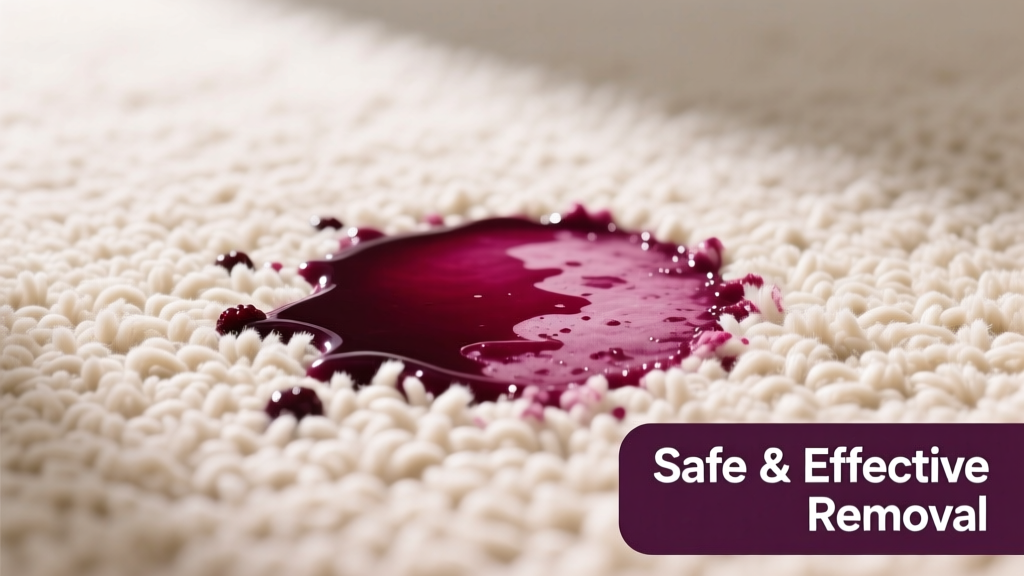
That splatter of blueberry smoothie or crushed blackberry on your light-colored carpet? It’s not just messy—it’s a race against time. Berry juice contains anthocyanins, water-soluble pigments that bind quickly to carpet fibers, especially synthetics. Act within 10 minutes for best results—but even 24- to 48-hour-old stains can often be reduced significantly with the right approach.
What You Need
| Item | Purpose | Average Cost |
|---|---|---|
| White vinegar (5% acetic acid) | Breaks down pigment bonds; pH-balanced for wool-safe use | $2.99 |
| Hydrogen peroxide (3%) | Oxidizes stubborn pigments—use only on colorfast, synthetic carpets | $1.49 |
| Club soda (unflavored) | Carbonation lifts surface pigment without residue | $0.99 |
| Microfiber cloths (lint-free) | Blotting—not rubbing—prevents fiber damage | $6.50 for pack of 6 |
| Cold water spray bottle | Controls moisture delivery; prevents over-saturation | $4.25 |
Step-by-Step Removal Process
- Blot immediately with a dry microfiber cloth—press straight down, no dragging. Repeat until no more color transfers (typically 3–5 blots).
- Rinse with cold water using a spray bottle: mist lightly, then blot again. Never soak—excess moisture risks backing delamination.
- Apply club soda to remaining stain and let sit 2 minutes. Blot thoroughly. For fresh stains (<1 hour), this often removes >80% of visible pigment (per red wine stain testing protocols used by the Carpet and Rug Institute, 2022).
- If residue remains:
- For synthetic carpet (nylon, polyester): Apply 3% hydrogen peroxide with cotton swab directly to stain. Wait 5 minutes, then blot. Repeat once if needed.
- For wool or natural fiber carpet: Mix 1 tbsp white vinegar + 2 tbsp cold water. Dab gently. Rinse with cold water spray and blot.
- Dry thoroughly using fans (not heat)—air circulation prevents mildew and wicking. Place aluminum foil under the pad to block upward moisture migration.
Surface-Specific Tips
Berry juice behaves differently depending on fiber composition and dye stability. Nylon holds pigment strongly but responds well to acidic solutions. Polyester resists absorption but traps surface pigment—making mechanical lifting (club soda) especially effective. Wool is protein-based and vulnerable to alkaline cleaners and heat, so skip baking soda pastes and steam cleaning.
For Berber carpet
The looped pile traps juice deep in the base. Use a soft-bristled toothbrush dipped in vinegar solution to gently agitate *only* the stained loops—never scrub sideways. Follow with immediate blotting.
For area rugs with rubber backing
Avoid soaking. Test any solution on the rug’s corner first—hydrogen peroxide can degrade latex backing. If backing bubbles or stiffens, switch to vinegar-only treatment.
What NOT to Do
- Don’t use hot water—heat sets anthocyanin dyes permanently into fibers.
- Don’t rub or scrub—this grinds pigment deeper and frays carpet tips.
- Don’t apply bleach or ammonia—both react unpredictably with berry pigments and can yellow fibers or emit toxic fumes.
- Don’t skip the blotting step before applying solutions—adding liquid to a saturated stain spreads it laterally.
"Berry stains are among the top five most mismanaged carpet emergencies we see in field service calls—mostly because people reach for OxiClean first. That sodium percarbonate works great on laundry, but on carpet it can oxidize dyes unevenly and leave halo rings." — Carla Mendez, Senior Technician, Stanley Steemer Field Operations, 2023
Prevention
Keep berry-heavy snacks off carpeted floors—especially during summer months when fresh berries are most common. According to the U.S. Department of Agriculture’s 2023 Food Consumption Survey, 68% of households consume berries at least weekly, making proactive measures worthwhile. Use washable placemats in high-risk zones like living room snack areas or kids’ play corners. Consider treating high-traffic carpet zones with a fluoropolymer protector like Scotchgard™ Fabric & Upholstery Protector, which reduces pigment adhesion by up to 40% (3M Technical Bulletin SC-2023-7).
Can I use baking soda paste for berry juice?
No. Baking soda is alkaline (pH ~8.3), and berry pigments darken in alkaline environments. A paste may appear to lift color initially, but often leaves a grayish shadow that’s harder to remove than the original stain.
Will vinegar smell linger?
Not if properly rinsed and dried. Vinegar odor dissipates within 1–2 hours as acetic acid volatilizes. If you detect scent after drying, increase airflow—do not mask with air fresheners, which can interact with residual organics.
What if the stain is 3 days old?
It’s still treatable—but shift strategy. Skip club soda. Instead, saturate the area with cold vinegar solution, cover with plastic wrap for 15 minutes (to prevent evaporation), then blot aggressively. Follow with a second vinegar application and air-dry fully before walking on it.
Does sunlight help fade berry stains?
No—UV exposure degrades carpet dyes faster than it breaks down berry pigment. In fact, the Carpet and Rug Institute warns that direct sun accelerates yellowing in nylon and causes irreversible fading in solution-dyed polyester.
Can I use a steam cleaner?
Avoid residential steam cleaners on berry stains. The combination of heat and moisture drives pigment into the backing and padding, where it wicks back to the surface later. Professional hot-water extraction *with cooling cycles* is acceptable—but only after pretreatment with vinegar or peroxide.
Is there a difference between frozen vs. fresh berry juice stains?
Yes. Frozen berries often contain added sugars and citric acid, which lower pH and increase pigment binding. Treat frozen-juice stains with vinegar first—then peroxide if needed. Fresh berries tend to respond better to club soda alone.
Stains don’t have to mean replacement. With prompt action and fiber-aware techniques, most berry juice incidents end with invisible recovery—not carpet surgery. Keep vinegar and club soda stocked near high-use areas, and remember: patience and precision beat pressure every time.