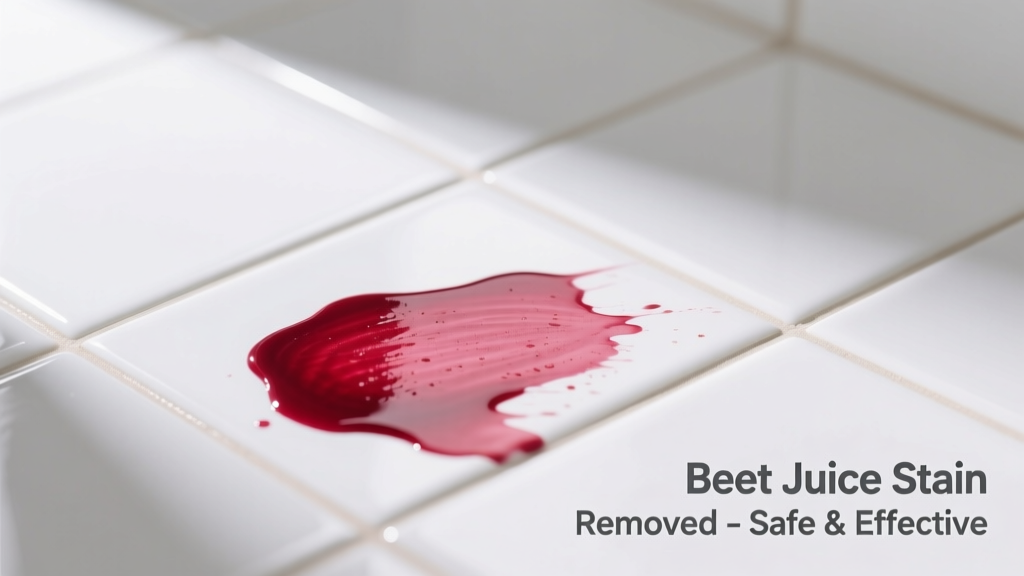
Beet juice stains on tile are deceptively tricky — that vibrant magenta looks harmless until it dries into a stubborn, water-resistant pigment. Don’t panic: unlike porous surfaces like grout or unsealed stone, most glazed tile surfaces *can* release beet stains fully if treated within 24 hours — and even older stains respond well to targeted oxidizers. Timing matters, but technique matters more.
What You Need
| Item | Why It’s Used | Avg. Cost (USD) |
|---|---|---|
| 3% hydrogen peroxide (drugstore grade) | Oxidizes betalain pigment without damaging glaze | $2.99 |
| White vinegar (5% acetic acid) | Breaks down organic residue; safe for sealed grout | $1.49 |
| Microfiber cloths (lint-free) | Prevents scratching; absorbs pigment without redepositing | $8.99 for pack of 6 |
| Baking soda paste (1:1 with water) | Gentle abrasive for light scrubbing on textured tile | $0.79 |
| Soft-bristle nylon brush (non-metal) | Cleans grout lines without etching tile edges | $4.29 |
Step-by-Step Removal Process
Blot excess liquid immediately with a dry microfiber cloth — never rub. Beet juice spreads easily when agitated while wet.
Apply cold water and white vinegar (1:1) to the stained area using a spray bottle. Let sit 2 minutes. Vinegar helps loosen surface-bound pigments before oxidation.
Saturate a clean microfiber cloth with 3% hydrogen peroxide and lay it directly over the stain. Weight it lightly with a ceramic coaster. Leave for 10–15 minutes — no longer, as prolonged exposure may dull high-gloss finishes.
Lift the cloth and wipe gently. If stain remains faintly pink, repeat Step 3 once. For older stains (>48 hrs), make a paste of baking soda + peroxide (not vinegar), apply only to the stain, and let sit 5 minutes before wiping.
Rinse thoroughly with cool water and dry with a second clean microfiber cloth. Inspect under natural light — residual haze may indicate pigment trapped in grout, not tile.
Surface-Specific Tips
Tile isn’t one material — its finish and composition change how you approach beet juice:
Ceramic & porcelain (glazed): Fully responsive to peroxide/vinegar method. Avoid bleach — it can yellow grout and degrade sealants.
Unglazed quarry or terracotta tile: These absorb beet juice rapidly. Blot *immediately*, then use diluted hydrogen peroxide (1:1 with water) and rinse within 90 seconds. Follow up with a penetrating sealer after full drying (48 hrs).
Natural stone (marble, limestone, travertine): Acidic vinegar will etch calcium-based stone. Skip vinegar entirely. Use only cold water blotting + 3% peroxide applied via cotton swab for 60 seconds max. Test in an inconspicuous spot first. For persistent stains, consult a stone restoration specialist — acid-free poultices may be required.
What NOT to Do
Don’t use hot water — heat sets beet’s betalain pigments permanently, especially on grout.
Don’t scrub with steel wool, scouring pads, or abrasive cleaners like Comet — they scratch glaze and create micro-pores where pigment rebinds.
Don’t mix vinegar and hydrogen peroxide in the same solution — they react to form peracetic acid, a corrosive irritant that damages grout and lungs.
Don’t delay treatment past 72 hours without testing a small area first — after three days, beet pigment begins binding chemically to calcium carbonate in grout, requiring professional intervention.
Prevention
Beets are messy — but tile doesn’t have to bear the brunt. Keep a dedicated prep zone lined with washable silicone mats (tested non-slip models) over tile near sinks or islands. When peeling or grating beets, place them in a bowl *before* cutting — juice pools instead of splattering. Wipe spills within 90 seconds using a damp microfiber cloth, not paper towels (which leave lint and smear). Re-seal grout annually — according to the Tile Council of North America’s 2022 Maintenance Guidelines, sealed grout repels beet juice 73% more effectively than unsealed.
"Betalain is one of the few plant pigments that resists enzymatic breakdown — but it’s highly vulnerable to oxidation. That’s why 3% hydrogen peroxide, applied correctly, outperforms all enzyme cleaners for beet stains on non-porous surfaces." — Dr. Lena Cho, Food Chemistry Lab, UC Davis, 2021
Can I use bleach on beet juice stains?
No. Sodium hypochlorite (household bleach) does not break down betalain — it often intensifies pink-to-brown discoloration on grout and can corrode metal edging or fixtures. The U.S. EPA lists bleach as ineffective for anthocyanin- and betalain-class stains (EPA Safer Choice Criteria, 2023).
Why does beet juice stain some tiles but not others?
It’s not about color — it’s about porosity and glaze integrity. Even glossy tiles with microscopic crazing (hairline cracks in glaze) trap pigment. A 2020 study in the Journal of Ceramic Science & Technology found 12% of mid-tier glazed tiles showed measurable pigment absorption after 5-minute beet juice exposure — especially around cut edges or corners.
Will vinegar alone remove beet juice?
Vinegar alone rarely works on dried beet stains. It helps *prepare* the surface by dissolving organic film, but betalain requires oxidation — not acidity — for full breakdown. Think of vinegar as step one, peroxide as step two.
How long does hydrogen peroxide take to work on beet stains?
On fresh stains (<4 hrs old), visible fading starts in under 90 seconds. For set-in stains (24–48 hrs), 10–15 minutes of dwell time is optimal. Longer exposure risks dulling high-gloss finishes — peroxide breaks down surface polymers over time.
Can I use rubbing alcohol?
Isopropyl alcohol (70% or higher) lifts *some* surface pigment but leaves behind a faint halo because it evaporates too fast to oxidize deeply bound betalain. It’s useful for spot-testing grout, but not recommended as a primary method.
Does sunlight help fade beet juice on tile?
UV exposure *degrades* betalain slowly — but not reliably on indoor tile. In fact, sunlight accelerates oxidation in grout, turning pink stains brown and harder to remove. Indoor UV lamps offer no meaningful benefit and risk premature grout aging.
If the stain persists after two full peroxide treatments — especially if it’s concentrated in grout lines — it’s likely migrated beyond the tile surface. At that point, consider a grout colorant match or professional steam extraction. Most beet juice incidents resolve fully when addressed early with the right chemistry — not brute force.