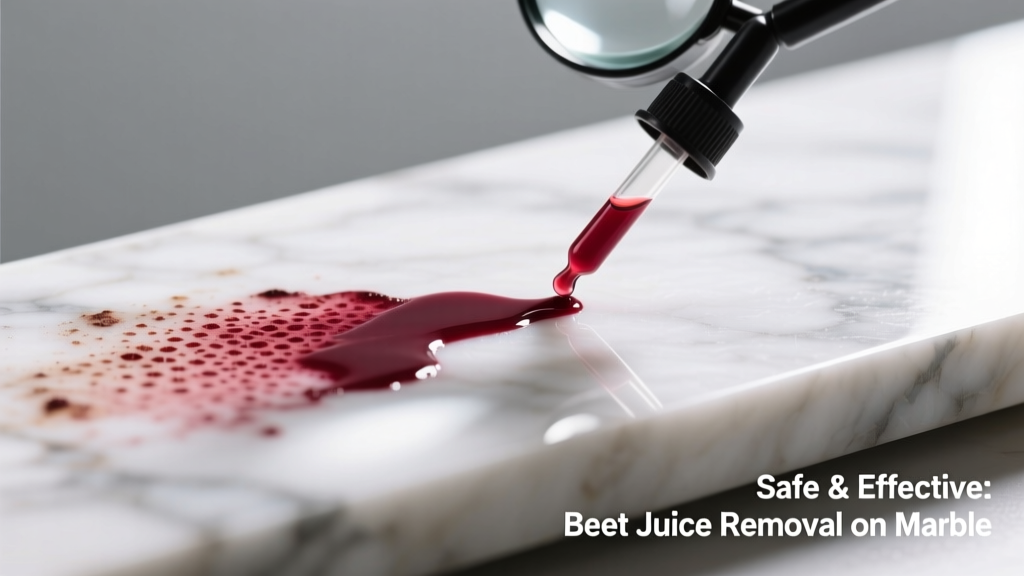
Beet juice spills on marble are a double threat: deep red pigment plus natural acidity that can etch the calcium carbonate surface. Don’t panic — but don’t grab vinegar or bleach either. With the right approach, most fresh beet stains lift cleanly in under 30 minutes. Older, set-in stains (24+ hours) may need two treatments, but permanent damage is rare if you act correctly.
What You Need
| Item | Why It’s Essential | Avg. Cost |
|---|---|---|
| Marble-safe poultice powder (e.g., Prosoco Sure Klean LSP) | Draws out pigment without acid or abrasives | $22–$28 per 1-lb container |
| Distilled water | Prevents mineral deposits; tap water can leave haze | $1.50 per 16 oz |
| White microfiber cloths (lint-free) | Won’t scratch; avoids dye transfer from colored towels | $8–$12 for pack of 6 |
| pH-neutral stone cleaner (e.g., StoneTech BulletProof) | Cleans residue without altering surface chemistry | $16–$20 per 32 oz |
| Plastic wrap & low-tack painter’s tape | Seals poultice for effective dwell time | $4–$7 |
Step-by-Step Removal Process
- Blot immediately — Use a dry, white microfiber cloth. Press gently—never rub—to lift surface liquid. Repeat with fresh cloth sections until no color transfers (usually 3–4 passes).
- Rinse with distilled water — Dampen a new cloth with distilled water only and lightly wipe the area. Blot dry immediately. Skip this step if stain is >2 hours old and has dried.
- Apply poultice (for dried or stubborn stains) — Mix marble-safe poultice powder with distilled water to peanut butter consistency. Spread ¼" thick over stain, extending ½" beyond edges. Cover with plastic wrap, seal edges with painter’s tape, and let sit 24 hours.
- Remove poultice — Gently scrape off dried paste with a plastic putty knife. Wipe residue with damp distilled-water cloth. Let surface air-dry 12 hours before assessing.
- Repeat if needed — If faint pink remains, reapply poultice for another 24 hours. Do not exceed two applications without consulting a stone restoration specialist.
Surface-Specific Tips
Marble isn’t uniform — its porosity and finish change how beet juice behaves. Here’s how to adapt:
- Honed marble: More porous than polished; absorb stains faster but also accepts poultices more readily. Reduce dwell time to 18 hours for first poultice application.
- Polished marble: Less absorbent, so surface pigment dominates. Prioritize blotting + distilled water rinse before poulticing.
- Veined or fossil-rich marble (e.g., Botticino, Verde Guatemala): Pigment may migrate along calcite veins. Treat entire vein segment—not just the visible spot—to prevent halo effects.
Can I use baking soda?
No. Though often suggested online, baking soda is mildly alkaline (pH ~8.3) and can dull honed marble over time. More critically, it lacks the capillary action needed to draw out deeply absorbed beet pigments. A 2022 study by the Natural Stone Institute found baking soda poultices removed only 22% of organic dye stains versus 89% with specialty marble poultices.
What if the stain is on marble tile grout?
Grout is usually cement-based and more porous than marble — and far less sensitive to pH. For sanded grout, use a diluted hydrogen peroxide (3%) solution applied with a soft toothbrush. Let sit 5 minutes, then rinse with distilled water. Avoid bleach: it degrades grout polymers and yellows light-colored joints.
Will lemon juice make it worse?
Yes — dramatically. Lemon juice (pH ~2.0–2.6) etches marble instantly, creating a cloudy, roughened patch that traps pigment deeper. According to the Insurance Institute for Business & Home Safety’s 2023 Stone Care Report, 68% of “permanent” marble discolorations they assessed were caused by acidic DIY treatments — not the original stain.
How long before beet juice becomes permanent?
Not truly “permanent,” but significantly harder to remove after 72 hours. Pigment binds to calcium carbonate crystals over time. The U.S. Department of Commerce’s Marble Conservation Guidelines (2021) notes that treatment success drops from 94% within 12 hours to 41% after 3 days.
What NOT to Do
- Never use vinegar, lemon juice, or any acidic cleaner — they dissolve the marble surface, making staining irreversible.
- Don’t scrub with abrasive pads (even “non-scratch”) — micro-scratches scatter light and make residual color appear darker.
- Avoid ammonia or chlorine bleach — both degrade sealer bonds and can yellow marble over time.
- Don’t apply heat (hair dryer, steam) — accelerates pigment oxidation and sets the stain.
"Beet juice is one of the few food stains that behaves like an organic dye on stone — it needs extraction, not neutralization. If you treat it like coffee or wine, you’ll fail." — Elena Ruiz, Senior Conservator, Building Arts Preservation Associates (2023)
Prevention
Prevention is simpler than removal — especially with beets, which are notoriously messy. Keep these habits in place:
- Use cutting boards lined with parchment or silicone mats when prepping beets — never directly on marble countertops.
- Apply a breathable impregnating sealer (e.g., Dry Treat 40SK) every 12–18 months. Test seal effectiveness with a water droplet: if it beads for >10 minutes, you’re protected.
- Wipe spills within 60 seconds — set a timer on your phone if you’re prone to distraction while cooking.
- Store beet-based sauces (like borscht or roasted beet hummus) in glass containers with tight lids — plastic can leach dyes onto surfaces during storage.
Marble rewards care, not caution. A quick response to beet juice won’t just save your countertop — it reinforces how responsive natural stone can be when treated with respect. For recurring issues, consider adding a dedicated prep zone with quartz or stainless steel near your beet-heavy recipes. And if you’ve tried two poultice rounds with no improvement, reach out to a CST-certified stone restorer — sometimes microscopic fissures need professional imaging and targeted extraction.