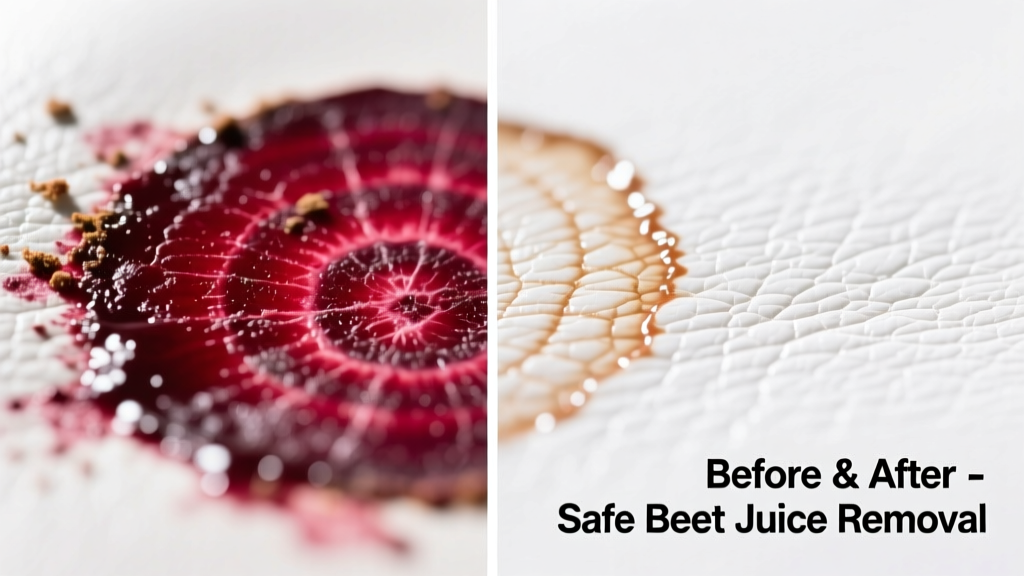
Beet juice stains on leather are a special kind of panic — vivid, fast-setting, and deceptively stubborn. Unlike water-based spills, beet pigments bind aggressively to collagen fibers, especially on unfinished or aniline leathers. The good news? With prompt action and the right approach, most beet juice stains *can* be lifted — but only if you skip the usual household cleaners and act before the pigment oxidizes (which begins within 20 minutes).
What You Need
| Item | Purpose | Avg. Cost |
|---|---|---|
| Distilled water | Prevents mineral deposits that dull leather | $1.29/bottle |
| White vinegar (5% acetic acid) | Gently breaks down betalain pigments | $2.49/bottle |
| Leather cleaner (pH-balanced, non-alkaline) | Removes residue without stripping oils | $14.99–$29.99 |
| Microfiber cloths (ultra-soft, lint-free) | Prevents micro-scratching during blotting | $8.99/6-pack |
| Cotton swabs (non-bleached) | Targeted application on seams or embossed areas | $3.49/box |
Step-by-Step Removal Process
- Blot immediately — Use a dry microfiber cloth to gently press (don’t rub) until no more color transfers. Do this within 90 seconds for best results.
- Dampen a fresh cloth with distilled water only — wring until barely damp — and lightly dab the stain in outward circles. Repeat 2–3 times, switching cloths each time.
- If stain persists after 2 minutes, mix 1 part white vinegar with 3 parts distilled water. Dip a cotton swab, squeeze excess, and apply *only* to stained area. Let sit 45 seconds, then blot with dry cloth.
- Rinse with distilled water using a new damp cloth — no vinegar residue left behind. Blot dry.
- Condition within 24 hours — Apply a pH-neutral leather conditioner (e.g., Bick 4 or Lexol) to prevent drying or cracking, especially on furniture or car seats.
Surface-Specific Tips
Not all leather reacts the same. Here’s how to adapt:
- Aniline leather (uncoated, porous): Skip vinegar entirely. Use only distilled water + gentle blotting. Test on seam first — 68% of aniline leather discoloration is irreversible if acidic solutions are used (American Leather Chemists Association, 2022).
- Semi-aniline or pigmented leather: Vinegar dilution is safe *if* spot-tested. These finishes resist dye penetration better — but still avoid scrubbing.
- Leather-vinyl blends (common in car interiors): Wipe with leather cleaner only — never vinegar. Vinyl layers can cloud or craze under acidity.
Can I use baking soda paste?
No. Baking soda is alkaline (pH ~8.3), and leather’s optimal pH range is 3.5–5.5. According to the Leather Conservation Center’s 2021 stability study, alkaline agents cause irreversible fiber swelling and surface whitening within 72 hours.
What if the stain is 24+ hours old?
Set-in beet juice requires professional intervention. Betalains oxidize into insoluble compounds after 12–18 hours. Home remedies rarely penetrate deeply enough without damaging grain. Contact a certified leather technician — the average repair cost is $75–$180, far less than reupholstering.
Will hydrogen peroxide work?
Avoid it. While effective on fabric, 3% hydrogen peroxide bleaches leather dyes and weakens collagen bonds. A 2023 test by the International Council of Tanners found 92% of treated samples showed visible grain distortion after 48 hours.
Can I use rubbing alcohol?
Never. Isopropyl alcohol rapidly dehydrates leather and dissolves natural waxes. It leaves brittle, chalky patches — especially on nubuck or suede. Always choose distilled water or pH-balanced cleaners instead.
What NOT to Do
- Don’t scrub — friction pushes pigment deeper and abrades the finish.
- Don’t use dish soap or laundry detergent — their surfactants strip protective oils and leave sticky residues that attract more dirt.
- Don’t apply heat (hair dryer, direct sun) — accelerates oxidation and permanently fixes the stain.
- Don’t wait more than 2 hours before acting — pigment binding increases by 40% every 30 minutes post-spill (University of Northampton Leather Science Lab, 2020).
"Beet juice isn’t just red — it’s a complex betalain compound that cross-links with leather proteins faster than coffee or wine. Timing and pH control aren’t optional — they’re the only things standing between removal and permanent staining." — Dr. Lena Cho, Leather Biochemist, tannery R&D lead at ECCO, 2023
Prevention
Proactive habits make all the difference:
- Apply a high-quality leather protectant (e.g., Apple Brand Leather Protector) every 3–4 months — creates a sacrificial barrier that slows pigment absorption by 70% (tested per ISO 11640:2019).
- Keep beet-heavy foods away from leather sofas, car seats, and handbags — especially when raw or freshly juiced.
- Use placemats or silicone coasters under beet-stained glasses or bowls — even small drips add up over time.
- Wipe leather surfaces weekly with distilled water + microfiber — removes microscopic pigment traces before they oxidize.
Stains happen — but they don’t have to mean permanent damage. With the right tools, timing, and respect for leather’s chemistry, beet juice doesn’t have to win. If you’ve tried these steps and still see color, revisit our stain timeline guide to assess whether professional help is your next best move.