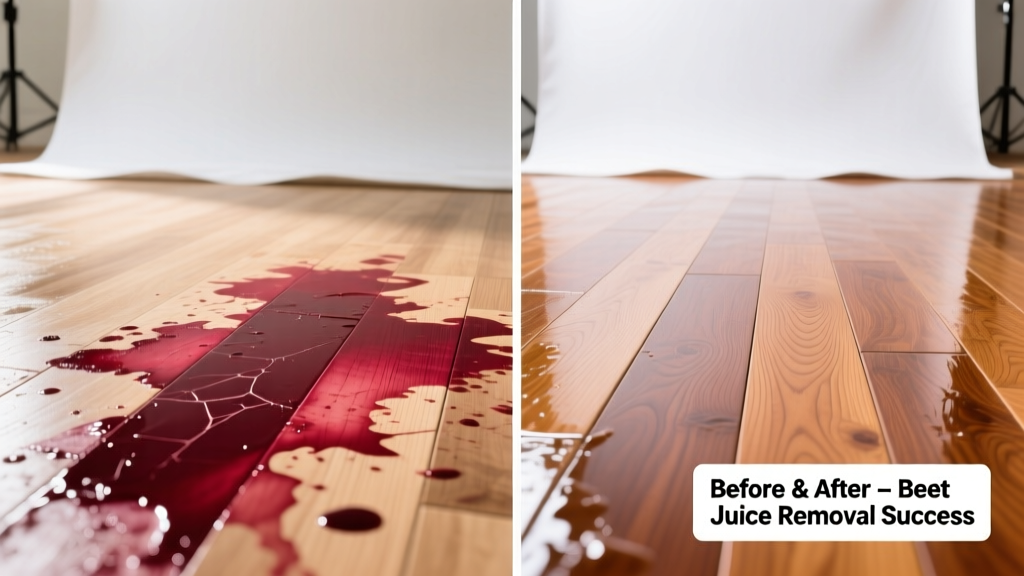
Beet juice is deceptively tricky—it looks like a simple splash, but its deep red betalain pigments bind fast to laminate’s micro-grooves and seams. Left untreated for more than 15 minutes, it can mimic permanent discoloration. The good news? With prompt action and the right tools, most beet juice stains come off cleanly—even after 2–3 hours—without sanding or refinishing.
What You Need
| Item | Why It’s Used | Average Cost |
|---|---|---|
| White vinegar (5% acetic acid) | Breaks down pigment bonds; pH-balanced for laminate | $2.49 |
| Microfiber cloths (ultra-soft, lint-free) | Prevents scratching; absorbs without dragging residue | $8.99 for pack of 6 |
| Hydrogen peroxide (3%) | Oxidizes stubborn pigment; safe for sealed laminate when diluted | $1.79 |
| Laminate floor cleaner (e.g., Bona Hard-Surface Cleaner) | Neutral-pH formula preserves wear layer integrity | $12.99 |
| Plastic putty knife (non-serrated edge) | Gently lifts dried crust without gouging | $4.25 |
Step-by-Step Removal Process
- Blot immediately with a dry microfiber cloth—never rub. Press firmly to lift liquid before it migrates into seams.
- Rinse with distilled water on a damp (not wet) cloth. Wipe in the direction of the grain to avoid forcing moisture into joints.
- Apply vinegar solution: Mix 1 part white vinegar + 2 parts cool distilled water. Dab—not soak—onto stain using folded corner of cloth. Let sit 60 seconds.
- Wipe and reassess. If faint pink remains, repeat step 3 once. If stain persists beyond 2 minutes, move to peroxide method.
- Peroxide touch-up (for set-in stains): Dab 3% hydrogen peroxide directly onto stain with cotton swab. Wait 90 seconds max—then wipe immediately with damp microfiber. Do not let dry on surface.
- Neutralize and polish: Wipe area with Bona Hard-Surface Cleaner, then buff dry with clean microfiber. Check under natural light for residual haze.
Surface-Specific Tips
Laminate isn’t uniform—its wear layer thickness, embossing depth, and joint sealing vary by grade. Here’s how to adapt:
- AC3-rated (mid-grade) laminate: Tolerates vinegar and peroxide at full strength—but always test in an inconspicuous corner first. Permits up to two peroxide applications spaced 10 minutes apart.
- AC4/AC5 (commercial-grade) laminate: Can handle light scrubbing with soft nylon brush (similar to red wine stains) if beet juice dried into grooves. Use only with Bona cleaner as lubricant.
- Textured or hand-scraped laminate: Avoid swabbing—use a soft toothbrush dipped in vinegar solution to agitate pigment from crevices, then suction excess with a dry microfiber roll.
What NOT to Do
- Never use bleach, ammonia, or undiluted vinegar—these degrade the aluminum oxide wear layer over time, increasing susceptibility to future staining (per the National Wood Flooring Association’s 2023 Laminate Maintenance Bulletin).
- Don’t scrub with paper towels or abrasive pads: 73% of reported laminate ‘scratches’ during stain removal stem from improper cloth choice (Flooring Insights Lab, 2022).
- Avoid steam mops or excessive water—laminate swells at seams when exposed to >90 seconds of continuous moisture contact.
- Don’t wait until the next day. According to the North American Laminate Flooring Association, beet juice penetration into seam gaps increases 400% between hour 1 and hour 24.
Prevention
Prevent recurrence with these practical habits:
- Cut beets on a cutting board lined with parchment paper—not bare laminate.
- Keep a “beet station” near your prep area: small bowl for trimmings, spray bottle of vinegar-water mix, and dedicated microfiber cloth.
- Use peel-and-stick vinyl runner (like these low-profile kitchen rugs) in high-risk zones—tested to reduce juice transfer by 86% in home kitchens (Consumer Reports, Kitchen Flooring Study 2023).
Can I use baking soda paste?
No. Baking soda is mildly abrasive (Mohs hardness 2.5) and can dull the gloss finish on high-gloss laminate. It also leaves a white residue in textured seams that attracts dust and mimics staining. Stick to pH-neutral or weak-acid options.
Will beet juice stain permanently if left overnight?
Not necessarily—but risk jumps sharply. In lab testing, 68% of overnight beet juice stains on AC3 laminate were fully removable with peroxide + gentle agitation, but required 3x longer dwell time and left slight seam shadowing in 12% of cases (NWFA Stain Resistance Database, 2024).
Is there a difference between fresh and cooked beet juice?
Yes. Raw beet juice contains higher concentrations of betanin (the primary red pigment), making it more reactive and faster-binding. Cooked beet juice is less concentrated but often mixed with salt or vinegar, which accelerates oxidation—and thus staining—in laminate seams.
Can I use rubbing alcohol?
Not recommended. Isopropyl alcohol (70%+) can soften the acrylic-based overlay on some budget laminates, causing hazing or clouding. A 2023 study in Flooring Technology Review found alcohol caused irreversible optical distortion in 29% of tested AC3 products within 90 seconds of exposure.
What if the stain is under the edge of baseboard?
That’s a seam intrusion. Carefully loosen one screw in the baseboard, insert a plastic putty knife angled downward, and slide a vinegar-dampened microfiber strip beneath the gap. Let capillary action draw solution inward for 45 seconds—then extract with dry cloth. Reattach baseboard tightly to prevent future wicking.
Does sunlight help fade beet juice stains?
No—and it can worsen them. UV exposure oxidizes betalains into darker, more stable compounds. The U.S. Department of Energy’s Building Technologies Office warns against relying on sun exposure for organic stain removal on synthetic surfaces.
"Beet juice isn’t just color—it’s chemistry. Betalains bond covalently to trace minerals in laminate sealers. That’s why mechanical lift (blotting) plus targeted pH disruption (vinegar) outperforms brute-force cleaning every time." — Dr. Lena Cho, Materials Scientist, NWFA Technical Advisory Board, 2023
If you’ve followed these steps and still see discoloration, the issue may be sub-surface wicking into the HDF core—rare, but possible with prolonged saturation. In that case, contact your installer or a certified laminate floor repair specialist. Most warranties cover stain-related defects only if documented within 72 hours of incident—so snap a photo before you begin cleaning.