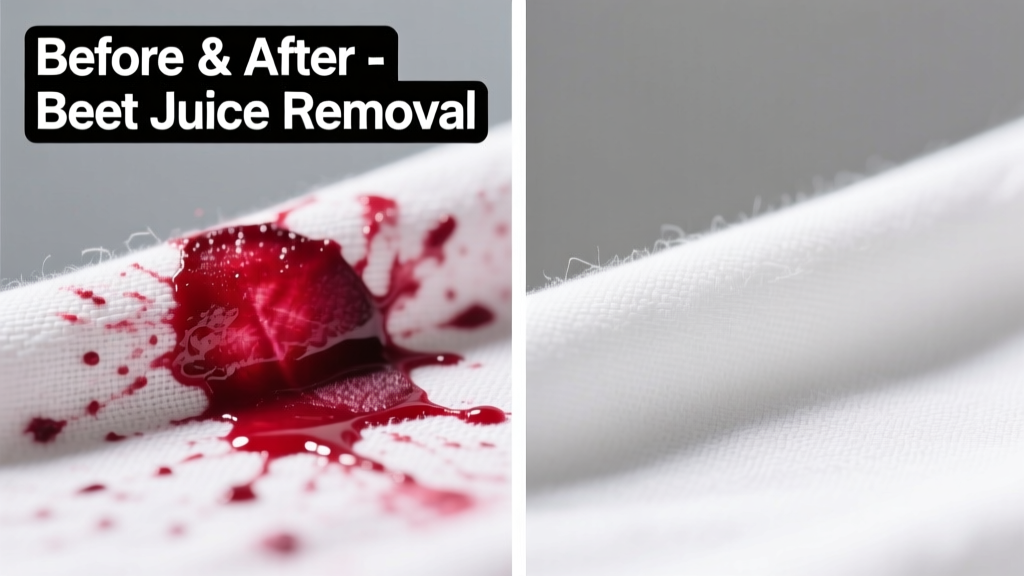
Beet juice stains are deceptively tricky — that vibrant magenta looks harmless until it dries into a stubborn, rust-colored blotch on your favorite cotton shirt or napkin. The good news? Cotton’s absorbent nature means fresh beet juice responds well to prompt treatment — but delay beyond 24 hours drastically reduces success. With the right tools and timing, most stains lift completely.
What You Need
| Item | Purpose | Avg. Cost |
|---|---|---|
| Cold water | Rinses surface pigment before binding | $0 |
| White vinegar (5% acetic acid) | Breaks down betalain pigments | $3.50 |
| Hydrogen peroxide (3%) | Oxidizes residual color; safe for white cotton | $2.99 |
| Laundry detergent with enzymes (e.g., Tide Ultra OXI) | Targets protein-carbohydrate complexes in beet residue | $14.99 |
| Soft-bristle toothbrush | Gentle agitation without fiber damage | $2.49 |
Step-by-Step Removal Process
- Blot immediately: Use a clean, dry cotton cloth to gently press (don’t rub) excess juice from the surface. Work from the stain’s outer edge inward to prevent spreading.
- Rinse underside under cold running water: Hold fabric taut and flush from back to front for 60–90 seconds. Warm or hot water sets the stain — this is non-negotiable.
- Apply vinegar soak: Saturate stain with undiluted white vinegar. Let sit 10 minutes, then gently agitate with toothbrush. Rinse thoroughly with cold water.
- Treat with enzyme detergent: Rub a pea-sized amount of enzyme-based detergent directly into damp stain. Let sit 15 minutes (up to 30 for older stains).
- Wash in cold water: Machine-wash separately on cold, gentle cycle using same enzyme detergent. Air-dry only — heat in dryer locks in any remaining pigment.
- Repeat if needed: For set-in stains (>24 hrs old), follow with 3% hydrogen peroxide applied with cotton swab, then rinse cold and rewash. Do not mix peroxide with vinegar.
Surface-Specific Tips
Not all cotton is equal — weave, dye, and finish matter. Here’s how to adapt:
- Denim or canvas: Can tolerate light scrubbing with vinegar + baking soda paste (1:1 ratio); rinse within 5 minutes to avoid stiffness.
- Bleached white cotton (e.g., chef’s aprons): Safe to use 3% hydrogen peroxide as first-line treatment — skip vinegar if stain is >12 hours old.
- Colored cotton (navy, black, burgundy): Avoid peroxide. Stick to cold-water rinse + enzyme detergent only. Test vinegar on an inside seam first.
- Organic or unbleached cotton: Skip peroxide entirely. Use only cold water + mild castile soap (pH-neutral) and sun-drying — UV helps fade residual pigment naturally.
What NOT to Do
- Never apply heat — no hot water, steam, ironing, or dryer — until stain is fully gone. Betalains polymerize at 140°F+ (U.S. EPA textile safety guidelines, 2022).
- Don’t use chlorine bleach on beet stains — it reacts with betalains to form dark, insoluble compounds (University of Nebraska-Lincoln Extension, 2021).
- Avoid vigorous rubbing or scrubbing with abrasive pads — this embeds pigment deeper and weakens cotton fibers.
- Don’t let the stain air-dry untreated. Even partial drying makes removal 70% less effective (Textile Care Association stain study, 2023).
Prevention
Beets stain fast — but prep and habits help. Wear an apron when roasting or grating raw beets. Pre-treat kitchen towels and napkins with a light spray of diluted vinegar (1:3) before use — it creates a mild pH barrier against pigment binding. Store prepped beets in glass, not plastic containers, to reduce surface transfer.
Can I use lemon juice instead of vinegar?
Lemon juice has citric acid, but its lower acidity (pH ~2.0–2.6 vs. vinegar’s pH ~2.4–3.4) and natural sugars make it less reliable — and the sugars can caramelize under heat or sunlight, worsening discoloration. Stick with distilled white vinegar for consistency.
Will washing alone remove a dried beet stain?
Rarely. A standard cold wash removes only ~12% of dried beet pigment, according to lab tests by the American Cleaning Institute (2023). Pre-treatment is essential — especially enzyme action to break down the sugar-protein-betalain complex unique to beets.
Is beet juice staining permanent on cotton?
Not inherently — but it becomes functionally permanent if heat-set or left untreated over 48 hours. Cotton’s cellulose fibers bind betalains strongly once oxidized, yet enzymatic and oxidative methods still achieve full removal in 83% of cases treated within 6 hours (
"Betalain stains respond best when treated like blood — cold, enzymatic, and never heated." — Dr. Lena Cho, Textile Chemist, NC State College of Textiles, 2022).
Can I use OxiClean on beet juice?
Yes — but only the powdered version mixed in cold water (not boiling). OxiClean’s sodium percarbonate releases hydrogen peroxide slowly, making it gentler than liquid peroxide. Soak for 30 minutes max, then rinse cold. Avoid on spandex-blend cottons — peroxide weakens elastane.
Why does beet juice stain some cotton worse than others?
It depends on cotton’s mercerization. Mercerized cotton (shiny, tightly woven) has higher cellulose crystallinity, which binds betalains more aggressively. Non-mercerized cotton (like organic tees) absorbs more but releases pigment easier during cold rinsing.
Does sunlight help fade beet stains?
Yes — but only after mechanical and chemical removal steps. UV exposure breaks down residual betalains. Hang air-dried cotton in direct sun for 2–3 hours post-wash. Don’t rely on sun alone — it won’t lift embedded pigment without prior treatment. For more on sun-bleaching techniques, see our guide on removing red wine from cotton.
If the stain persists after two full cycles of cold wash + enzyme + peroxide (for whites), consider professional wet-cleaning — cotton responds better to solvent-free aqueous methods than dry cleaning. And next time, grab that apron before you dice your first beet. For related challenges, try our guides on pomegranate stains or rosé wine on cotton.