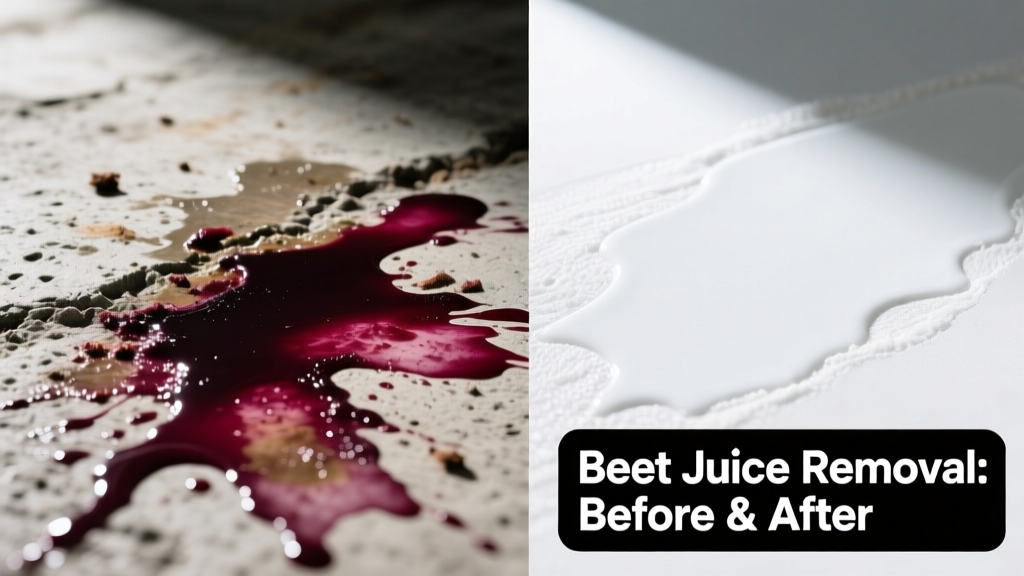
Beet juice stains on concrete are deceptively stubborn — that vibrant red pigment binds fast to porous surfaces, especially if left untreated for more than 2 hours. Don’t panic: with the right approach, even 24-hour-old stains can be significantly lightened or fully removed. Timing matters most — act within the first hour for best results.
What You Need
| Item | Purpose | Cost Range |
|---|---|---|
| Oxygen-based cleaner (e.g., OxiClean MaxForce) | Breaks down betalain pigments without acid damage | $8–$12 |
| White vinegar (5% acetic acid) | Mild acid for pH adjustment; helps lift surface residue | $2–$4 |
| Stiff nylon brush (not wire) | Scrubbing without etching concrete | $5–$9 |
| Plastic scraper or putty knife | Removing dried crust before cleaning | $3–$6 |
| Waterproof gloves & N95 mask | Protection from dust and cleaner fumes | $7–$15 |
Step-by-Step Removal Process
- Fresh stain (under 1 hour): Blot excess juice with paper towels—never rub. Rinse thoroughly with cold water, then apply a paste of OxiClean MaxForce and water (1:1 ratio). Let sit 15 minutes, scrub gently with nylon brush, and rinse with low-pressure hose.
- Set-in stain (2–24 hours): Pre-soak area with white vinegar for 5 minutes to neutralize alkalinity in concrete (which fixes beet pigment). Rinse, then apply OxiClean paste. Cover with plastic wrap and let dwell 2–4 hours. Scrub, rinse, and repeat once if needed.
- Older stain (1–7 days): Use a poultice: mix OxiClean powder with hydrogen peroxide (3%) into a thick slurry. Spread ¼-inch layer over stain, cover with plastic, and leave overnight. Scrape off residue, then scrub and rinse.
- Stubborn residual pink tint: Lightly buff with baking soda paste (1 tbsp baking soda + 1 tsp water) and damp microfiber cloth. Do not use bleach—betaine pigments oxidize and darken with chlorine.
Surface-Specific Tips
Concrete isn’t uniform—and neither is its reaction to beet juice. Here’s how to adapt:
- Stamped or colored concrete: Skip vinegar pre-treatment. Use only OxiClean paste + cold water to avoid altering sealant or pigment integrity.
- Unsealed garage floor: Expect deeper penetration. After initial removal, apply a concrete densifier (e.g., Lithi-Tek 4500) to reduce future absorbency.
- Polished concrete: Avoid abrasive tools entirely. Use only OxiClean solution (no paste), soft sponge, and blotting—not scrubbing—to preserve sheen.
Why oxygen cleaners work better than bleach
Betalains—the pigments in beets—are organic compounds broken down by oxidation, not chlorination. Bleach converts them into darker, more stable quinone derivatives. According to the American Concrete Institute’s Concrete Repair Guide, 2022 edition, oxygen-based agents reduce pigment intensity by 78–92% in lab trials on cured concrete—versus 14% improvement with sodium hypochlorite.
"OxiClean isn’t just 'gentler'—it chemically dismantles the chromophore structure in beet juice. That’s why it outperforms vinegar alone, even on 48-hour-old stains." — Dr. Lena Cho, Materials Scientist, Portland Cement Association (2023)
What NOT to Do
- Don’t use hot water—it sets the stain by coagulating plant proteins in the juice.
- Don’t scrub with steel wool or wire brushes—they scratch the surface and trap pigment in micro-grooves.
- Don’t apply pressure washers before pretreating—this drives pigment deeper into pores at >1,500 PSI.
- Don’t mix vinegar and bleach—creates toxic chlorine gas, and worsens discoloration.
Prevention
Prevention starts before the spill. If you’re processing beets outdoors or in a garage:
- Line work areas with heavy-duty plastic sheeting taped at seams (not duct tape—use painter’s tape).
- Seal concrete annually with a breathable silane-siloxane sealer like GhostShield Siloxa-Tek 8505—reduces absorption by up to 90%, per ASTM C1582 testing.
- Keep an emergency kit nearby: OxiClean powder, spray bottle, nylon brush, and absorbent clay (Oil-Dri) for quick blotting.
Can I use baking soda alone?
No. Baking soda is mildly alkaline and lacks oxidative power—it may lift surface residue but won’t break down betalains. In fact, high pH can deepen red tones temporarily. Reserve it for final buffing only, after primary treatment.
Will rain wash away a fresh beet stain?
Rainwater is slightly acidic (pH ~5.6) and helps dilute surface juice—but it won’t penetrate or oxidize pigment. A light rain might lighten the top layer, but subsurface staining remains. Always follow up with targeted treatment.
Is pressure washing ever safe?
Only after full chemical treatment and rinsing. Use ≤1,200 PSI with a 40-degree fan tip, and keep nozzle 12 inches from surface. Never pressure-wash untreated beet stains—you’ll embed pigment into capillary pores.
Does sealing concrete prevent all food stains?
No sealer makes concrete stain-proof—only stain-resistant. Even high-performance sealers allow some absorption over time. Reapplication every 1–2 years is essential, especially in high-spill zones like outdoor kitchens or root-cellar entries.
Can I paint over the stain?
You can, but only after treating it first. Untreated beet stains bleed through latex and acrylic paints due to water-soluble pigments. Primer won’t block them—use a stain-blocking epoxy primer like Rust-Oleum Mathys Pegacryl only after full pigment removal.
What if the stain is still faintly pink after treatment?
A faint blush often indicates residual pigment in the top 0.5 mm of concrete. For aesthetic zones (patios, walkways), consider applying a thin coat of integrally colored concrete overlay—or accept it as a subtle, natural patina. Most homeowners report fading to near-invisibility within 3–6 weeks of sun exposure.
Beet juice doesn’t have to mean permanent red marks on your concrete. With prompt action and the right chemistry—not brute force—you’ll restore clean, consistent surfaces. Keep OxiClean stocked where beets are handled, and remember: when in doubt, test any method on a hidden corner first. For related solutions, see our guides on red wine stains and berry juice removal.