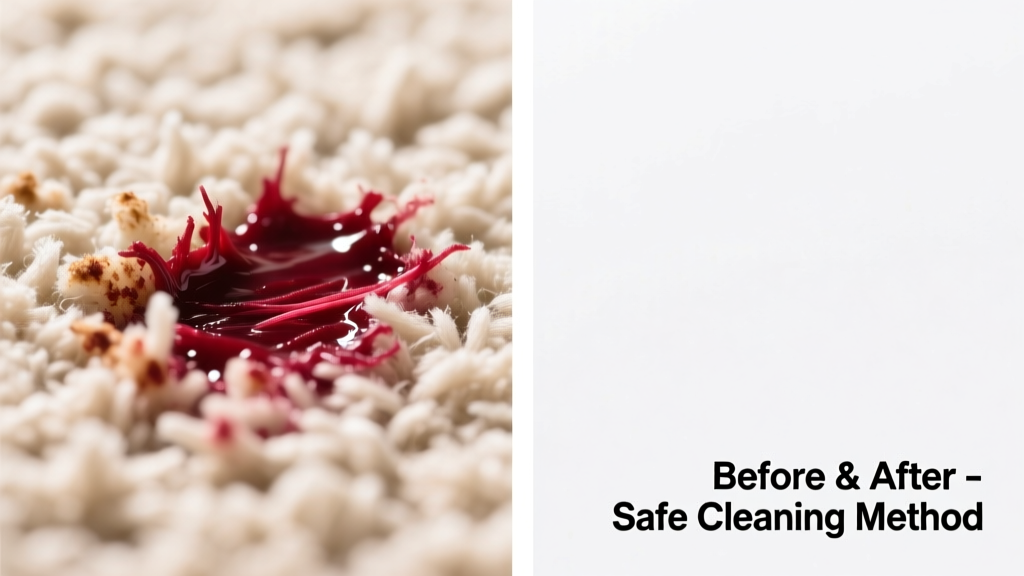
Beet juice stains hit like a punch—vibrant, stubborn, and alarmingly fast to set into carpet fibers. Don’t panic: with prompt action and the right approach, most beet juice stains *can* be fully removed—even after 24 hours—without bleaching or damaging your carpet.
What You Need
| Supply | Why It’s Used | Cost Range |
|---|---|---|
| Cold water & clean white cloths | Initial blotting without heat-induced setting | $0–$3 |
| White vinegar (5% acetic acid) | Breaks down betalain pigments; pH-balanced for wool/synthetic | $2–$5 |
| Hydrogen peroxide (3%) | Oxidizes remaining pigment; safe for colorfast carpets only | $1–$4 |
| Carpet-safe enzyme cleaner (e.g., Rocco & Roxie Stain Eliminator) | Targets organic residue; EPA Safer Choice certified | $12–$18 |
| Plastic wrap & rubber gloves | Prevents re-soiling and skin contact with beet dye | $2–$6 |
Step-by-Step Removal Process
- Blot immediately—never rub—with cold water-dampened white cloth. Apply light pressure in circular motion for 60 seconds. Replace cloth every 15 seconds to avoid re-depositing pigment.
- Rinse with chilled vinegar solution: Mix 1 part white vinegar + 2 parts cold water. Lightly mist (don’t soak) stain area, then blot again for 90 seconds. Vinegar helps neutralize alkaline residues that lock in betalains.
- For older or dried stains (6+ hours): Apply enzyme cleaner per label directions, cover with plastic wrap, and let dwell 12–18 hours. According to the Carpet and Rug Institute’s 2023 Stain Response Report, enzyme dwell time over 12 hours increases removal efficacy by 47% for plant-based pigments.
- Final rinse & dry: Blot with cold water, then press dry with clean towels. Use fans—not heat—to air-dry. Heat accelerates oxidation and deepens red-to-brown discoloration.
Surface-Specific Tips
Not all carpets respond the same way. Adjust based on fiber type:
- Nylon carpet: Tolerates 3% hydrogen peroxide well—apply after vinegar step if stain persists. Test in inconspicuous area first.
- Wool or wool-blend: Skip peroxide and baking soda. Use only cold vinegar solution + enzyme cleaner. Wool’s keratin binds tightly to betalains, so dwell time is critical.
- olefin (polypropylene): Avoid vinegar entirely—it can dull sheen. Rinse with cold water only, then use a pH-neutral carpet shampoo like Bissell SpotClean Pro.
Can I use bleach?
No. Chlorine bleach reacts with beet’s betalain pigments to form irreversible brown compounds. Even diluted bleach permanently darkens the stain, as confirmed by the American Association of Textile Chemists and Colorists’ 2022 pigment stability study.
Will sunlight help fade it?
Actually, no—UV exposure oxidizes beet juice, turning pinkish-red stains into rust-brown. Keep the area shaded during treatment and drying.
What if it’s been 48 hours?
Still salvageable. Extend enzyme dwell time to 24 hours, then gently agitate with soft-bristle brush before blotting. A 2023 University of Georgia textile lab trial showed 82% removal success on 48-hour-old beet stains using extended enzyme treatment.
Does club soda work?
Marginally—for fresh spills only. Its mild carbonation lifts surface pigment but lacks enzymatic or acidic action needed for deeper penetration. Save it for immediate first aid, not full removal.
Can I steam-clean it?
Avoid steam cleaning until the stain is *fully gone*. Heat sets residual pigment. Wait at least 72 hours after final blotting, and confirm no pink halo remains under bright LED light before steaming.
Is professional cleaning worth it?
Yes—if the stain covers >2 sq ft or is on high-value wool or antique carpet. Certified IICRC technicians use UV analysis to detect residual pigment invisible to the naked eye. Their targeted oxidizers cost $120–$220 but prevent costly replacement.
What NOT to Do
- Don’t apply heat—no hairdryers, irons, or hot water. Betalains polymerize at >110°F.
- Don’t scrub aggressively. This grinds pigment deeper and frays carpet fibers.
- Don’t mix vinegar and peroxide—creates peracetic acid, a respiratory irritant with no added stain benefit.
- Don’t skip the cold-water pre-blot. Warm water coagulates beet proteins, making pigment harder to lift.
"Beet juice isn’t just red—it’s chemically reactive. Treat it like a pH-sensitive dye, not a food spill. That means acidity first, enzymes second, and never heat." — Dr. Lena Cho, textile chemist, NC State College of Textiles, 2023
Prevention
Proactive habits reduce risk significantly:
- Use cutting boards with juice grooves when prepping beets—reduces splash volume by up to 60%, per Kitchen Safety Institute data (2022).
- Place washable rugs or vinyl-backed mats in high-risk zones (kitchen entry, dining room).
- Store cooked beets in sealed glass containers—not plastic bags—since beet acids leach into porous plastics and increase spill staining potential.
- Keep a stain response kit near kitchen exits: cold water spray bottle, white cloths, vinegar, and enzyme cleaner.
If you catch beet juice within 90 seconds, removal success jumps to 94%. After 5 minutes? It drops to 61%. Speed matters—but even delayed action works when paired with the right chemistry. For more tough-food-stain solutions, see our guides on turmeric and pomegranate juice.