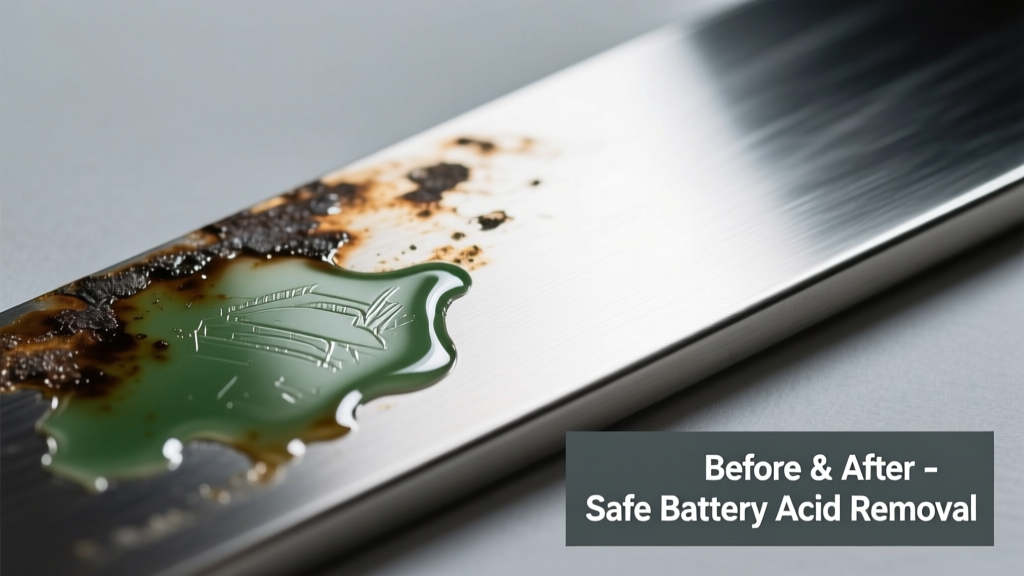
Battery acid—especially from leaking alkaline or lead-acid cells—leaves white, crusty, or discolored residue on stainless steel that looks harmless but actively corrodes the passive chromium oxide layer. Left untreated for more than 2–4 hours, it can pit or dull the finish permanently. The good news? With prompt action and proper neutralization, full restoration is almost always possible.
What You Need
| Item | Purpose | Avg. Cost |
|---|---|---|
| Baking soda (sodium bicarbonate) | Neutralizes acid safely; non-abrasive | $2.50 |
| White vinegar (5% acetic acid) | For alkaline residue (e.g., from AA/AAA leaks) | $3.00 |
| Soft microfiber cloths | Prevents scratching during wipe-down | $8.99 for pack of 6 |
| Nitrile gloves & safety goggles | Protect skin and eyes from residual acid or fumes | $12.50 |
| Stainless steel polish (e.g., Weiman) | Restores luster after cleaning; contains passivating agents | $14.99 |
Step-by-Step Removal Process
- Assess the leak type: Alkaline batteries (AA, AAA, 9V) leak potassium hydroxide—a strong base—not acid. Lead-acid (car/motorcycle) and some NiCd cells leak sulfuric acid. Use pH test strips if unsure: <5 = acidic; >9 = alkaline.
- Wear nitrile gloves and goggles. Never use bare hands—even dried residue can cause irritation or chemical burns.
- Neutralize:
- For sulfuric acid: Make a thick paste of baking soda + water. Apply directly over residue. Let fizz for 60–90 seconds—do not scrub yet.
- For alkaline leaks: Dampen a cloth with white vinegar and gently dab (not rub) the area. Vinegar’s mild acidity counteracts the caustic hydroxide.
- Rinse thoroughly with distilled water (tap water minerals can leave spots). Use a squeeze bottle for controlled flow—no high-pressure sprays.
- Dry immediately with a clean microfiber cloth. Stainless steel left wet after acid exposure is vulnerable to flash rusting in crevices.
- Polish: Apply a small amount of stainless steel polish using circular motions. This replenishes the chromium oxide layer and buffs out light haze. Skip this step only if the surface is perfectly matte and undamaged.
Surface-Specific Tips
Stainless steel isn’t one material—it’s a family of alloys with different corrosion resistance. Here’s how to adapt:
- Appliance exteriors (e.g., fridge doors): Use only non-scratching cloths and avoid abrasive pads—even “stainless-safe” sponges can micro-scratch brushed finishes.
- Knife blades or surgical tools: Soak briefly (≤2 minutes) in baking soda solution (1 tbsp per cup distilled water), then rinse and dry with lint-free gauze.
- Outdoor fixtures (e.g., gate hardware): After neutralizing and rinsing, apply a thin coat of food-grade mineral oil to inhibit future moisture-driven corrosion.
Why distilled water matters
Tap water contains chlorides and calcium that accelerate pitting in stainless steel—especially near acid-damaged zones. The U.S. Department of Energy’s 2022 Corrosion Prevention Handbook explicitly warns against tap-rinsing post-acid exposure on austenitic grades like 304 and 316.
What NOT to Do
- Never use bleach or ammonia—these react with residual acid to produce toxic chlorine gas.
- Don’t scrub with steel wool or scouring powders. They embed iron particles that rust and stain the surface (a phenomenon called “rouging”).
- Avoid vinegar on large areas of stainless steel—prolonged exposure (>5 minutes) can dull polished finishes, especially on lower-grade 201 or 430 alloys.
- Don’t delay. According to the Nickel Institute’s 2023 Stainless Steel Corrosion Guide, visible etching begins within 90 minutes on 304 stainless exposed to 10% sulfuric acid at room temperature.
"Battery corrosion on stainless steel isn’t just cosmetic—it breaches the passive layer. Neutralize within the first hour, or you’re fighting micro-pits, not stains." — Dr. Lena Cho, Metallurgist, Center for Corrosion Science, 2023
Prevention
Preventing battery acid contact is easier—and cheaper—than repair. Start here:
- Store spare batteries in original packaging or a dedicated plastic case—never loose in drawers with metal objects.
- Replace all batteries in a device at once, even if one tests 'good.' Mismatched charge states increase leakage risk by up to 40%, per Panasonic’s 2022 Battery Reliability Report.
- Use lithium primary batteries (e.g., Energizer L91) in critical devices—they’re far less prone to leakage than alkalines.
- For car batteries: Check terminals every 3 months and coat with dielectric grease (how to clean car battery terminals) to block acid creep.
Can I use baking soda on brushed stainless steel?
Yes—but mix it into a smooth, lump-free paste and apply with fingertip pressure only. Never use a stiff brush. Brushed finishes trap abrasives easily, and baking soda crystals can scratch if rubbed dry.
Does vinegar damage stainless steel?
Short, targeted use (under 2 minutes) on alkaline residue is safe. But prolonged or repeated vinegar exposure degrades the passive layer over time—especially on lower-nickel steels. Always rinse with distilled water and follow with polish.
Why does battery residue look white and chalky?
That’s potassium carbonate (from alkaline leaks) or zinc sulfate/carbonates (from zinc-carbon cells)—salts formed when electrolytes react with air and moisture. They’re not inert; they wick moisture and maintain localized pH extremes that eat into stainless grain boundaries.
Is hydrogen peroxide effective for battery acid?
No. Peroxide doesn’t neutralize acid or base—it’s an oxidizer. It may lighten discoloration temporarily but won’t stop corrosion and can worsen pitting on compromised surfaces.
Can I restore heavily pitted stainless steel at home?
Minor surface haze: yes, with fine-grade stainless polish and patience. Deep pits (visible under magnification or catching fingernails): no. That requires professional electropolishing or passivation. See our guide on stainless steel passivation at home for borderline cases.
Will lemon juice work instead of vinegar?
Not recommended. Lemon juice is citric acid (~5–6% concentration), but its organic acids and sugars leave sticky residues that attract dust and promote microbial growth in seams—making future cleaning harder. Stick to distilled white vinegar.
Act fast, neutralize correctly, and protect the surface afterward. Most battery acid damage on stainless steel is reversible—if you intervene before the clock hits 90 minutes. Keep baking soda and distilled water in your utility drawer, and you’ll rarely need more than five minutes to save a $300 appliance panel or your favorite chef’s knife.