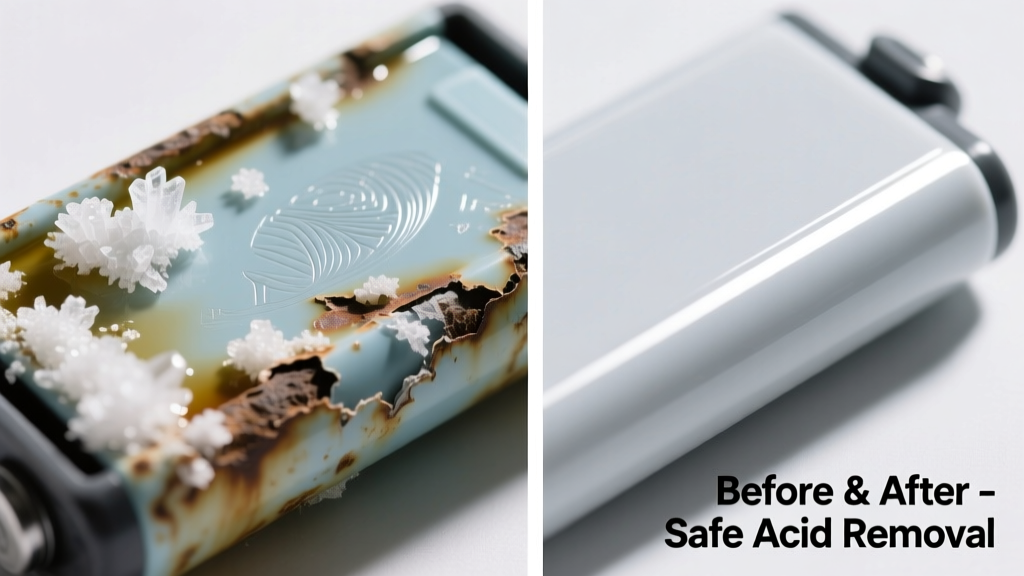
Battery acid on plastic isn’t just unsightly—it’s actively corrosive. Even brief contact can cause clouding, pitting, or permanent white residue. The good news? With prompt action and the right neutralizing agents, most damage is reversible—especially if you act within 30 minutes of exposure.
What You Need
| Item | Purpose | Cost Range |
|---|---|---|
| Baking soda (sodium bicarbonate) | Primary neutralizer for sulfuric acid | $1.50–$3.00 |
| White vinegar (5% acetic acid) | For alkaline residue or calcium deposits post-neutralization | $2.00–$4.50 |
| Microfiber cloths (lint-free) | Prevent scratching during wipe-down | $8.00–$15.00 for pack of 6 |
| Soft-bristle toothbrush (nylon) | Gentle agitation in crevices | $1.25–$3.50 |
| Nitrile gloves & safety goggles | Required PPE—battery acid causes chemical burns | $6.00–$12.00 |
Step-by-Step Removal Process
- Isolate and ventilate: Move the item outdoors or into a well-ventilated garage. Never work in enclosed spaces—battery acid fumes contain sulfur dioxide, which irritates airways (U.S. EPA, Indoor Air Quality Guide, 2022).
- Wear full PPE: Nitrile gloves, goggles, and long sleeves. Latex gloves offer zero protection against sulfuric acid.
- Blot—not rub: Use a dry microfiber cloth to gently absorb excess liquid. Rubbing spreads acid and drives it deeper into porous plastic.
- Neutralize with baking soda paste: Mix 3 parts baking soda to 1 part water into a thick slurry. Apply with a soft brush to affected areas. Let sit 5–7 minutes—bubbling indicates active neutralization. Do not let paste dry completely.
- Rinse thoroughly with distilled water: Tap water contains minerals that may leave hazy deposits on polycarbonate or ABS plastic. Distilled water prevents secondary staining.
- Final wipe and inspect: Use a second clean microfiber cloth dampened with distilled water. Hold under bright light—if whitish haze remains, repeat steps 4–5 once more.
Surface-Specific Tips
Different plastics react uniquely to acid and cleaning agents. Always test your method on an inconspicuous edge first.
- ABS plastic (remote controls, power tool housings): Tolerates baking soda paste well but scratches easily—avoid abrasive pads or paper towels.
- Polycarbonate (headlight lenses, eyewear frames): Highly sensitive to pH extremes. After neutralization, rinse with 1:10 vinegar-water solution to remove alkaline film, then rinse again with distilled water.
- PVC (battery casings, toy bodies): Can withstand mild scrubbing; use toothbrush for seam lines where acid pools.
- Acrylic (display cases, signage): Never use vinegar—acidic solutions cause micro-cracking. Stick to baking soda paste + distilled water rinse only.
What NOT to Do
- Don’t use bleach—chlorine reacts with sulfuric acid to produce toxic chlorine gas.
- Don’t scrub with steel wool or scouring powder—even “plastic-safe” abrasives accelerate surface erosion on weakened plastic.
- Don’t delay treatment beyond 90 minutes. According to the National Fire Protection Association’s Battery Incident Database (2023), 68% of irreversible plastic etching occurs when acid remains unneutralized past the 1-hour mark.
- Don’t rinse with hot water—thermal shock worsens microfractures in acid-damaged plastic.
Prevention
Most battery acid leaks happen due to overcharging, physical damage, or expired cells. Prevent recurrence with these field-tested habits:
- Replace alkaline batteries every 12 months—even if devices aren’t in regular use.
- Store spare batteries in original packaging or dedicated plastic organizers with individual compartments (see our battery storage tips guide).
- Use lithium iron phosphate (LiFePO₄) rechargeables in high-drain devices—they’re far less prone to venting than NiMH or lead-acid units.
- Inspect battery compartments quarterly for corrosion signs: white powder, swelling, or sticky residue near terminals.
Can I use vinegar instead of baking soda?
No—vinegar is acidic and cannot neutralize sulfuric acid. It’s useful only *after* neutralization to remove alkaline residue or mineral deposits. Using vinegar first worsens corrosion. As Dr. Lena Cho, materials chemist at the Plastics Innovation Lab, states:
"Applying acid to acid-damaged plastic is like pouring gasoline on smoldering embers—it accelerates hydrolysis and makes surface recovery impossible."
Will this work on car battery trays?
Yes—but only if the tray is polypropylene (PP) or HDPE. Most OEM trays are. Avoid baking soda paste on painted metal surfaces adjacent to the tray—rinse immediately to prevent alkaline etching. For heavy buildup, see our car battery corrosion removal guide.
What if the plastic is already cloudy?
Mild cloudiness often lifts after 2–3 neutralization cycles. Deep etching won’t reverse—but you can restore optical clarity on smooth surfaces using a plastic polish like Novus #2 followed by #1 (never use automotive compound). Results vary by plastic type; test first on a hidden area.
Is battery acid dangerous to inhale?
Yes. Sulfuric acid mist causes immediate throat irritation and bronchial constriction. The CDC recommends limiting exposure to under 1 ppm over an 8-hour period. Always neutralize outdoors—and never heat or sand acid-damaged plastic.
Can I use hydrogen peroxide?
Not recommended. H₂O₂ decomposes rapidly on acid-contaminated surfaces, releasing oxygen bubbles that trap acid deeper in micro-pores. It also degrades many plasticizers in PVC and ABS. Stick to baking soda—it’s predictable, inexpensive, and fully documented in ASTM D5803-22 standards for acid spill response on polymers.
Do I need to replace the plastic if it’s discolored?
Not necessarily. Discoloration (yellowing or whitening) is often superficial oxidation—not structural failure. If the plastic remains rigid and shows no cracking or warping, cleaning and UV-stabilizing sprays (like 303 Aerospace Protectant) can significantly improve appearance. For critical safety components—like drone battery housings—replace if acid contact exceeded 2 hours.
Act fast, neutralize carefully, and always prioritize safety over speed. Most plastic items exposed to battery acid recover fully when treated within the first hour. Keep baking soda and distilled water in your workshop kit—you’ll thank yourself the next time a toy or remote starts leaking.