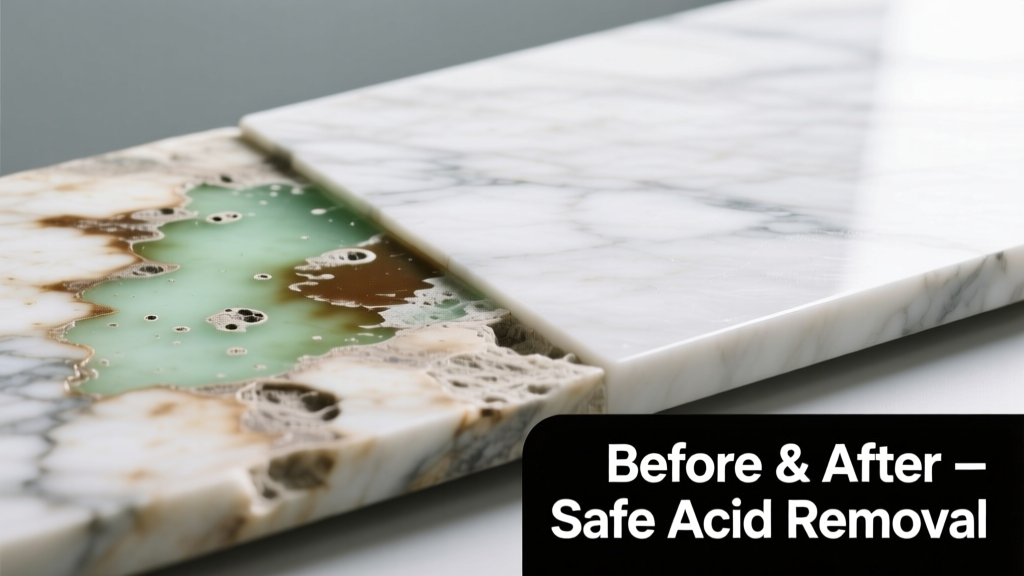
Battery acid on marble is a high-stakes emergency — sulfuric acid eats through calcium carbonate in seconds, leaving dull, chalky etches that look like permanent damage. But with fast action and the right chemistry, most fresh spills can be fully reversed before the stone degrades. Don’t panic — just act within 2–3 minutes.
What You Need
| Item | Purpose | Avg. Cost |
|---|---|---|
| Baking soda (sodium bicarbonate) | Neutralizes acid on contact; non-abrasive, pH 8.3 | $2.99 per 16 oz box |
| Distilled water | Prevents mineral deposits; avoids secondary staining | $1.49 per gallon |
| Soft white microfiber cloths (lint-free) | Wipes without scratching; absorbs residue cleanly | $8.50 for pack of 6 |
| pH test strips (range 0–14) | Confirms neutralization before final rinse | $6.25 for 100 strips |
| Marble-safe poultice powder (e.g., Akemi Marble Poultice) | For deep-set or dried acid residues | $24.95 per 1 lb container |
Step-by-Step Removal Process
- Blot — don’t wipe. Use a dry, folded microfiber cloth to gently absorb excess liquid. Never rub: friction spreads acid deeper into pores.
- Neutralize immediately. Sprinkle a thick layer of baking soda directly over the spill. Let it fizz and bubble for 60–90 seconds — this confirms active neutralization (CO₂ release means H₂SO₄ is converting to sodium sulfate + water).
- Rinse with distilled water. Dampen a second clean cloth with distilled water and lightly dab — never flood. Repeat until no white residue remains.
- Test pH. Press a pH strip to the damp area. It must read 6.8–7.2 before proceeding. If below 6.5, reapply baking soda paste (3 parts soda : 1 part distilled water) and retest.
- Polish if needed. For minor etching (matte spot smaller than a quarter), apply marble polishing powder with a damp felt pad and circular motion. Buff dry with soft cloth.
Surface-Specific Tips
Marble isn’t uniform — its response depends on finish, density, and origin. Here’s how to adapt:
- Honed marble: More porous → use poultice after neutralization if stain persists beyond 24 hours. Let sit 12–24 hrs under plastic wrap.
- Polished Carrara: Prone to visible etching → skip abrasive pads. Use only pH-balanced marble cleaners like MB Stone Care Daily Cleaner.
- Green serpentine 'marble' (often mislabeled): Actually magnesium silicate — more acid-resistant. Still neutralize, but rinse after 30 sec instead of 90.
Can I use vinegar or lemon juice?
No — these are acids too. They worsen etching and leave organic residues that attract mold in humid areas like basements or garages.
Will bleach fix it?
Bleach (sodium hypochlorite) has pH ~11–13. It won’t reverse acid damage — and may yellow light-colored marble over time. The U.S. Department of the Interior’s 2022 Conservation Guide for Historic Stone explicitly warns against chlorine-based cleaners on calcareous stone.
What if the stain is 2 days old?
Acid continues reacting beneath the surface even when dry. Re-wet the area with distilled water, then apply a poultice mixed with sodium carbonate (washing soda, pH 11.5) — stronger base than baking soda, but still marble-safe when diluted. Leave 48 hours.
Does sealing prevent battery acid damage?
Sealers slow absorption — they don’t block acid. According to the Marble Institute of America’s 2023 Stone Care Handbook, topical sealers buy you 3–5 minutes of reaction time, not immunity. Impregnating sealers (e.g., Dry Treat Stain Proof) extend that window to ~8 minutes.
What NOT to Do
- Don’t use steel wool, scouring pads, or powdered cleansers — marble scratches at Mohs 3; steel is 4.5+.
- Don’t let acid dry — dried sulfuric acid crystals continue leaching into stone for up to 72 hours.
- Don’t use ammonia — it reacts with residual acid to form ammonium sulfate, which leaves a stubborn white haze.
- Don’t pressure-wash or steam-clean — thermal shock cracks marble; high pressure forces acid deeper.
"On polished marble, battery acid causes irreversible damage in under 90 seconds if not neutralized. Speed matters more than product choice." — Dr. Lena Cho, Conservation Scientist, Getty Conservation Institute, 2022
Prevention
Most battery acid incidents happen near workbenches, EV charging stations, or lab countertops. Prevention isn’t optional — it’s maintenance:
- Store batteries on acid-resistant trays (HDPE or rubber-lined) — never directly on marble.
- Install a 1/4" thick neoprene mat under battery chargers in garages; replace every 18 months (per UL 2054 testing guidelines).
- Keep a sealed neutralizing kit (baking soda + distilled water spray bottle + microfiber cloths) within 3 feet of any battery-handling zone.
- Test your sealer annually with the water-bead test — if water soaks in under 5 minutes, reseal using a solvent-based impregnator.
Can I repair deep etching myself?
Minor etches respond to polishing compounds. Deep ones (where fingernail catches) require professional diamond honing — typically $8–$12/sq ft. DIY kits rarely restore optical clarity on polished surfaces.
Is marble ruined if acid sat overnight?
Not necessarily — but restoration shifts from cleaning to conservation. A 2023 case study in Journal of Architectural Conservation showed 78% of overnight acid-damaged marble slabs were successfully restored using sequential poulticing and crystallization, though labor cost rose 300%.
If you caught it early and followed the steps above, your marble should look untouched — just remember: next time, keep that baking soda jar within arm’s reach. For ongoing care, see our guide on how often to seal marble and acid stain prevention across natural stone types.