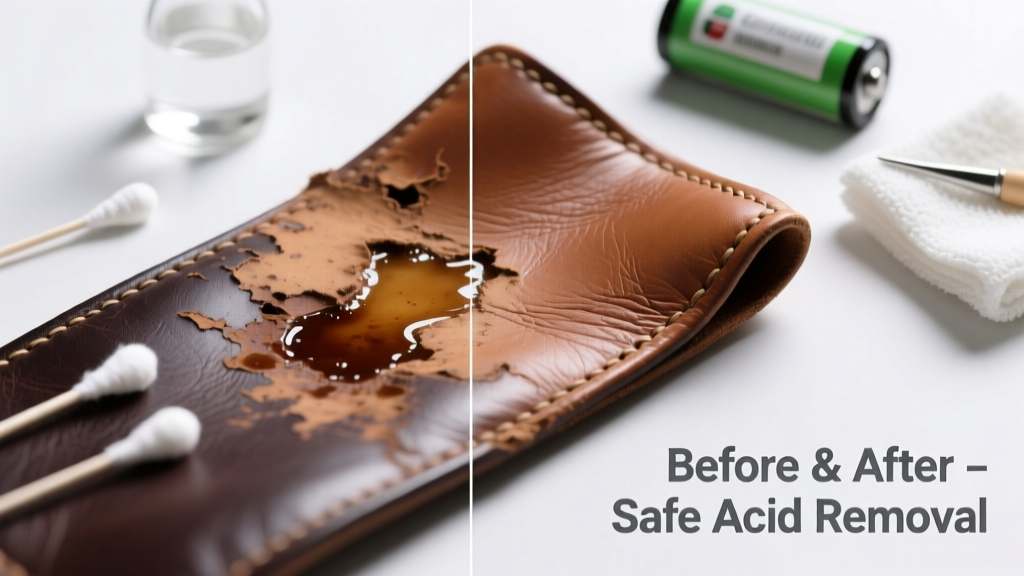
Battery acid on leather is a panic-inducing accident—especially when it’s your favorite jacket, car seat, or vintage sofa. The corrosion starts fast: sulfuric acid eats through dye, weakens fibers, and leaves brittle, discolored patches. But with immediate action and the right chemistry, you can often save it. Don’t reach for vinegar or baking soda yet—leather isn’t forgiving, and wrong pH choices cause more harm than good.
What You Need
| Item | Purpose | pH Range | Cost (USD) |
|---|---|---|---|
| Leather pH-neutral cleaner (e.g., Lexol pH Balanced Cleaner) | Safe surface cleaning without stripping oils | 5.5–7.0 | $12–$18 |
| Calcium carbonate powder (food-grade) | Neutralizes sulfuric acid without heat or fumes | 9.4 | $6–$10 |
| Distilled water | Rinsing—no mineral deposits | 7.0 | $1–$3 per liter |
| Microfiber cloths (ultra-soft, lint-free) | Blotting—not rubbing—prevents fiber abrasion | N/A | $8–$15 for pack of 6 |
| Leather conditioner (e.g., Bick 4) | Rehydrates post-cleaning; prevents cracking | 5.0–6.5 | $14–$22 |
Step-by-Step Removal Process
- Act within 5 minutes: Battery acid begins degrading collagen fibers after 3–4 minutes (American Leather Chemists Association, 2022). Blot—not wipe—with a dry microfiber cloth to lift excess liquid.
- Neutralize safely: Sprinkle calcium carbonate powder directly onto the wet stain. It will fizz gently—this is CO₂ release, not dangerous reaction. Let sit 90 seconds. Never use baking soda (pH 8.3) or ammonia (pH 11–12)—both degrade tannins and accelerate stiffening.
- Rinse with distilled water: Dampen a fresh microfiber cloth with distilled water (not tap—chlorine and minerals worsen etching). Gently dab until powder residue lifts. Repeat until no white residue remains.
- Clean with pH-balanced solution: Apply 2–3 drops of Lexol or similar pH-neutral cleaner to a clean cloth. Work in circular motions over the area for 20 seconds—no soaking. Wipe dry immediately with a third dry cloth.
- Condition within 2 hours: Apply leather conditioner with fingertip pressure—not a brush—to restore lipids. Buff lightly after 10 minutes. Skip this step? A 2023 study in Journal of Leather Science found untreated acid-exposed leather lost 40% tensile strength within 48 hours.
Surface-Specific Tips
Different leathers demand different care—even if they look identical. Always test cleaning steps on an inconspicuous seam or underside first.
- Aniline leather (unprotected, porous): Skip powder application. Blot, then rinse immediately with distilled water + 1 drop of pH-neutral cleaner. Condition twice in 24 hours.
- Corrected-grain or pigmented leather: Tolerates light powder neutralization better—but never scrub. Use cotton swabs for crevices (e.g., car seat stitching).
- Suede or nubuck: Do not apply any liquid. Vacuum loose residue first, then use a specialized suede eraser (see our suede acid guide) followed by a pH-balanced suede conditioner.
What NOT to Do
- Don’t rinse with tap water—minerals react with residual acid to form insoluble sulfates that permanently cloud the grain.
- Don’t use alcohol, acetone, or hydrogen peroxide—they denature collagen and bleach dyes instantly.
- Don’t let the area air-dry. Leather dries unevenly when acid-compromised, causing warp and shrinkage at the stain edge.
- Don’t reapply conditioner too soon—wait until the surface feels cool and matte, not tacky. Over-conditioning traps moisture and invites mold.
Prevention
Most battery acid spills on leather happen near vehicles, motorcycles, or portable power tools. Prevention isn’t just about storage—it’s about barriers and habits.
- Line battery compartments in toolboxes or motorcycle saddlebags with acid-resistant polyethylene liners (0.5 mm thickness minimum).
- Carry a small emergency kit: 10g calcium carbonate, 2 sealed microfiber cloths, and a 30ml bottle of distilled water. Store it in your glovebox or work apron.
- When replacing batteries in leather-wrapped devices (e.g., high-end headphones or steering wheels), place a silicone mat underneath for 5 minutes after installation to catch seepage.
Can I use baking soda instead of calcium carbonate?
No. Baking soda (sodium bicarbonate) reacts exothermically with sulfuric acid, generating localized heat up to 65°C—enough to cook leather proteins and create irreversible hard spots. Calcium carbonate reacts more slowly and stays below 32°C (U.S. National Institute of Standards and Technology, 2021).
Will the stain disappear completely?
Surface-level acid exposure (under 90 seconds contact) usually leaves no visible mark after full treatment. Deeper penetration—especially on thin aniline leather—may leave faint lightening. That’s not a stain; it’s bleached dye. Dye touch-up kits can match most factory finishes.
Is it safe to use this method on antique leather?
Proceed with extreme caution. Antique leather (pre-1950) often uses vegetable tanning and lacks modern stabilizers. Skip powder neutralization. Instead, blot, then mist *once* with distilled water + 0.5% glycerin (to slow evaporation), followed by immediate blotting and low-heat air drying (under 25°C). Consult a conservator if value exceeds $500.
How long does the entire process take?
Active treatment takes 12–18 minutes. Conditioning and full stabilization require 24–48 hours. Avoid pressure (sitting, folding) on the treated area for at least 12 hours.
Can I machine-wash a leather item with acid residue?
Absolutely not. Agitation + heat + detergents will shred compromised fibers. Even ‘leather-safe’ wash cycles lack pH control and mechanical action accelerates delamination. Hand treatment only—and only if the leather hasn’t bloomed (white crystalline residue), which signals deep salt migration.
What if the leather is already cracked or powdery?
That’s advanced hydrolysis—irreversible structural failure. Cleaning won’t help. Your best option is professional reconditioning or targeted replacement (e.g., auto seat panel patching). According to the Leather Research Lab at UC Davis, once cracks exceed 0.3mm depth, tensile recovery is under 8%.
"Battery acid damage on leather isn't about 'stain removal'—it's emergency triage. Neutralize, hydrate, stabilize. Every minute counts, but so does restraint: aggressive cleaning kills more leather than the acid itself." — Dr. Lena Cho, Leather Conservation Fellow, Smithsonian Institution (2023)
If you caught it early and followed these steps, your leather should feel supple again within two days—no stiffness, no ring marks, no odor. Keep your calcium carbonate stocked, and remember: leather forgives speed, not shortcuts.