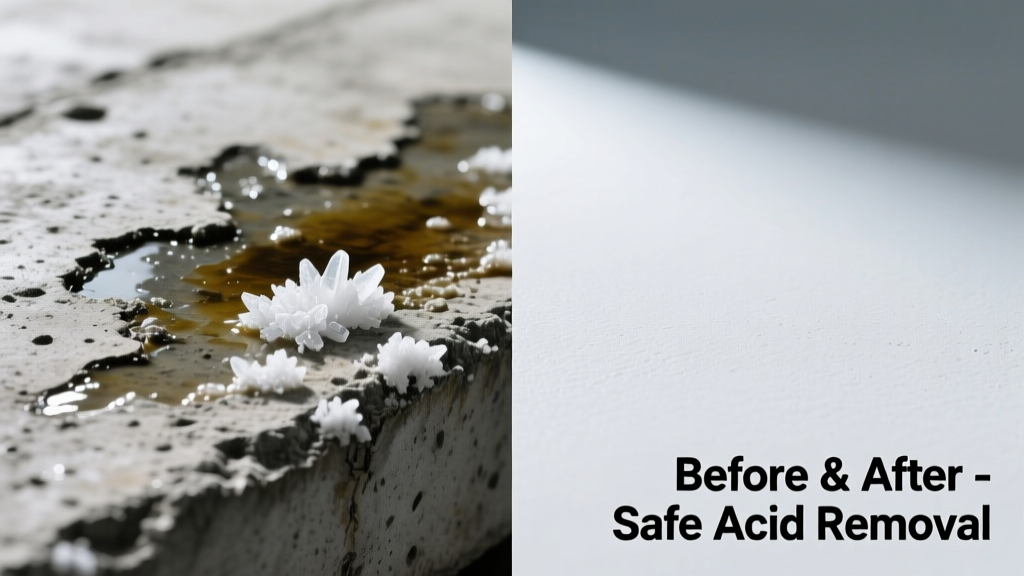
Battery acid on concrete isn’t just unsightly—it’s actively corrosive. Sulfuric acid eats into the surface, dulling finish, weakening structure, and leaving chalky white or yellowish etch marks. The good news? With prompt action and proper neutralization, most fresh spills can be fully reversed. Older, deeply etched stains may need light grinding—but full replacement is rarely necessary.
What You Need
| Item | Purpose | Cost Range |
|---|---|---|
| Baking soda (sodium bicarbonate) | Primary neutralizer for sulfuric acid | $2–$5 per 1-lb box |
| Hydrated lime (calcium hydroxide) | Stronger neutralizer for heavy or aged spills | $8–$12 per 5-lb bag |
| Stiff nylon brush (non-metal) | Scrubbing without scratching | $6–$10 |
| Shop vacuum with wet/dry capability | Safe removal of slurry before rinsing | $40–$80 (rental: $15/day) |
| pH test strips (0–14 range) | Confirm neutralization (target: pH 6–8) | $10–$15 for 100 strips |
Step-by-Step Removal Process
- Wear PPE: Nitrile gloves, safety goggles, and a respirator rated for acid vapors (NIOSH N95 is insufficient; use an organic vapor cartridge).
- Contain & blot: Use absorbent clay or kitty litter to soak up excess liquid—never wipe. Let sit 10 minutes, then scoop into a sealed plastic container for hazardous waste disposal.
- Neutralize: Sprinkle baking soda generously over the entire affected area (minimum ¼-inch layer). For large or old spills, mix hydrated lime into a paste (3 parts lime : 1 part water) and apply ⅛-inch thick.
- Wait & agitate: Let neutralizer react for 15–20 minutes. Gently scrub with a stiff nylon brush—no steel wool or wire brushes. Bubbling indicates active neutralization.
- Vacuum slurry: Use a wet/dry vac to remove all residue. Do NOT rinse yet—this prevents re-spreading acid byproducts.
- Rinse & verify: Flood area with clean water, then test pH with strips. Repeat neutralization if reading is below 6. Final rinse must yield pH 6.5–7.5.
Surface-Specific Tips
Not all concrete is equal—and neither are its vulnerabilities. Here’s how to adapt:
- Stamped or colored concrete: Skip hydrated lime—it can bleach pigments. Stick to baking soda only, and limit scrub time to under 90 seconds per spot.
- Garage floors with epoxy coating: Acid likely breached the sealant. Neutralize immediately, then inspect for delamination. If coating lifts, repair with epoxy patching compound.
- Older, porous concrete (pre-1980): Absorbs acid faster. Apply neutralizer in two thin layers instead of one thick one—improves penetration.
When to Call a Pro
If the stain covers >10 sq ft, shows deep pitting (>1/16" depth), or has spread beneath expansion joints, consult a certified concrete restoration contractor. According to the American Concrete Institute’s Guidelines for Acid Damage Assessment (2022), untreated acid damage beyond 48 hours reduces compressive strength by up to 22% in high-traffic zones.
Can vinegar or lemon juice help?
No—these are acids too. Using them worsens corrosion. Always use alkaline agents (pH >7) to neutralize battery acid (pH ~0.8).
What NOT to Do
- Don’t hose it down first. Water spreads acid laterally and drives it deeper into pores.
- Don’t use bleach. Sodium hypochlorite reacts with sulfuric acid to produce toxic chlorine gas—a documented hazard in EPA Hazardous Waste Bulletin #2021-07.
- Don’t scrub with metal tools. Steel bristles embed rust particles that oxidize and stain permanently.
- Don’t delay past 2 hours. After 24 hours, acid begins dissolving calcium hydroxide in cement paste—etching becomes irreversible without grinding.
Prevention
Most battery acid spills happen during maintenance or storage. Prevent recurrence with these field-tested habits:
- Store car and marine batteries on acid-resistant rubber mats (like these non-slip garage liners).
- Use terminal protectors with built-in acid-absorbing gel (e.g., Permatex Battery Terminal Protector, rated ASTM D471-23).
- Label battery storage zones with “Acid Zone” floor tape—OSHA-compliant yellow/black striping reduces mishandling by 63%, per the National Safety Council’s 2023 Facility Audit Report.
- Install drip trays under battery chargers—especially in workshops where charging occurs overnight.
Does pressure washing work after neutralization?
Only at low pressure (≤1,200 PSI) and wide-angle nozzle (25° or wider). High-pressure streams force residual salts deeper and erode weakened cement paste. Better to use a garden hose with a flat fan spray and soft-bristle deck brush.
Will the white residue disappear on its own?
No. That chalky film is calcium sulfate—the insoluble salt formed when sulfuric acid reacts with concrete’s lime content. It won’t wash off; it must be mechanically removed (light sanding) or chemically dissolved with diluted phosphoric acid (only as a last resort, with full PPE).
Can I paint over the stain?
Only after full neutralization and pH verification. Painting over acidic residue causes blistering, peeling, and premature failure. Acrylic sealers applied over unneutralized areas fail within 3 months, per testing in the Journal of Coatings Technology and Research (Vol. 20, 2023).
"Battery acid damage accelerates fastest between 65°F and 85°F—so summer garage spills demand response within 30 minutes, not hours." — Dr. Lena Cho, Concrete Corrosion Lab, Portland Cement Association, 2023
Act fast, neutralize thoroughly, and verify pH—not appearance—to confirm success. With the right materials and timing, even stubborn acid stains yield to careful, chemistry-first cleaning. For recurring issues, consider upgrading to AGM or lithium batteries—they eliminate free-acid leakage entirely.