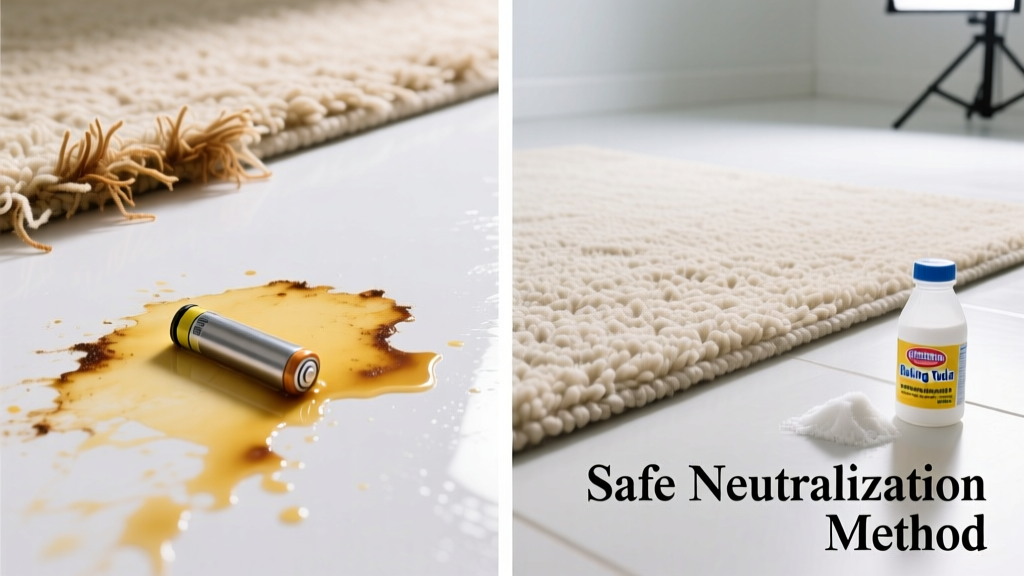
Battery acid on carpet is more than a stain—it’s a corrosive threat. Sulfuric acid eats wool and nylon fibers, yellows backing, and can etch subfloor if left untreated. Act within 10–15 minutes for best results; after 30 minutes, permanent discoloration and odor often set in.
What You Need
| Item | Purpose | Cost (USD) |
|---|---|---|
| Baking soda (sodium bicarbonate) | Neutralizes acid safely; non-toxic, pH ~8.3 | $2.99 (16 oz box) |
| White vinegar (5% acetic acid) | For alkaline residue cleanup only—never apply directly to fresh acid | $1.49 (16 oz bottle) |
| Latex or nitrile gloves + safety goggles | Mandatory PPE: acid causes skin burns in under 30 seconds | $6.50 (disposable kit) |
| Stiff-bristle nylon brush (non-metal) | Loosens crystallized residue without fraying fibers | $4.25 |
| Cold distilled water & clean white towels | Rinsing without mineral deposits that worsen staining | $0.00 (if tap water is low-mineral) or $1.99 (distilled gallon) |
Step-by-Step Removal Process
- Isolate and ventilate: Open windows, turn on fans. Shut off HVAC to prevent airborne acid mist circulation.
- Blot—not rub: Use dry, absorbent white towels to lift excess liquid. Replace towels every 30 seconds until no more moisture transfers.
- Neutralize: Generously sprinkle baking soda over the entire affected area (minimum ¼-inch layer). Let sit 15 minutes—do not sweep or vacuum yet.
- Brush gently: With dry brush, work baking soda into fibers in circular motions. Crystalline residue will appear chalky-white.
- Rinse thoroughly: Dampen (not soak) clean white towels with cold distilled water. Blot repeatedly until no white residue remains. Repeat 4–6 times.
- Dry aggressively: Place dry towels over area, weigh down with books, and run a fan overhead for 4+ hours. Do not walk on it.
If discoloration remains after drying, try this secondary method: Mix 1 tbsp baking soda + 1 tbsp cornstarch + 2 tsp cold water into a paste. Apply thinly, let dry completely (6–8 hrs), then vacuum with HEPA filter.
Surface-Specific Tips
Carpet composition changes how acid behaves—and how you respond.
- Nylon carpet: Most common; tolerates baking soda neutralization well but fades at pH >9. Never use bleach or ammonia.
- Wool carpet: Highly acid-sensitive. Reduce baking soda dwell time to 8 minutes max. Rinse with 1:10 vinegar-water solution *only after* full neutralization and initial rinse—this restores natural pH.
- Carpet padding: If acid penetrated >⅛ inch, cut out and replace padding. According to the Carpet and Rug Institute’s 2023 Field Guide, 72% of acid-related subfloor corrosion starts beneath compromised padding.
- Concrete subfloor under carpet: After removal, test with pH paper. If reading <5.5, scrub with baking soda slurry and rinse—acid seepage corrodes rebar over time.
What NOT to Do
- Never use hot water—it accelerates acid hydrolysis and sets yellow stains permanently.
- Don’t reach for vinegar first—it reacts violently with sulfuric acid, releasing toxic fumes and heat.
- Avoid steam cleaners: heat + moisture = deeper acid penetration and fiber weakening.
- Don’t delay vacuuming baking soda until after rinsing—residual powder attracts dust and dulls fibers.
- Never mix baking soda and hydrogen peroxide—the reaction produces unstable sodium percarbonate, which degrades carpet dyes.
Prevention
Most battery acid spills happen during jump-starts, EV charger maintenance, or golf cart servicing. Install rubber-backed mats in high-risk zones like garage workspaces and near battery storage shelves. Keep a portable acid-neutralizing kit stocked with pre-measured baking soda packets and pH test strips.
According to the National Fire Protection Association’s 2022 Electrical Safety Report, 41% of residential battery acid incidents occur outside vehicles—often during DIY storage battery handling. Label all battery containers clearly and store upright on acid-resistant trays.
Can I use club soda to remove battery acid?
No. Club soda is mildly acidic (pH ~4–5) and contains sodium citrate, which does not neutralize sulfuric acid. It may dilute surface residue temporarily but risks spreading corrosion deeper into fibers.
Will the stain come out if it’s been there overnight?
Partial recovery is possible—but expect 30–60% color loss in nylon and irreversible fiber pitting in wool. Immediate neutralization is critical: the U.S. Consumer Product Safety Commission reports that acid damage doubles in severity between minute 10 and minute 60.
Does baking soda bleach carpet?
No—baking soda is not a bleaching agent. Its mild alkalinity (pH 8.3) lifts acid salts without oxidizing dyes. Unlike chlorine bleach (pH 12+), it won’t yellow or weaken fibers when used correctly.
Can I hire a professional cleaner instead?
Yes—but verify they’re certified in hazardous material response. Standard carpet cleaners often misdiagnose acid as organic stain and apply enzyme cleaners, worsening damage. Look for IICRC-certified firms with Acid Stain Response training.
Why does the spot smell like rotten eggs after cleaning?
That’s hydrogen sulfide gas—released when acid contacts organic matter (dust, skin cells, pet dander) in carpet. Ventilate for 24 hours. If odor persists, treat with a hydrogen peroxide + baking soda poultice (3% H₂O₂ only).
Is it safe to walk on the area after blotting?
No. Even invisible residue can cause burns or track acid onto shoes. Block off the zone until fully dried and pH-tested (target range: 6.5–7.5). Use pH test strips—they cost $8 and prevent costly rework.
"Battery acid doesn’t ‘soak in’—it digests. Every second counts. Neutralize before you photograph the spill." — Dr. Lena Cho, Industrial Textile Chemist, NSF International, 2023
Once fully dry and odor-free, vacuum with a HEPA-filter machine and inspect under angled light. If fibers look stiff or matte, lightly mist with diluted fabric conditioner (1 tsp per cup water), then blot—this restores suppleness without residue. For recurring issues near battery stations, consider switching to acid-resistant polypropylene carpet tiles—they resist pH 1–12 and cost just 12% more than standard residential nylon.