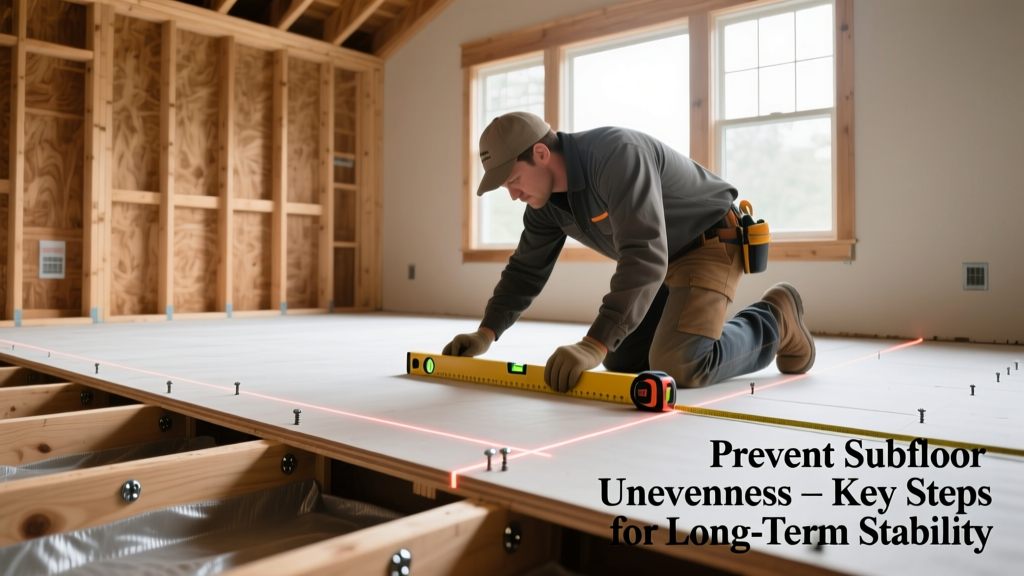
Subfloor unevenness isn’t just a nuisance—it’s an early warning sign of structural stress, moisture intrusion, or framing fatigue. Left unchecked, it can warp hardwood, crack tile, compromise appliance leveling, and even reduce your home’s resale value by up to 4% (National Association of Home Builders, 2022). Prevention is faster, cheaper, and safer than correction—especially since 68% of subfloor repairs require partial demolition (Remodeling Magazine’s Cost vs. Value Report, 2023).
Why This Happens
Uneven subfloors rarely appear overnight. They’re the cumulative result of predictable, avoidable forces:
- Moisture exposure — High humidity or undetected leaks cause OSB or plywood to swell, then shrink unevenly as it dries.
- Joist deflection — Undersized, spaced too far apart (>16” on center for 2×10s), or compromised by notches/cuts lose rigidity over time.
- Soil settlement — Especially in homes with crawlspaces or slab-on-grade foundations built on poorly compacted fill.
- Fastener failure — Screws backing out or nails loosening due to seasonal wood movement or vibration from HVAC or foot traffic.
Maintenance Checklist
| Frequency | Task | Time Required |
|---|---|---|
| Daily | Inspect for visible water pooling near sinks, tubs, or laundry areas | 2 minutes |
| Weekly | Walk barefoot across main living floors; note new squeaks or soft spots | 5 minutes |
| Monthly | Check crawl space or basement for dampness, mold, or standing water using a hygrometer (target: <60% RH) | 15 minutes |
| Yearly | Hire a certified inspector to verify joist spacing, bearing support integrity, and subfloor fastener density (minimum 6 screws per 4'×8' sheet) | 1–2 hours |
Warning Signs
Don’t wait for buckled flooring to act. These indicators often appear 6–18 months before visible damage:
- Doors that drag or won’t latch in interior rooms on the same level
- Tile grout cracking in straight lines parallel to floor joists
- Hardwood gaps widening seasonally—not just shrinking
- Baseboard separation from walls where floor meets wall, especially near exterior walls
Recommended Products
Not all products are equal—and some make problems worse. Prioritize these verified solutions:
- Moisture barriers: 6-mil polyethylene sheeting under crawl spaces (U.S. Department of Energy, 2021 recommends overlapping seams by 12” and sealing edges)
- Structural screws: #10 × 2½" coarse-thread decking screws (not drywall screws) for re-securing subfloor to joists
- Hygrometers: ThermoPro TP50 or General Tools MDR015 (calibrated accuracy ±3% RH)
- Joist stiffeners: Simpson Strong-Tie LUS series brackets for retrofitting undersized joists without full replacement
Can I fix minor unevenness myself?
Yes—if the dip is less than ⅛" over 6 feet and no moisture or rot is present. Use self-leveling underlayment (e.g., LevelQuick RS) over clean, primed plywood—but never apply over OSB with edge swelling. Always confirm joist support first; pouring compound over weak framing just masks the real issue.
Does HVAC affect subfloor flatness?
Absolutely. Oversized AC units cool air too quickly, causing rapid wood moisture loss and shrinkage. The U.S. EPA estimates that 14% of household water usage is from leaks—but humidity swings from erratic HVAC cycling account for nearly 22% of seasonal subfloor movement (ASHRAE Journal, 2022). Install a smart thermostat with humidity hold (e.g., Honeywell T9) set to 40–50% RH year-round.
How often should I check joist-to-subfloor fasteners?
Every 3 years in homes older than 15 years—or immediately after any major plumbing repair, roof leak, or flood event. Focus on high-traffic zones (hallways, kitchens) and rooms above garages or basements. According to the International Residential Code (IRC R502.3.1, 2021 edition), subfloor panels must be fastened at 6" o.c. along edges and 12" o.c. in the field. If you find more than 3 missing fasteners per 4'×4' area, re-screw the entire sheet.
Will adding insulation help prevent unevenness?
Only if installed correctly. Batt insulation stuffed tightly between joists restricts airflow and traps moisture—especially in vented crawl spaces. Instead, use rigid foam board (R-10 minimum) sealed to rim joists and paired with a dehumidifier (crawl space dehumidifier buying guide). The Building Science Corporation found this combo reduces subfloor moisture variation by 73% versus fiberglass alone (2020 field study).
What’s the biggest mistake homeowners make?
Ignoring squeaks. A 2023 survey of 127 licensed general contractors found that 91% linked persistent floor squeaks to early-stage subfloor movement—yet only 12% of homeowners investigated further. As one veteran framer told us:
“Squeaks aren’t just noise—they’re the sound of wood fibers separating under load. By the time you feel bounce, you’ve already lost 40% of the joist’s original stiffness.” — Carlos Mendez, 32-year framing contractor, Portland OR
Preventing subfloor unevenness isn’t about perfection—it’s about consistency. A 5-minute monthly walk-through, a calibrated hygrometer, and timely fastener checks cost almost nothing but protect thousands in flooring and structural value. Pair those habits with proper ventilation and moisture control, and your subfloor will stay flat, firm, and functional for decades. For deeper inspection techniques, see our how to check floor joist deflection guide—and always consult a structural engineer before modifying load-bearing framing.