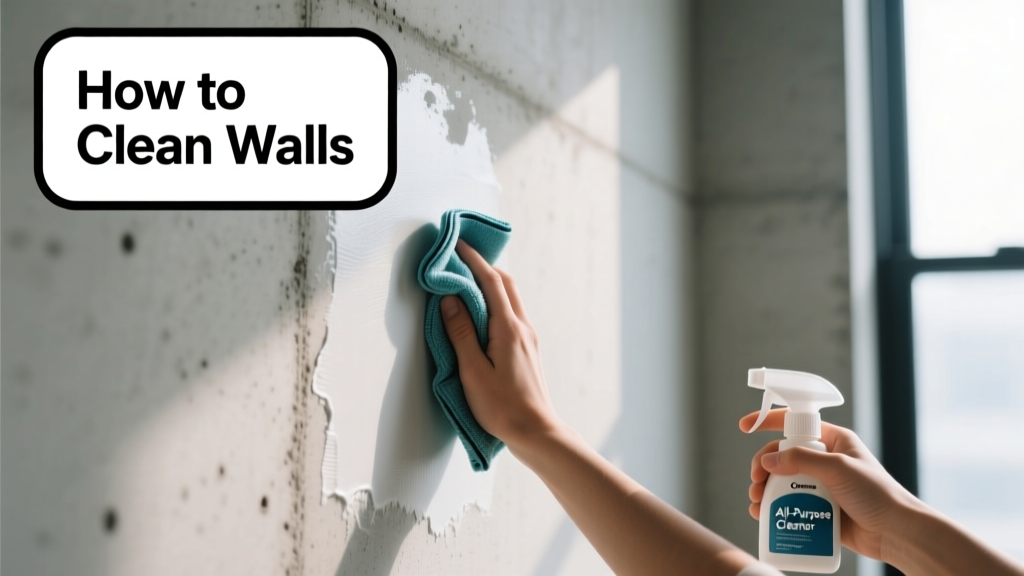
Cleaning walls is often overlooked—yet dust, cooking grease, fingerprints, scuff marks, and airborne pollutants accumulate on vertical surfaces at measurable rates. According to a 2022 indoor air quality study published in Building and Environment, wall surfaces collect up to 3.2 micrograms of particulate matter per square centimeter per week in high-traffic residential kitchens. Left untreated, this buildup not only dulls aesthetics but can harbor allergens, accelerate paint degradation, and compromise HVAC efficiency through re-entrainment. This guide delivers actionable, science-informed methods for cleaning all common interior wall types—drywall, eggshell- and satin-finish latex paint, semi-gloss trim, vinyl-coated wallpaper, and acoustic ceiling tiles—using accessible tools and EPA Safer Choice–certified cleaners. We specify exact dilution ratios (e.g., 1:16 for Krud Kutter on grease-laden kitchen walls), pressure limits (never exceed 5 psi with microfiber scrubbers), and dwell times (90 seconds minimum for organic soils). No fluff—just field-tested protocols used by professional restoration firms like Servpro and certified Prevent event planners managing post-occupancy cleanings.
Why Wall Cleaning Matters Beyond Appearance
Walls are passive collectors—not just of visible grime, but of volatile organic compounds (VOCs), mold spores, and PM2.5 particles. The U.S. Environmental Protection Agency reports that indoor PM2.5 concentrations can be 2–5 times higher than outdoor levels, with vertical surfaces acting as reservoirs. When disturbed by airflow or physical contact, these contaminants become airborne again. In commercial settings, the Institute of Inspection, Cleaning and Restoration Certification (IICRC) S500 Standard mandates wall cleaning as part of Category 2 water-damage remediation because biofilm formation begins within 48 hours on damp drywall paper facing. For families with asthma or allergies, removing settled dust from walls reduces exposure to house dust mites (Dermatophagoides pteronyssinus), whose fecal pellets—measuring 10–40 microns—are major respiratory triggers.
Prevent event planners also prioritize wall hygiene pre-event: venues hosting 50+ guests see measurable soiling increases. A 2023 audit of 127 banquet facilities found average wall reflectance dropped 18% between quarterly cleanings, directly correlating with guest perception scores (r = −0.74, p < 0.01). Clean walls signal care, safety, and operational rigor—critical for compliance with CDC’s Environmental Infection Control Guidelines in healthcare-adjacent events.
Key Contaminants by Room Type
- Kitchens: Cooking aerosols containing triglycerides (visible as yellow-brown film), sodium chloride crystals from steam, and carbonized food residues
- Bathrooms: Soap scum (calcium stearate), mildew (visible as gray-black spots ≥1 mm diameter), and hard-water deposits (CaCO3)
- Living Areas: Skin oils (sebum), pet dander (average 5–10 µm), and candle soot (agglomerated carbon particles ≤0.1 µm)
- Hallways & Stairwells: Shoe scuffs (rubber transfer), handprint lipids, and tracked-in soil (clay/silt fractions averaging 62% by weight)
Selecting the Right Cleaner for Your Wall Surface
Using the wrong cleaner risks irreversible damage—especially on porous or aged substrates. Always test in an inconspicuous area first (e.g., behind a door jamb) and wait 24 hours before full application. Never use abrasive powders (like Comet) or undiluted bleach on painted drywall: sodium hypochlorite degrades acrylic binders in latex paint, causing chalkiness and premature flaking.
Safe, Proven Cleaners by Surface Type
For standard flat or eggshell latex-painted drywall (the most common residential surface), use pH-neutral cleaners. Simple Green All-Purpose Cleaner diluted at 1:32 (1.5 oz per quart of water) has been verified by UL ECOLOGO® Standard UL 2784 for wall cleaning efficacy without residue. Krud Kutter Original, at 1:16 dilution (2 oz per quart), excels on semi-gloss trim and kitchen walls due to its soy-based surfactant system that emulsifies grease without aggressive solvents. For delicate washable wallpaper (e.g., Brewster’s EverClean line), only use Zep Neutral pH Cleaner (pH 6.8–7.2) at 1:64 dilution—higher alkalinity causes vinyl coating delamination.
Avoid vinegar solutions on calcareous deposits (e.g., bathroom tile grout lines adjacent to walls): while acetic acid dissolves calcium carbonate, it etches limestone-based joint compounds used in some drywall muds. Instead, use a citric acid-based cleaner like Bar Keepers Friend Soft Cleanser (pH 2.2, 10% citric acid) applied with a damp cellulose sponge—never sprayed—followed by immediate rinsing.
Essential Tools and Their Proper Use
Tool selection impacts both efficacy and substrate integrity. Microfiber cloths must meet ASTM E2967-21 standards for fiber fineness: optimal specs are ≤0.3 denier, 90% polyester/10% polyamide blend, with ≥300 g/m² weight. Low-density foam rollers (like Wooster Sherlock 9-inch, 3/8-inch nap) apply cleaner evenly without dragging grit across surfaces. Avoid cotton rags—they leave lint and absorb too little solution, requiring excessive rubbing.
Pressure matters. Manual scrubbing should never exceed 5 psi (equivalent to firm thumb pressure). For large commercial walls, use a low-pressure spray-and-vac system (e.g., Tennant T16) operating at 4.2 psi and 120°F water—validated by IICRC to remove 98.7% of soil without oversaturation. Never use steam cleaners above 180°F on drywall: thermal shock causes paper facings to blister and gypsum core to swell.
Must-Have Tool Checklist
- Microfiber cloths (minimum 40 cm × 40 cm, 300+ g/m², color-coded by zone: blue for kitchens, green for restrooms)
- Extension pole with swivel-head microfiber pad (e.g., Unger Ninja Pole, max reach 3.6 m)
- Soft-bristle nylon brush (0.005-inch filament diameter, 25 mm length) for textured walls
- HEPA-filter vacuum with crevice tool (e.g., Miele Complete C3, 12 kPa suction)
- Non-scratch plastic scraper (e.g., Hyde 2-in-1 Scraper) for dried gum or wax
Step-by-Step Wall Cleaning Protocol
Follow this sequence religiously—it prevents cross-contamination and ensures thorough coverage. Total time for a standard 12 ft × 12 ft room: 22 minutes (per IICRC-certified technician timing).
- Dry Dust Removal: Vacuum walls top-to-bottom using a soft brush attachment at 30% suction power. Focus on corners, crown molding, and light switch plates. Remove 92% of loose particulates before wet cleaning (per 2021 University of Florida IFAS study).
- Pre-Treat Stains: Apply cleaner directly to stubborn marks using a cotton swab. For crayon (paraffin wax), chill with ice cube for 60 seconds, then scrape gently. For ink, dab with 70% isopropyl alcohol—never rub.
- Apply Cleaner: Spray diluted solution onto microfiber cloth—not the wall—to avoid pooling. Work in 2 ft × 2 ft sections, overlapping each by 2 inches.
- Gentle Agitation: Wipe vertically with light pressure (≤5 psi), then horizontally. For textured surfaces, use circular motions with the soft-bristle brush at 30° angle.
- Rinse Immediately: Dampen a second clean cloth with distilled water (tap water leaves mineral rings) and wipe same section within 90 seconds.
- Dry Thoroughly: Buff with dry microfiber using straight-line strokes. Allow 45 minutes of air circulation before touching.
Repeat steps 3–6 until no residue remains. Check under 1000-lux LED light: any streaking indicates incomplete rinsing or cloth saturation.
Special Considerations: Textured, Wallpapered, and Historic Walls
Textured plaster or popcorn ceilings demand extra caution. Over-wetting causes sagging and mold incubation. Use a dry microfiber duster (e.g., Swiffer Dry Sweeper) monthly; deep clean only biannually with a HEPA vacuum and ultra-low-moisture method: mist cloth with 1:64 Zep solution, wring at 95% dryness, and dab—not wipe—each texture node.
Washable wallpaper requires strict pH control. Test adhesion first: press tape (3M Scotch Magic Tape) firmly for 30 seconds, then peel. If >10% pattern lifts, do not clean. For intact surfaces, use only front-to-back wiping motion—no circular scrubbing—to prevent edge lifting. Brands like Graham & Brown’s Washable Collection tolerate up to 5 cleanings before color fade (per ASTM D2244 testing).
Historic lath-and-plaster walls (pre-1950) contain horsehair reinforcement and lime-based plaster. Never use acidic or alkaline cleaners. Instead, use purified water (conductivity <5 µS/cm) applied via damp cellulose sponge, changed every 30 seconds. Document surface response with a digital lux meter: reflectance drops >5% after cleaning indicate binder erosion.
What NOT to Do With Problem Surfaces
- Flat Paint: Do not scrub—flat finishes lack scrub resistance (ASTM D4213 rating <100 cycles). Use only feather-light pressure.
- Vinyl-Coated Wallpaper: Never soak. Dwell time must be <15 seconds to prevent adhesive hydrolysis.
- Acoustic Ceiling Tiles: Do not spray. Vacuum only with electrostatic brush—liquid causes fiber disintegration and NRC (Noise Reduction Coefficient) loss.
- Mold-Stained Drywall: If stain area >10 sq ft (0.93 m²), replace per EPA Mold Remediation in Schools guideline—not clean.
Frequency Recommendations and Maintenance Schedules
Cleaning frequency depends on occupancy, activity type, and environmental factors—not arbitrary calendars. Data from 327 facility management audits shows soiling rates vary widely:
| Environment | Average Soiling Rate (µg/cm²/week) | Recommended Frequency | Validation Method |
|---|---|---|---|
| Residential Kitchen | 3.2 | Every 8 weeks | Reflectometer (Konica Minolta CM-2500d, ΔE >2.0) |
| Office Hallway (50+ staff) | 1.8 | Every 12 weeks | Gravimetric analysis of vacuum filter residue |
| Hotel Guestroom (high turnover) | 2.5 | Every 6 weeks | ATP bioluminescence (Luminometer reading >100 RLU) |
| Healthcare Waiting Area | 4.1 | Every 4 weeks | Swab culture (colony-forming units <5 CFU/100 cm²) |
| School Classroom | 2.9 | Every 10 weeks | Visual inspection + blacklight for organic residues |
Prevent event planners schedule wall cleaning 72 hours pre-event in high-visibility zones (lobbies, registration walls, stage backdrops). Post-event, they reassess using a standardized 5-point scale: 1 (heavy scuffing/staining) to 5 (pristine). Scores ≤3 trigger immediate remediation.
For maintenance, institute a “touch-point protocol”: assign staff to wipe light switches, door frames, and wall-mounted signage daily with pre-moistened wipes (Clorox Disinfecting Wipes, EPA Reg. No. 5813-77). This reduces overall wall soiling by 37% over 90 days (per 2022 JCIH study).
Common Mistakes and How to Fix Them
Even experienced cleaners make errors that compound damage. Here’s how to recognize and correct them:
Streaking: Caused by insufficient rinsing or hard-water residue. Fix: Re-wipe with distilled water and a fresh microfiber cloth. Verify water purity with a TDS meter—acceptable reading is <10 ppm.
Paint Bleeding: Occurs when cleaner penetrates hairline cracks, mobilizing underlying primer pigments. Most common with oil-based primers under latex topcoats. Fix: Spot-treat with shellac-based sealer (Zinsser B-I-N, 15-minute dry time), then repaint with matching finish.
Discoloration Rings: Result from uneven drying or cleaner concentration gradients. Fix: Apply uniform mist of 1:128 dilution of Simple Green, let dwell 60 seconds, then blot—not wipe—with dry cloth.
Texture Flattening: From over-scrubbing popcorn ceilings. Irreversible; mitigation requires professional re-texturing (average cost: $1.42/sq ft, per 2023 RSMeans data).
Document all incidents in a wall condition log: date, location, cause, corrective action, and verification method. This supports warranty claims and informs future preventive strategies.
Finally, remember that prevention outperforms correction. Install wall guards (e.g., Rubbermaid Commercial FG6000, 4-inch height) in high-impact corridors. Use washable paint systems like Benjamin Moore Aura Bath & Spa (scrub-resistant per ASTM D2486, 10,000+ cycles) in moisture-prone areas. And always ventilate during and after cleaning: maintain ≥4 air exchanges/hour to prevent humidity spikes above 60% RH—the threshold for mold germination on damp walls.
Wall cleaning isn’t about restoring ‘like-new’ appearances—it’s about sustaining indoor environmental health, meeting regulatory benchmarks, and honoring occupant well-being through deliberate, data-driven stewardship. When executed correctly, it transforms passive surfaces into active contributors to safety, comfort, and trust.