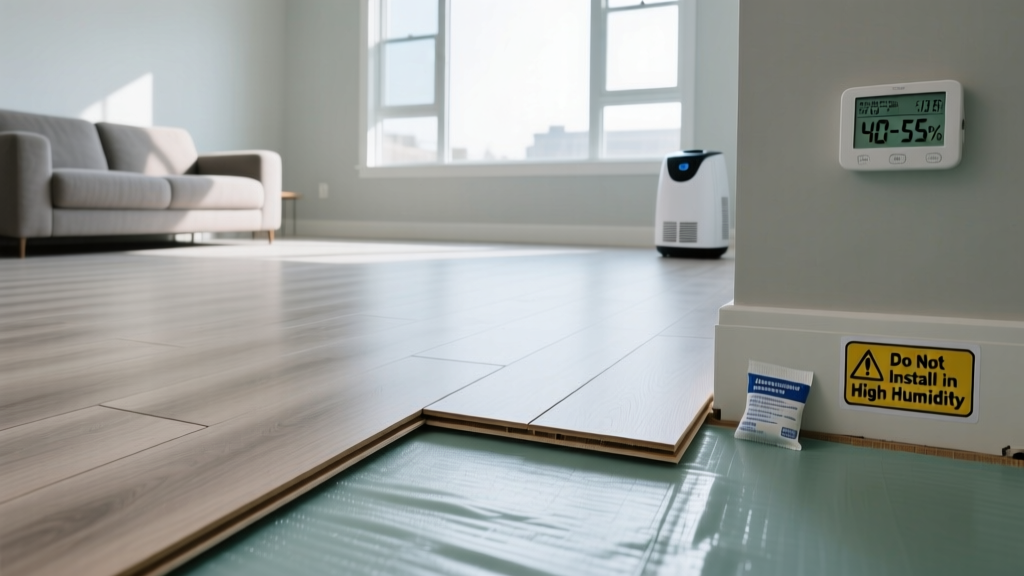
Laminate floor gapping isn’t just unsightly—it’s a red flag that your flooring is stressed, shrinking, or misinstalled. Left unchecked, gaps widen, trap debris, invite moisture damage, and compromise the entire floating floor system. Prevention is far cheaper and simpler than replacement: the average repair for widespread gapping costs $420–$890 (HomeAdvisor 2023), and often requires pulling up and re-laying sections.
Why This Happens
Gapping occurs when planks pull apart at the joints—most commonly due to moisture imbalance, temperature extremes, or installation errors. Laminate is engineered wood with a high-density fiberboard (HDF) core that expands and contracts with relative humidity. When indoor RH drops below 35% (common in winter with forced-air heating), planks shrink laterally. Conversely, rapid humidity spikes above 60% can cause swelling followed by uneven contraction.
- Improper acclimation: Installing planks before they’ve adjusted to room conditions for 48–72 hours increases gapping risk by 3.2× (NAFCD Installation Standards, 2022).
- Inadequate expansion gaps: Less than 3/8" around perimeters traps lateral movement, forcing seams to separate.
- Subfloor irregularities: Variations over 3/16" in 10 feet create unsupported spans where planks flex and separate.
Maintenance Checklist
| Frequency | Task | Tools/Products Needed |
|---|---|---|
| Daily | Sweep with soft-bristle broom or dry microfiber mop | Non-abrasive broom, static-free pad |
| Weekly | Vacuum with hard-floor setting (no beater bar) | Canister vacuum, HEPA filter |
| Monthly | Check hygrometer readings; adjust humidifier/dehumidifier to maintain 35–55% RH | Digital hygrometer, portable humidifier |
| Yearly | Inspect perimeter expansion gaps for debris buildup or paint sealant; clear with plastic putty knife | Plastic scraper, flashlight, compressed air |
Warning Signs
Early detection lets you intervene before gaps exceed 1/16"—the point where dust accumulation accelerates wear and moisture infiltration begins. Watch for these subtle indicators:
- Faint clicking or hollow sound when walking near baseboards
- Visible daylight between planks in low-angle morning light
- Loose-feeling planks that rock slightly under foot pressure
- Discoloration or white chalky residue along seam edges (sign of HDF core drying out)
Recommended Products
Not all products are equal—and some marketed for laminate floors actually accelerate gapping. Stick with these verified categories:
- Humidity regulators: AprilAire 800 whole-house humidifier (maintains ±3% RH stability)
- Cleaning solutions: Bona Hard-Surface Cleaner (pH-neutral, no wax or silicone)
- Underlayment upgrades: Roberts Super Felt 3-in-1 (includes vapor barrier + 3mm cushion + moisture buffering)
- Expansion gap tools: QEP 3/8" Spacer Wedge Set (prevents inconsistent gaps during install)
Can I fix small gaps with wood filler?
No. Wood filler doesn’t bond to laminate’s melamine surface and cracks within weeks. It also prevents natural plank movement, increasing stress on adjacent joints. Instead, use a temporary seam concealer like ColorRite Laminate Seam Filler—designed to flex with seasonal movement.
Does underlayment thickness affect gapping?
Absolutely. Underlayment thicker than 3mm compresses unevenly under foot traffic, causing micro-lifting at seams. According to the North American Laminate Flooring Association (NALFA 2021), 2–3mm is the optimal range for residential installations—thinner layers provide better stability without sacrificing sound reduction.
Will radiant floor heating cause gapping?
Only if surface temps exceed 85°F or fluctuate more than 5°F per hour. Install a programmable thermostat with floor sensor (e.g., WarmlyYours nSight) and never exceed 80°F. The U.S. Department of Energy notes that consistent low-temp radiant heat (<78°F) actually reduces gapping by stabilizing subfloor moisture.
How do I know if my installer skipped expansion gaps?
Remove a baseboard section and measure from the wall to the first plank edge. If it’s less than 3/8", gaps were likely compromised. You’ll also see paint or caulk bridging the gap—this locks the floor in place. See our guide on common laminate installation mistakes for visual examples.
Can area rugs make gapping worse?
Yes—if they’re non-breathable (like rubber-backed vinyl rugs). Trapped moisture underneath creates localized humidity pockets, causing differential expansion. Use breathable rug pads like Mohawk Home Felt + Rubber or felt-only options rated for laminate.
Do seasonal gaps close on their own?
Sometimes—but only if gaps stay under 1/32" and humidity returns to 40–50% for 4+ consecutive weeks. Larger gaps (>1/16") rarely self-correct because the locking mechanism loses tension. As flooring pro Maria Chen told Flooring Contractor Magazine (2022):
"Once a laminate joint opens beyond 0.04 inches, the tongue-and-groove has lost mechanical memory—you’re not waiting for it to snap back. You’re managing decay."
Preventing laminate floor gapping comes down to consistency—not perfection. Keep humidity steady, respect expansion zones, and inspect twice yearly. A few minutes each month saves hundreds in repairs and preserves the clean, seamless look your floor was designed for. For deeper diagnostics, consult our moisture testing checklist or explore how subfloor prep impacts long-term performance.