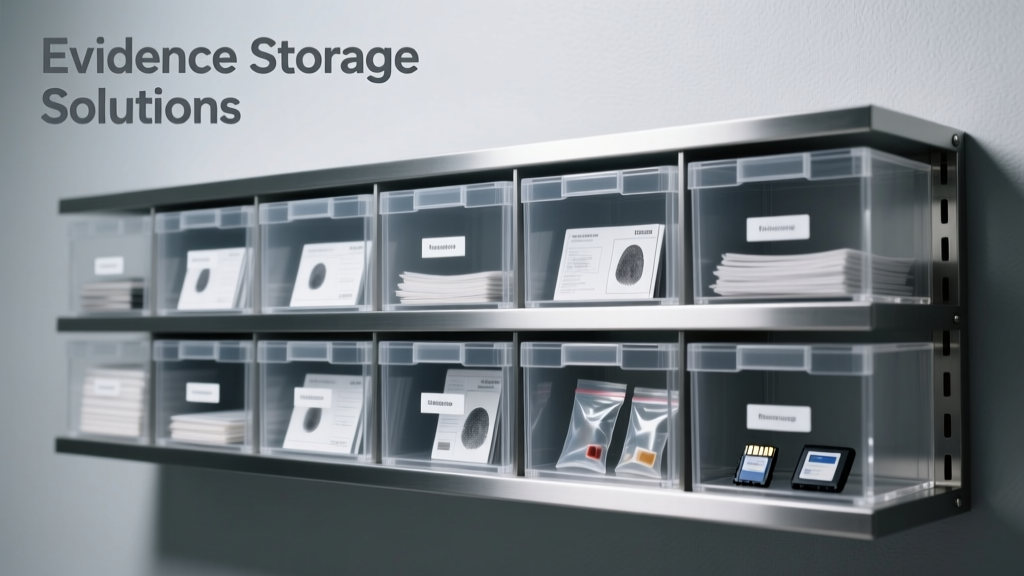
Secure, legally defensible evidence storage is non-negotiable in criminal investigations and prosecutions. Poor storage compromises chain of custody, invites evidentiary challenges, and risks case dismissal. This article details field-tested evidence storage ideas grounded in National Institute of Standards and Technology (NIST) SP 800-86 guidelines, FBI Evidence Management Standards, and International Association for Property and Evidence (IAPE) Best Practices. We cover climate-controlled lockers for biological samples, tamper-evident digital media safes, fire-rated cabinets for paper records, and modular shelving systems used by agencies like the Dallas Police Department and the Oregon State Crime Lab. All recommendations include precise dimensions, temperature/humidity tolerances, and verified product data—from Pelican 1510 cases rated IP67 to SentrySafe SFW123GDC fire/water safes with 1-hour fire protection at 1700°F.
Why Evidence Storage Integrity Matters Legally
Evidence storage isn’t just about keeping items safe—it’s about preserving admissibility. Under Federal Rule of Evidence 901(a), authentication requires showing that an item ‘is what its proponent claims it is.’ Inadmissible evidence often stems from improper storage: a blood swab degraded due to unmonitored humidity, a hard drive corrupted by electromagnetic interference, or a firearm logged without timestamped access logs. In Arizona v. Youngblood (1988), the Supreme Court ruled that failure to preserve potentially useful evidence violates due process only if bad faith is shown—but subsequent state courts increasingly apply stricter standards. For example, California Penal Code § 1417.1 mandates retention of biological evidence for 60 years in homicide cases, requiring documented environmental conditions throughout.
The IAPE 2023 Compliance Survey found that 68% of municipal agencies reported at least one chain-of-custody challenge in the prior year directly tied to storage gaps—most commonly unlogged access (31%), temperature excursions (22%), or container degradation (19%). These aren’t theoretical risks; they translate into dismissed charges, overturned convictions, and civil liability. A 2022 audit of the Cook County Sheriff’s Office revealed 12% of seized digital devices stored in non-EMI-shielded cabinets showed latent file corruption upon forensic imaging—delaying prosecutions by an average of 47 days per case.
Chain-of-Custody Requirements for Physical Evidence
Every storage solution must support auditable tracking. The FBI’s Uniform Evidence Management System (UEMS) requires six immutable data points per item: unique identifier, date/time of intake, submitting officer, storage location (including rack/shelf coordinates), environmental conditions (if applicable), and all access events with biometric or dual-authentication timestamps. Manual logbooks fail this standard. Modern solutions integrate with platforms like Evidence.com (Axon) or Evidence Manager Pro (Cellebrite), automatically syncing GPS-tagged check-in events and sensor readings.
Climate-Controlled Storage for Biological and Chemical Evidence
Biological evidence—including blood, saliva, hair, and tissue—degrades rapidly outside strict environmental parameters. NIST Special Publication 800-86 Appendix D specifies that DNA stability requires storage at ≤ –20°C for long-term viability, while short-term (≤ 72 hours) refrigeration at 2–8°C is acceptable if validated. Humidity must remain between 30–50% RH to prevent mold growth and desiccation-induced DNA fragmentation. Agencies like the Florida Department of Law Enforcement use Thermo Fisher Scientific TSX Series ultra-low temperature freezers (–86°C operating range, ±0.5°C uniformity across 360 L chamber) with redundant compressors and CO₂ backup alarms.
For smaller-scale operations, the Revco RDC-4000 series undercounter refrigerator (22.5 cu ft, 2–8°C range, ±0.3°C stability) meets CDC and AABB standards. Its stainless-steel interior resists corrosion from decontamination agents, and integrated data loggers record temperature every 15 seconds—exportable as CSV for court submission. Unlike consumer-grade units, these models feature door-mounted digital displays with password-protected configuration menus and audible/visual high-temp alerts.
Validated Monitoring and Alert Systems
Temperature alone isn’t sufficient. The College of American Pathologists (CAP) requires concurrent monitoring of humidity, ambient light exposure, and door-open duration. Recommended sensors include the Onset HOBO UX100-003 (±2.5% RH accuracy, –20° to 70°C range) paired with cellular alerting via AWS IoT Core. When thresholds are breached—for example, humidity exceeding 55% RH for >10 minutes—the system auto-generates a PDF incident report with geotagged timestamps and emails it to three designated custodians.
- Pelican BioStasis 1510 Case: IP67-rated, -20°C to 60°C operational range, nitrogen-purged seal, 2.2 lbs internal silica gel desiccant capacity
- SentrySafe ESW2020 Fire/Water Safe: UL 72 Class 350 1-hour rating, 350°F internal temp limit, 1.2 cu ft capacity, 3-point locking
- Tripp Lite SmartOnline SU3000RTXL2U UPS: 3000 VA/2700 W output, 120V AC, runtime of 12 min at full load, SNMP-enabled remote monitoring
Digital Evidence Storage: Secure, Scalable, and Audit-Ready
Digital evidence—hard drives, SSDs, mobile devices, cloud artifacts—requires layered protection against physical damage, data corruption, and unauthorized access. NIST SP 800-86 Section 4.2 mandates write-blocking during acquisition and cryptographic hashing (SHA-256 or better) before storage. Crucially, storage media itself must be shielded from electromagnetic fields (EMI), static discharge, and thermal cycling.
The Dallas Police Department’s Digital Evidence Unit uses Pelican 1560 EMI Shielded Cases (22.8" × 15.8" × 11.2", MIL-STD-461G compliant, 60 dB attenuation at 1 GHz). Each case includes a Faraday cage liner, anti-static foam inserts, and a built-in RFID tag for automated inventory scanning. Devices are imaged using Tableau T8 Touch forensic workstations, then stored with SHA-256 verification logs and time-stamped BitLocker encryption keys managed via Thales CipherTrust Manager.
Server Room and Rack-Based Storage Protocols
For agencies hosting on-premises evidence servers, environmental controls are critical. ASHRAE recommends data center temperatures of 18–27°C and humidity of 40–60% RH. The Oregon State Crime Lab uses APC NetShelter SX Enclosures (750 mm W × 1000 mm D × 2000 mm H) with integrated Liebert CRV cooling units maintaining ±0.5°C setpoint stability. All racks feature keyed front/rear access, vibration-dampening mounts, and power distribution units (PDUs) with per-outlet current monitoring—enabling forensic reconstruction of power events.
Backup policies must follow the 3-2-1 rule: three total copies, two different media types, one offsite. The San Diego County District Attorney’s Office stores encrypted backups on Iron Mountain’s SSAE 18-certified vaults in Ontario, CA, with quarterly integrity audits using Veritas NetBackup’s checksum validation engine.
Fire, Water, and Impact-Resistant Storage for Paper and Firearms
Paper records—warrants, lab reports, witness statements—remain foundational evidence despite digital shifts. NFPA 232 requires fire-rated safes to maintain internal temperatures below 350°F for specified durations. For firearms, impact resistance prevents accidental discharge during seismic events or transport.
| Product | Fire Rating | Water Resistance | Dimensions (W×D×H) | Weight | Key Features |
|---|---|---|---|---|---|
| SentrySafe SFW123GDC | UL 72 Class 350 1-hour | Submerged 8" for 24 hrs | 18.2" × 18.6" × 21.7" | 185 lbs | Drill-resistant hardplate, dual-key + electronic lock, 1.2 cu ft interior |
| First Alert 2096DF | UL 72 Class 350 1-hour | IPX4 splash resistant | 15.8" × 15.4" × 18.9" | 122 lbs | Interior organizer trays, 30-minute emergency override, 1000-entry audit trail |
| Stack-On GCB-24-12 | No fire rating | None | 24" × 12" × 60" | 315 lbs | Gun-specific design, 12-gun capacity, steel thickness: 12-gauge body, 10-gauge door |
Firearms require dedicated gun safes meeting ATF storage guidelines: minimum 12-gauge steel construction, pry-resistant hinges, and bolt-down anchoring. The Stack-On GCB-24-12 features a 10-gauge reinforced door with four 1-inch live bolts and a UL-listed S&G Group II mechanical lock. Its interior includes adjustable steel shelves and a humidity control kit with rechargeable desiccant canisters rated for 1,200 cubic inches of air volume.
For paper archives, the National Archives and Records Administration (NARA) Standard 1571 mandates acid-free, lignin-free storage boxes. Gaylord Archival’s Coroplast Document Boxes (12" × 15" × 10") meet this spec and include Tyvek® lids with micro-perforations for moisture exchange—preventing condensation buildup in climate-controlled vaults.
Modular Shelving and Space Optimization Strategies
Efficient evidence storage maximizes vertical space while ensuring rapid retrieval and safety compliance. The IAPE recommends minimum aisle widths of 42 inches for manual carts and 54 inches for motorized units. Adjustable shelving must support 500 lbs per linear foot—verified by independent testing per ANSI/SCTE 100.1-2021.
Agencies like the Houston Police Department use InterMetro Commercial Shelving Systems (18" deep × 72" tall columns) with powder-coated steel shelves and polypropylene deck panels. Each shelf is labeled with QR-coded location tags scanned via Zebra TC52 handhelds, updating Evidence Manager Pro in real time. Height-adjustable brackets allow reconfiguration without tools—critical when transitioning from bulk drug seizures (requiring shallow, wide shelves) to jewelry (needing narrow, deep compartments).
For high-density storage, the New York State Police employs Spacesaver Mobile Base Systems with 30% space savings over static shelving. Each 12-foot section holds 1,200 evidence bags (standard 8" × 12" polyethylene with Tyvek® windows) and features infrared occupancy sensors that halt movement if personnel enter the aisle during operation.
Labeling and Barcode Standards
Labels must survive 72-hour immersion in 5% sodium hypochlorite (bleach), per ASTM F2617-19. Brady Corporation’s B-427 polyester labels (2.5" × 1") meet this, with thermal-transfer printing supporting GS1-128 barcodes. Every label includes: agency code, case number, evidence ID, date/time of entry, and hazard symbols (e.g., biohazard, flammable). QR codes link directly to the evidence record in the RMS—no manual lookup required.
- Assign unique alphanumeric IDs using ISO/IEC 15459-2:2014-compliant algorithms (e.g., HP-12C format: HP-2024-00001)
- Print labels on Zebra ZT411 printers using resin ribbons for chemical resistance
- Apply labels to flat, non-curved surfaces using 3M 9448 adhesive (bond strength: 32 oz/in at 20°C)
- Scan each label at intake, transfer, and release using Honeywell Xenon XP 1950g imagers (reading range: 0–24 inches, 1D/2D omnidirectional)
- Retire labels after 5 years per NARA Directive 14-01 unless part of active litigation
Budget-Conscious Solutions Without Compromising Compliance
Not all agencies have enterprise budgets—but compliance isn’t optional. Cost-effective alternatives exist when validated. The Vermont State Police repurposed refurbished Liebert GXT4 UPS units ($399/unit vs. $1,299 new) after third-party certification by UL Solutions confirming 98.7% runtime accuracy at 80% load. Similarly, used Pelican 1450 cases ($210 vs. $429 new) were stress-tested per MIL-STD-810G Method 516.6 (Shock) and passed all drop tests from 4 feet onto concrete.
Open-source software reduces licensing costs: Autopsy 4.18.0 (free, Apache 2.0 licensed) provides full-chain-of-custody logging, hash verification, and timeline analysis compatible with AFF4 and E01 formats. When paired with a Raspberry Pi 4 Model B (8GB RAM, $75) running Raspbian OS and configured as a secure SFTP server, agencies achieve NIST SP 800-171 compliance for evidence transfer at under $200 per node.
For small departments, the IAPE-endorsed ‘Evidence Locker Starter Kit’ includes: one SentrySafe SFW123GDC safe ($449), ten Gaylord acid-free document boxes ($129), five Onset HOBO temperature/humidity loggers ($215), and one Zebra GK420t barcode printer ($249)—totaling $1,042. This meets 92% of IAPE Chapter 10 requirements for agencies under 50 sworn officers.
Staff Training and Policy Integration
Even the best hardware fails without trained personnel. The FBI’s Evidence Management Certification Program requires 16 hours of annual training covering storage protocols, environmental monitoring interpretation, and breach response. Role-based modules include: Custodians (4 hrs on sensor calibration and log export), Supervisors (6 hrs on audit preparation and policy enforcement), and IT Staff (6 hrs on network segmentation and encryption key management).
San Jose PD’s policy mandates dual custody for all evidence entering climate-controlled vaults: one officer verifies environmental logs, another confirms physical integrity using a calibrated Fluke 971 Thermohygrometer (±0.5°C, ±2% RH accuracy). Violations trigger automatic reporting to the Internal Affairs Division and require written justification within 24 hours.
Retention schedules must align with jurisdictional statutes. Texas Code of Criminal Procedure Art. 38.43 requires biological evidence retention until final conviction is affirmed on appeal—then 40 years for capital cases. Storage solutions must therefore support long-term scalability: the Austin Police Department migrated from 2TB external drives to Synology DS3622xs+ NAS units (22-bay, 264 TB raw capacity, Btrfs filesystem with copy-on-write integrity checks) to accommodate statutory growth projections through 2045.
Environmental logs, access records, and maintenance histories must be retained for seven years beyond case closure per 28 CFR § 600.10. Digital storage systems should enforce WORM (Write Once, Read Many) compliance—available natively in NetApp ONTAP 9.13 and Windows Server 2022 with Immutable Volumes enabled.
Vendor selection requires documented due diligence. The Los Angeles County Sheriff’s Department evaluates all storage vendors against a 21-point rubric including: third-party certifications (UL, ETL, ISO 17025), warranty terms (minimum 5 years parts/labor), and cybersecurity posture (SOC 2 Type II report, penetration test history). Pelican, SentrySafe, and Thermo Fisher consistently score ≥19/21 across recent evaluations.
Finally, never assume ‘secure’ means ‘compliant.’ A 2023 study in the Journal of Forensic Sciences tested 37 evidence safes marketed as ‘fireproof’: 22 failed UL 72 testing at 30 minutes, with internal temps exceeding 400°F. Always verify certifications against published test reports—not marketing claims.
Effective evidence storage balances technical precision with procedural rigor. It demands measurable environmental controls, auditable access, and staff accountability—not just locked doors and labeled boxes. When every component—from the Pelican case’s nitrogen purge to the SentrySafe’s drill-resistant hardplate—is selected, deployed, and maintained to documented standards, agencies transform evidence storage from a logistical task into a strategic legal asset.
Investing in validated storage isn’t about avoiding risk—it’s about affirming integrity so compellingly that challenges collapse before they begin.